Ringless voicemail, better known as voicemail drops, are a unique tool that allows you to leverage the existing habits of your customers, clients, and employees without causing disruption to their daily routines.
In today’s fast-paced society, making sure your message is received amid the deluge of communications that people receive every day can prove challenging. With people receiving so many emails, notifications, messages, and alerts on a day-to-day basis, it often helps to take a multi-pronged approach.
In this post, we’ll help you to understand everything you need to know about ringless voicemail and how it can help boost engagement and sales in your organization.
What is Ringless Voicemail?
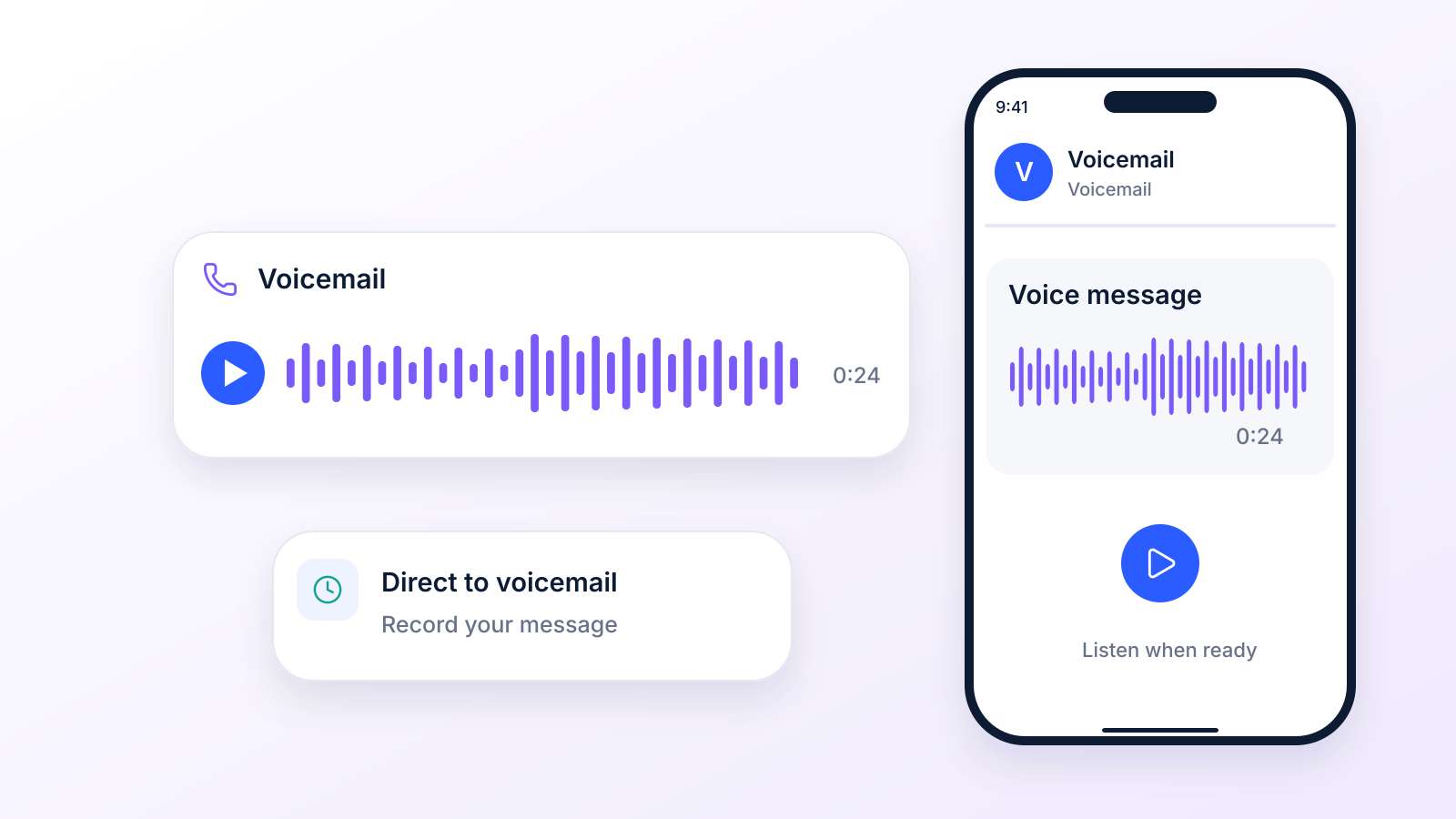
Simply put, ringless voicemail is a specialized software system that delivers prerecorded messages directly to a person’s cell phone voicemail. With Broadcast’s direct to voicemail technology, the phone usually doesn’t ring and you can deliver prerecorded audio messages to thousands of voicemail boxes at once. (The FCC notes that some carriers may still ring the phone once or show a new-message alert; see FCC 22-85, para. 16.) Skipping the ring changes how the message arrives, not how the law sees it: the FCC ruled in 2022 that ringless voicemail to cell phones is a "call" made with a prerecorded voice, so it needs the recipient's consent (FCC announcement).
The flexibility and scalability of ringless voicemail means that it can be used across multiple industries to achieve various goals – everything from lead generation to customer appreciation and alert notifications.
While ringless voicemail is quite often used for customer outreach, it can also be used internally to disseminate messages across various departments. In this way, ringless voicemail works to ensure that stakeholders are kept in the loop with important happenings within the company.
Why Choose Ringless Voicemail?
Once you understand the difference between traditional telemarketing, voice broadcasting, and straight to voicemail, it’s easy to spot several advantages right away:
- Voicemail drops don’t ring the phone the way a call does, so they interrupt less (they are still regulated as calls, and telemarketing drops must follow the 8 a.m. to 9 p.m. calling-hours rule; 47 CFR 64.1200(c)(1))
- Many people listen to their voicemails before deleting them (but may hang up on a recorded broadcast message)
- Ringless voicemail is often transcribed by voicemail-to-text services (so recipients are likely to read your message, even if they don’t listen)
- Direct to voicemail technology is highly cost-effective, especially when compared to employing live operators to conduct calls
- In addition to these more obvious benefits, a properly structured ringless voicemail campaign can be combined with other forms of outreach to create highly effective overall marketing or messaging campaign.
For example, you might use a voicemail drop to follow up with warm leads in an ad campaign. This is particularly effective in generating callbacks because your personalized message can be tailored specifically to the offer in question.
Sending your messages straight to voicemail does not come across as a typical telemarketing communication, but rather a one-on-one message that encourages interaction and response. Legally, though, it is treated like other prerecorded calls, so send it only to people who agreed to hear from you (see our ringless voicemail compliance guide).
Potential Drawbacks of Ringless Voicemail
Limited Interaction
One downside to ringless voicemail is that it doesn’t allow for immediate two-way communication. While voicemail drops can be effective, they don’t provide the same instant feedback as a live phone call. To mitigate this, include a clear call to action in your message, encouraging the recipient to contact you directly.
Risk of Overuse
Like any marketing strategy, overusing ringless voicemail can lead to negative results. If recipients feel bombarded by too many voicemail messages, they may become frustrated and opt-out of your communications. To avoid this, use ringless voicemail sparingly and make sure each message offers value to the recipient.
How to Set Up Your First Campaign
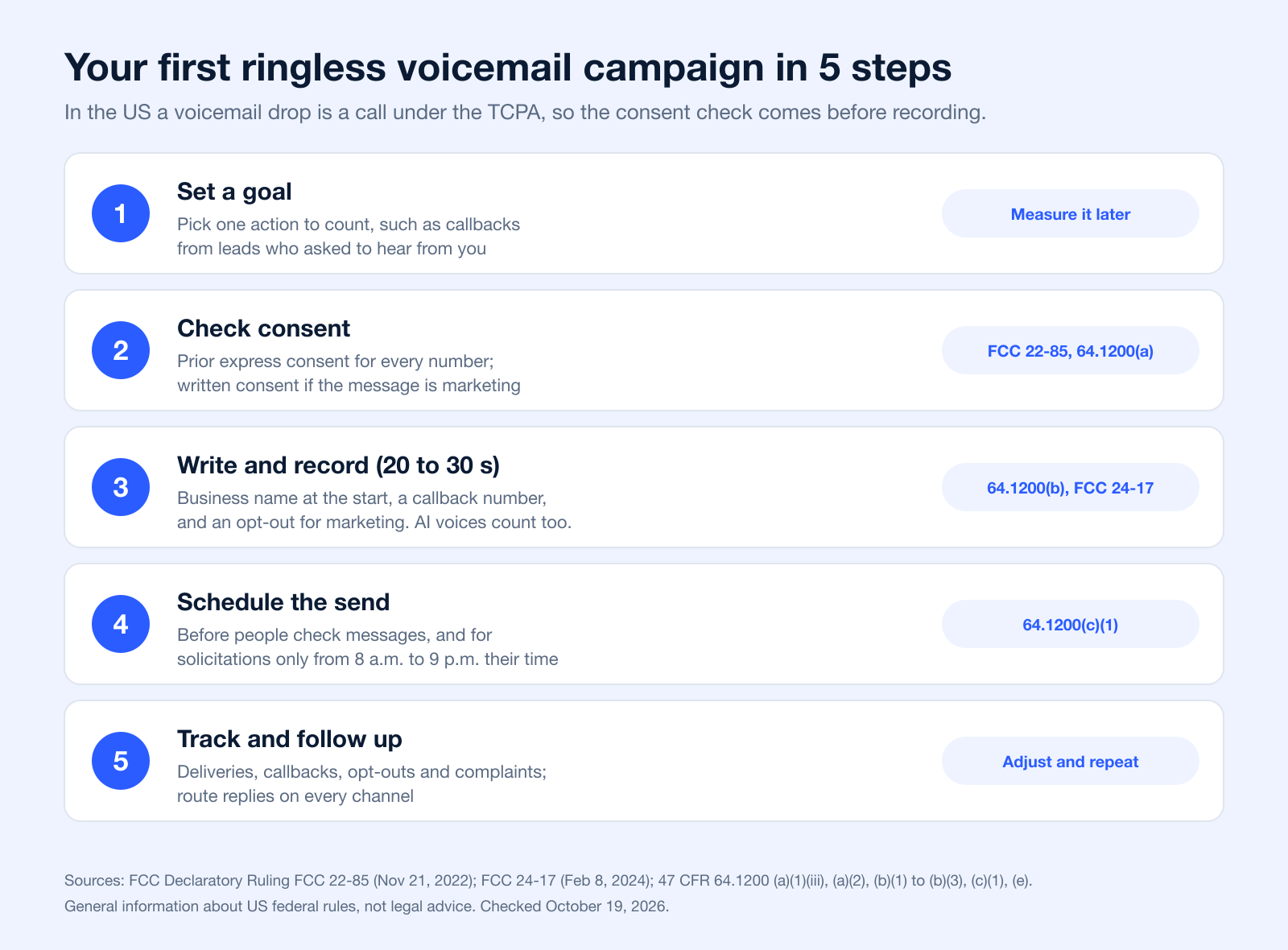
Getting started with ringless voicemail is simple. In general, you’ll want to follow these steps:
- Set a goal for your campaign. Setting a goal allows you to track objective results and gives you the means to evaluate the performance of your campaign. Goals for campaigns will vary, but at the very least you want to track how many people perform the desired action for the campaign. For example, you might track the number of leads that call back as a result of your campaign.
- Record your message. The best voicemail drop campaigns are personalized and highly targeted. For lead generation, your message should appear to be directed to an individual versus a mass broadcast. For informational campaigns, you should ensure that all relevant details are included succinctly within the message itself. Don’t be afraid to write a script! This can help you to organize your thoughts and ensure that you communicate effectively with your audience. The rules require every prerecorded message to name your business at the beginning and give a callback number (47 CFR 64.1200(b)); our voice message templates can help with the script.
- Schedule a time. One of the benefits of ringless voicemail is that the phone usually doesn’t ring, so the message interrupts less. However, scheduling is still important as you want to be sure that people listen to your message in a timely fashion, and telephone solicitations may only go out between 8 a.m. and 9 p.m. in the recipient’s local time (47 CFR 64.1200(c)(1)). Consider when your audience is most likely to be checking their emails, whether this is on a lunch break or at another time throughout the day, and schedule voicemail delivery prior to those times throughout the day.
- Track your results. Once your campaign has launched, keep up with ongoing results and make adjustments as necessary. This is particularly important when ringless voicemail is a part of a multifaceted outreach campaign.
Avoiding Common Pitfalls
When setting up your campaign, there are a few best practices that can help you to avoid the most common mistakes people make when sending messages straight to voicemail. Here are the major issues you’ll want to be aware of as you set up your own campaigns.
Little or No Targeting
Because ringless voicemail works best when perceived as a direct message versus a scripted “blast”, it helps to target your audience in a way that lets you leave a custom message that will apply to everyone in the group. More generalized messaging may be perceived as telemarketing spam and will not get the same level of engagement.
Poor Messaging
Vague or unclear messages don’t generate results. Make sure the recipient understands why they are receiving the message, who you are, and be very specific about the action that you want them to take. This can be as simple as requesting a callback, so long as the listener understands why they need to call you back. Saying who you are is also a legal requirement: the business name at the start of the message and a callback number during or after it (47 CFR 64.1200(b)).
Inadequate Follow-Up
Have a system in place for following up with people who may respond after hours, or through other channels that you don’t expect (i.e. submitting a contact form when you expected a phone call). If you are running a large-scale campaign, ensure appropriate staff is aware of how to route any inquiries from leads and customers for this specific campaign if there are differences when compared to how you usually handle inbound communications.
Fortunately, a well-planned ringless voicemail campaign will sidestep most of these pitfalls by default.
Measuring the Success of Your Ringless Voicemail Campaign
If you’ve set up specific goals for your campaign, measuring the results is straightforward. Here are some metrics that you might track to measure the performance of your voicemail drop campaign and compare it to your other marketing initiatives:
- Deliverability – how many people successfully received the message compared to other channels?
- Response Rate – what percentage of people responded to your message versus other channels?
- Quality of Response – what percentage of people performed the desired action versus other channels?
- Complaint Rate – what percentage of people complained about your messaging versus other channels?
- Overall ROI – when comparing costs to results, how did your ringless voicemail campaign compare to your other marketing initiatives?
By objectively evaluating your campaigns using the same KPIs, you will be able to zero in on which campaigns are most effective. Depending on your industry, you may find that sending messages direct to voicemail performs best on a particular type of campaign, or as a complement to your established campaigns. Once you find an implementation that works for your business, don’t be afraid to experiment and further optimize your campaigns. And don’t forget about SMS text messaging for your campaigns. Need inspiration? Check out these text message examples to send to your customers. For more campaign ideas, see our ringless voicemail marketing guide.
Need Help to Get Started?
Our Quick Start Guide for Ringless Voicemail will help you build and launch your first campaign from the ground up. If you’d like personalized, step-by-step guidance with setting up your voicemail drop campaign in our system, give us a call or create your free Broadcast account.
Conclusion
Ringless voicemail is a powerful tool that can help businesses reach their target audience in a non-intrusive, cost-effective way. By understanding how ringless voicemail works and following best practices, you can create successful voicemail marketing campaigns that engage customers and drive results. If you’re looking for a way to enhance your marketing strategy, ringless voicemail could be the right choice for your business.
Frequently Asked Questions
Are Ringless Voicemail Drops Legal?
Ringless voicemail drops are legal in the United States, but they are subject to strict regulations under the Telephone Consumer Protection Act (TCPA). In November 2022 the FCC ruled that ringless voicemail to cell phones "is a ‘call’ made using an artificial or prerecorded voice" and therefore "requires consumer consent" (FCC 22-85, para. 1). It rejected the arguments that the TCPA does not apply when the consumer is not charged and that the technology is a voicemail service rather than a call (paras. 17 and 19). Businesses must obtain prior express consent before sending, and written consent when the message is marketing (47 CFR 64.1200(a)(2)). Each message must name the business at the start and give a callback number, telemarketing messages need an opt-out mechanism (64.1200(b)), and AI-generated voices follow the same consent rules (FCC 24-17). Failing to comply can result in significant fines. A reputable provider helps, but the sender is responsible for consent. Read more in our guides to ringless voicemail compliance and express written consent. This is general information, not legal advice.
How Effective is Ringless Voicemail?
Ringless voicemail can be an effective marketing channel because it reaches your audience without a live call interrupting them, and the message waits in their voicemail until they are ready to listen. How well it works depends on your list, your message and your follow-up, so measure it against your other channels with the KPIs in the section above. Because the recipient chose to hear from you, a relevant message is more likely to get a response.
What is the Success Rate of Voicemail Drops?
The success rate of a voicemail drop depends on several factors, including the quality of the message, the target audience, and the timing of the drop. There is no reliable industry-wide figure, so set a baseline from your first campaign (deliveries, callbacks, opt-outs) and improve from there. Using ringless voicemail technology, businesses can deliver their voicemail messages directly to the recipient's voicemail inbox, increasing the chances of engagement.
How Long Should a Voicemail Drop Be?
A voicemail drop should be concise and to the point, typically lasting between 20 to 30 seconds. The key is to deliver a clear and compelling message that captures the recipient’s attention quickly. Longer voicemail messages may lose the recipient's interest, while shorter ones may not provide enough information. It’s important to include a strong call to action in your voicemail message to encourage immediate response.
Does Voicemail Drop Work on Landlines?
It depends on the provider and the phone company's voicemail system. Ringless voicemail is mainly used for cell phones, and the FCC's 2022 ruling addresses messages sent to mobile numbers (FCC 22-85, footnote 51). Ask your provider whether it supports landline voicemail before you plan a campaign around it. If a prerecorded telemarketing message does reach a residential landline, it also needs prior express written consent (47 CFR 64.1200(a)(3)).
How Much Does Ringless Voicemail Cost?
Pricing varies by provider, volume and plan, so compare the cost per delivered message, any monthly fees and what is included (scripts, scheduling, reports). For Broadcast's current plans, see the pricing page.
Do Voicemail Drops Work?
They can, when they go to people who agreed to hear from you and the message is short, specific and easy to answer: who you are, why you are calling, one action and a callback number. Results vary by list and message, so track callbacks, opt-outs and complaints and compare them with your other channels.
How Can I Send Ringless Voicemails?
You send them through a ringless voicemail platform (Broadcast's is described on the ringless voicemail page). In general: load a list of contacts who gave consent, record a 20 to 30 second message that names your business and gives a callback number, schedule it within calling hours, and track the responses. The steps above cover each part.
What Is *86 on a Cell Phone?
On Verizon, *86 is the code to reach your voicemail; Verizon's voicemail support page lists it for setting up voicemail (Verizon). It is not related to ringless voicemail and does not send calls to voicemail. For other carriers, check your carrier's voicemail support page.