Silence doesn't mean ‘no.’ It often means ‘not right now.’ Your initial message is just the opening line in a world of constant digital noise; the real conversation starts with the follow-up. A well-crafted follow up text after no response can be the difference between a missed opportunity and a closed deal, a confirmed appointment, or a lifelong customer.
But what should you say? How long should you wait? And how do you avoid being annoying? This guide moves beyond guesswork and provides a playbook of field-tested follow-up templates designed for sales, appointments, events, and more. You will get specific, replicable strategies for each scenario, showing you not just what to send but explaining the strategic why behind the message.
We will break down seven distinct follow-up methods, analyzing the psychology that makes each one effective. You'll learn how to pair your texts with other channels, like a strategically timed ringless voicemail drop, to create a persistent yet professional outreach sequence. To maximize the impact of your text follow-ups, it's crucial to adhere to proven strategies like those outlined in SMS marketing best practices to ensure effectiveness and maintain engagement. This article provides the tools you need to turn radio silence into meaningful conversations and, ultimately, measurable results. Let's get started.
How Long to Wait Before Sending a Follow-Up Text
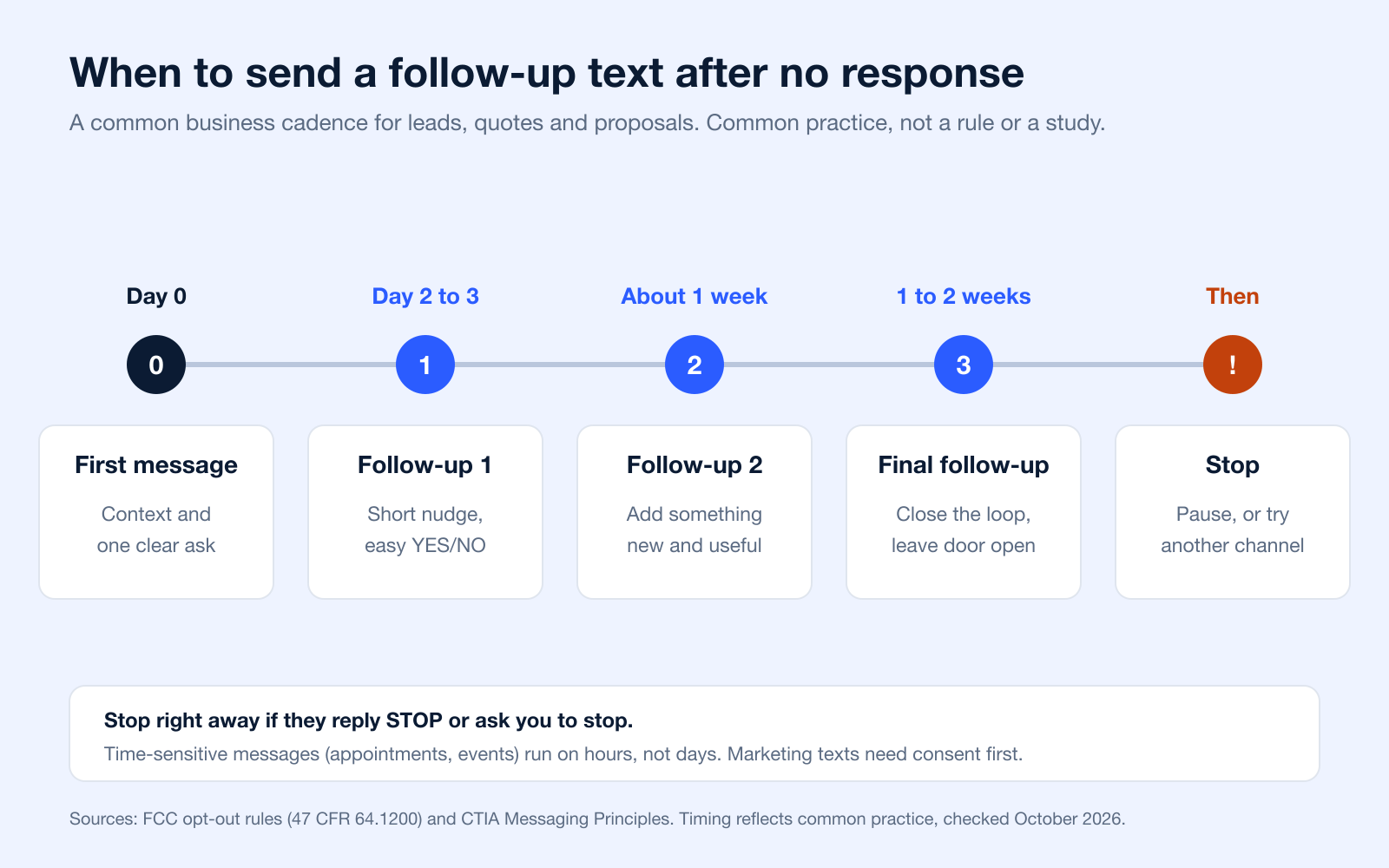
Yes, a follow-up text after no response is normal. Most unanswered texts were seen at a busy moment and then forgotten. The questions that matter are when to send it, how many to send, and when to stop.
No published study sets one right number for business follow-ups, so treat the timing below as common practice, not a rule. Adjust it to how urgent the topic is: an appointment tomorrow runs on hours, a proposal runs on days.
| Situation | 1st follow-up | 2nd follow-up | Final follow-up | When to stop |
|---|---|---|---|---|
| New lead who asked for information | Same day or next business day | 2 to 3 business days later | About 1 week later | After 3 follow-ups with no reply |
| Quote, estimate or proposal sent | 2 to 3 business days | About 1 week after the quote | 1 to 2 weeks after the quote | After the final "close the loop" text |
| Appointment not confirmed | The day before | A few hours before | Not needed | After the appointment time passes |
| Missed appointment (no-show) | Same day | 2 to 3 days later | About 1 week later | After the rebooking offer goes unanswered |
| After a demo or sales call | 1 business day | 3 to 5 business days | About 2 weeks | When they say no, or after the final text |
| Unpaid invoice | A few days after the due date | About 1 week later | About 2 weeks later, then a call or letter | When paid or handed to another process |
| Old lead gone quiet for months | One re-engagement text | Only if something new happens | Not needed | After one text with no reply |
| Anyone who replies STOP or asks you to stop | None | None | None | Immediately (see the compliance section) |
Two practical limits sit on top of any cadence: send during daytime hours in the recipient's time zone, and honor every opt-out. Both are covered in the compliance basics below.
A Simple Formula for a Follow-Up Text That Gets a Reply
Every template in this guide follows the same three parts. If you only remember one thing, remember this:
- Context: who you are and what you talked about. The person may not have your number saved.
- Reason: why you are writing now. A deadline, a new detail, an answer to their question, or simply closing the loop.
- One easy question: something they can answer in a word or two, like YES, NO, CALL or a time.
What Not to Send
- "Just checking in" with nothing else. It gives the person no reason to reply. Add context and one question.
- Guilt or pressure. "I guess you're not interested" or "I've texted you three times" reads as passive-aggressive.
- Several questions at once. Each extra question makes the reply harder.
- A wall of text. Keep follow-ups to two or three short sentences.
- A bare link from an unknown number. Say who you are first; a link with no context looks like spam.
- Fake urgency or made-up numbers. The FTC lists false "low stock" and false "high demand" messages as dark patterns (FTC staff report).
- Texts late at night or very early. Federal rules limit marketing calls and texts to 8 a.m. to 9 p.m. local time, and some states are stricter.
- Anything after STOP. Once someone opts out, the only text allowed is one confirmation with no marketing.
- Sensitive details. Keep account numbers, health details and amounts owed to a minimum in a text anyone holding the phone can read.
1. The Soft Reminder & Direct Question Follow-up
This classic approach is a workhorse for a reason: it’s direct, respectful of the recipient's time, and incredibly effective. When you need a follow up text after no response, this method cuts through the noise by combining a gentle nudge with a simple, closed-ended question. It’s perfect for busy people who may have seen your first message but got distracted before they could reply.
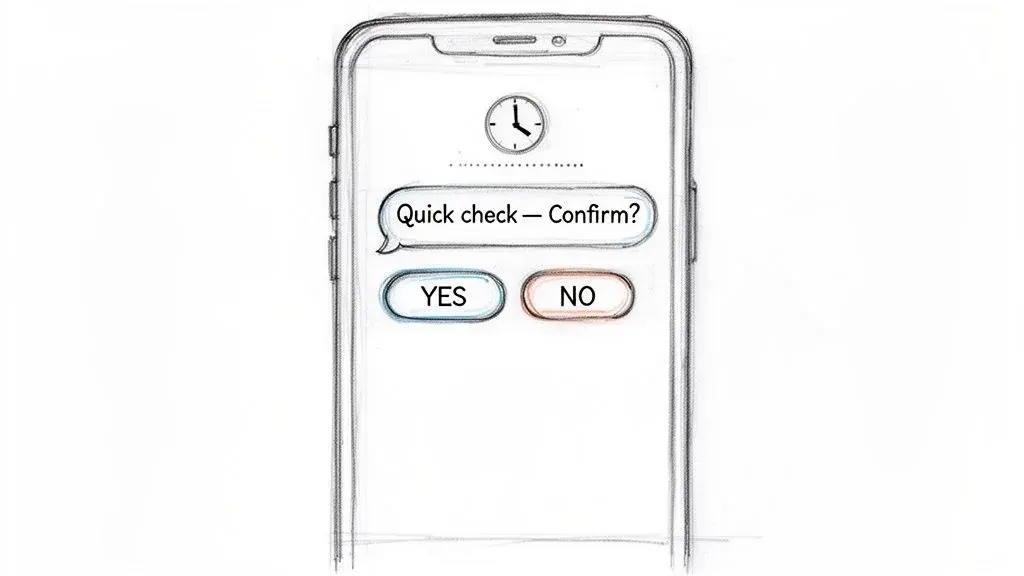
The core principle is to lower the barrier to response. Instead of asking someone to type out a full sentence or make a complex decision, you give them an effortless way to engage, often with a single word. This simplicity makes it easy for them to reply and gives you the clear data you need to take the next step.
Strategic Breakdown & Examples
The power of this technique lies in its adaptability across different business contexts. It's not just a single template, but a framework for getting a clear signal from your audience.
- Healthcare Appointment Confirmation:
- Message:
Hi [Patient Name], this is a reminder for your appointment with Dr. Smith on [Date] at [Time]. Please reply CONFIRM to keep your slot or RESCHEDULE to change it. - Analysis: This message is direct, provides all necessary information, and gives the patient two simple keyword actions. This reduces no-shows and automates the confirmation process, freeing up front-desk staff.
Sales Lead Qualification:
- Message:
[Prospect Name], following up on the proposal we discussed. Is solving [pain point] still a priority for you this quarter? A simple YES or NO is fine. - Analysis: This moves beyond "just checking in." It re-focuses the conversation on the prospect's goals and asks a direct question that helps a sales rep qualify or close the lead without being pushy.
Event & Webinar Attendance:
- Message:
Hey [Name]! Quick question: are you still planning to join the webinar on [Topic] tomorrow? Reply YES, NO, or MAYBE. - Analysis: Using "MAYBE" as an option is a smart tactic. It helps segment contacts who are interested but uncertain, creating an opportunity for a different follow-up (like sending a recording link post-event).
Actionable Takeaways & Tips
To get the most out of this follow up text after no response, timing and structure are key.
- Timing is Crucial: Wait 2-3 days for a soft reminder. If you still get no response, you can send a final, more direct question after 5-7 days.
- Keep it Simple: Use keywords like YES, NO, CONFIRM, CALL, or single letters (Y/N). This makes it easy for automation tools like Broadcast to track responses and trigger next steps.
- One Question Only: Don't ask multiple questions in one text. The goal is to make the response as low-effort as possible.
- Compliance is Key: Include a clear way to opt out, such as
Reply STOP to unsubscribe. Carrier guidelines (CTIA) call for opt-out instructions, FCC rules require you to honor STOP and similar replies (47 CFR 64.1200), and it builds trust.
2. The Value-Add Follow-up
When a first message goes unanswered, simply repeating the request can feel nagging. The Value-Add approach sidesteps this pitfall by introducing a new piece of information or benefit, giving your contact a fresh reason to engage. This follow up text after no response isn't a reminder; it's a new opportunity that shifts the dynamic from a simple check-in to a helpful update.
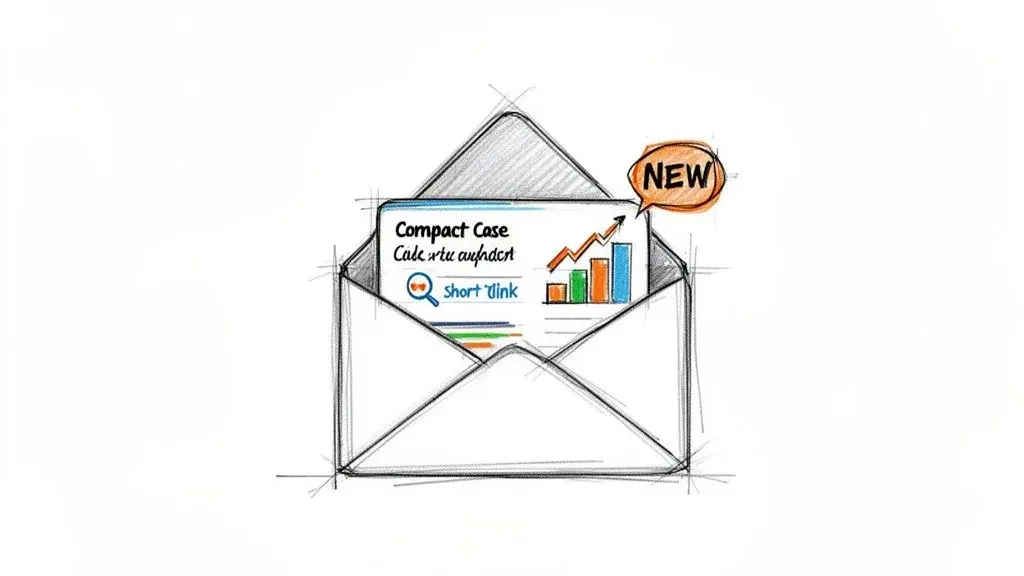
The strategy here is to re-ignite interest by adding something concrete to the conversation. Instead of asking "did you see my message?", you're saying "here's something else that might interest you." This method respects the recipient's silence while demonstrating that you're still thinking about their needs and are prepared to offer more value. It’s a powerful technique popularized by consultative sales teams and content marketers who understand that building relationships is about giving, not just taking.
Strategic Breakdown & Examples
This technique shines when you can connect a new benefit directly to the recipient’s potential interest. It transforms a cold lead into a warm conversation by providing timely, relevant information.
- Sales Prospect Nurturing:
- Message:
Hi [Name], I was thinking about our chat on [Topic] and thought you'd find this interesting. We just published a case study showing how [Similar Company] got [result] using our platform. See it here: [tracked-link] - Analysis: This message is non-intrusive and offers genuine value. Using a tracked link provides crucial data on engagement, showing you who is interested enough to click without them having to reply.
Local Business Promotion (Karate Studio):
- Message:
Sensei John here from Premier Martial Arts. For this week only, all new members get a FREE uniform ($60 value). We have classes starting at [Time]. Reply SCHEDULE to book a trial! - Analysis: This creates urgency and introduces a tangible incentive. It answers the "what's in it for me?" question directly and gives a clear call to action, making the decision to reply much easier.
Healthcare Appointment Scheduling:
- Message:
Good morning, this is the office of Dr. Evans. To better serve our patients, we've just added new evening appointment slots. Would [Date] at 6:30 PM work for your check-up? - Analysis: This message addresses a common pain point: limited appointment availability. By offering a solution (evening hours), the clinic shows it listens to patient needs and makes it easier for them to book. For more ideas on effective patient communication, explore these text message examples.
Actionable Takeaways & Tips
To make your value-add follow-up feel authentic and drive action, focus on relevance and delivery.
- Timing is Key: Wait 3-5 days after the initial message. This gives the contact time to consider your first offer and makes the new information feel like a well-timed update, not a desperate plea.
- Personalize with Custom Fields: Reference the contact's name, company, or a previously discussed pain point using merge tags. This shows the message is specifically for them and not a generic blast.
- Track Engagement: Always use shortened, trackable links for case studies, articles, or special offers. Click data is a form of response and helps you identify who is warm, even if they don't text back.
- Test Your Value: Don't be afraid to A/B test different value propositions. One segment might respond to a discount, while another might be more interested in a new feature or a compelling case study.
- Consider Other Channels: If a text goes unanswered, a value-add update is a great reason to use a different channel. For example, a ringless voicemail drop allows you to leave a pre-recorded message detailing the new information without interrupting their day, making it a powerful and non-intrusive tool in your follow-up sequence.
3. The Curiosity-Driven Follow-up
This strategy moves away from direct questions and instead aims to spark a recipient's natural curiosity. When a standard follow up text after no response isn't working, this method uses an intriguing statement or an open-ended question to create a "knowledge gap." It's a powerful technique, popularized by direct mail experts and modern growth hackers, that compels someone to click or reply simply because they need to know the answer.
The underlying principle is to break the recipient's pattern of ignoring messages. By presenting something unexpected or incomplete, you create a psychological pull that a straightforward reminder lacks. The goal isn't just to get a response; it's to re-engage an otherwise cold contact by making them want to take the next step.
Strategic Breakdown & Examples
This approach is highly versatile but requires a delicate touch. It must deliver on the promise it creates, providing genuine value to maintain trust.
- Ecommerce Cart Abandonment:
- Message:
Quick question about your cart: what's the one thing that would make you complete your order today? Let me know, I might be able to help. [link] - Analysis: This is more engaging than a simple "you left items in your cart." It positions the brand as helpful and gathers valuable feedback. The link can lead back to the cart with a special, one-time offer, rewarding their curiosity.
Sales Prospect Nurturing:
- Message:
[Prospect Name], we just published a short guide on what top firms in [Prospect's Industry] are doing to cut costs. Worth 2 mins? [link] - Analysis: This text creates a sense of urgency and exclusivity. It's not a generic sales pitch but an offer of valuable insider information. It tempts the prospect to click by showing you understand their market and have something relevant to share.
Event & Webinar Promotion:
- Message:
You won't believe who just confirmed they're speaking at our [Date] webinar. See the final lineup and grab your spot: [link] - Analysis: This creates a mini-cliffhanger. For anyone who was on the fence, the mystery of the new speaker is a strong incentive to click and re-evaluate attending. It turns a simple announcement into an engaging reveal.
Actionable Takeaways & Tips
To successfully use curiosity, you must align the hook with the payoff.
- Deliver on the Promise: When a user clicks, the destination must immediately satisfy the curiosity you created. If you promise a surprising speaker, that name should be front and center on the landing page.
- Track the Clicks: Use a URL shortener with tracking. A click, even without a reply, is a strong signal of interest. This lets you segment contacts who are warm but silent and follow up with a different strategy, like sending a ringless voicemail.
- Match Brand Voice: A playful startup can use more provocative language than a conservative financial firm. Your curiosity hook should feel authentic to your brand, not like out-of-place clickbait.
- Follow Up the Click: Use automation to send an immediate, relevant message after a link is clicked. If they view the webinar lineup, the next text could be:
Glad you saw the lineup! The session with [Surprise Speaker] will be great. Hope you can make it.
4. The Multi-Channel Orchestrated Follow-up
This advanced strategy moves beyond a single follow up text after no response and into a coordinated sequence across multiple communication channels. It’s an orchestrated campaign that uses SMS, ringless voicemail, voice calls, and email in a predefined order to create multiple touchpoints without overwhelming the contact. This method acknowledges that people have channel preferences; some ignore texts but listen to voicemails, while others delete emails but respond to calls.
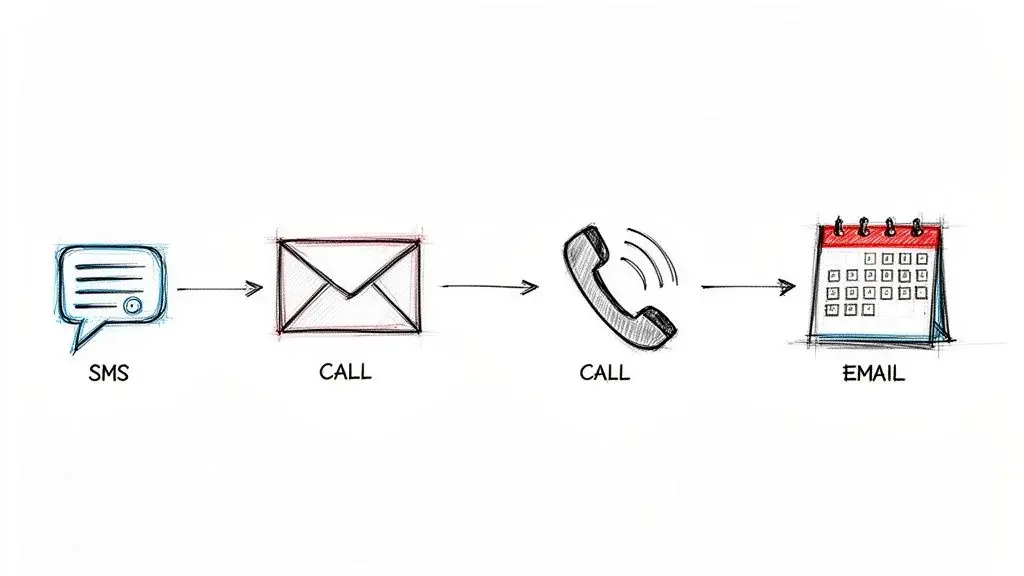
The core idea is to build a persistent, yet respectful, presence. By sequencing different message types over several days, you increase the odds of connecting with your audience on their preferred platform at the right time. This is a common practice among top-performing B2B sales teams and healthcare providers who need to ensure critical messages are received. Keywords like "ringless voicemail drop" and "voice broadcast" are central to this strategy, as they offer scalable ways to add a human touch to automated outreach.
Strategic Breakdown & Examples
An effective multi-channel sequence is more than just random outreach; it's a story told across platforms. Each touchpoint builds on the last, guiding the contact toward a specific action.
- Healthcare Appointment Sequence:
- Sequence: Day 1: SMS reminder. Day 2: Ringless voicemail from the office manager. Day 3: Final SMS confirmation request.
- Analysis: This sequence respects the patient's attention. The initial SMS is a low-friction nudge. The ringless voicemail adds a personal, human touch without being disruptive. The final SMS creates urgency to confirm, which can help reduce no-shows.
High-Value Sales Cadence:
- Sequence: Day 1: SMS intro. Day 2: Personal voice call. Day 4: SMS with a recorded case study link. Day 5: Ringless voicemail follow-up.
- Analysis: This cadence warms up a lead methodically. The initial text is a soft-opener. The voice call is for direct qualification. The subsequent SMS provides value (the case study), and the final ringless voicemail serves as a non-intrusive final reminder, directing them back to the value you provided.
Event Promotion Drip:
- Sequence: Day 1: SMS teaser. Day 3: Ringless voicemail from the main speaker. Day 5: SMS with a final registration link and "last chance" messaging.
- Analysis: This builds excitement and social proof. The teaser sparks initial interest. The speaker's voicemail adds authority and a personal connection. The final SMS drives action by combining urgency with an easy-to-use registration link, boosting sign-ups.
Actionable Takeaways & Tips
To execute this strategy, you need precise timing and thoughtful channel selection. A poorly designed sequence can feel like spam, but a well-designed one feels like helpful, persistent service.
- Design with Timers: Use automation software like Broadcast to set specific time delays between each touchpoint (e.g., wait 24 hours after SMS, then send ringless voicemail).
- Space Your Channels: Never bombard a contact with multiple channels on the same day. Strategic spacing (24-48 hours apart) prevents fatigue and gives them time to respond. To go deeper, you can explore how to build a complete multi-channel communication strategy for your business.
- Use Voice for High-Value Touches: Reserve ringless voicemail drops and direct calls for more significant steps in the funnel, such as for warm leads or critical reminders. The "ringless" aspect ensures you deliver your message without causing an interruption.
- Segment Your Sequences: Don't send your most aggressive sequence to a cold lead. Create different cadences for warm leads (more touchpoints) versus cold leads (fewer, value-focused touchpoints).
6. The Problem-Acknowledgment Follow-up
This advanced technique moves beyond a simple reminder and demonstrates deep customer empathy. When you send a follow up text after no response, this method proactively identifies and addresses the most likely reason for the silence. It’s built on the idea that silence often isn't a "no," but a "not yet" blocked by a specific objection like cost, timing, or confusion.
The strategy here is to show you understand the prospect's hesitation and are ready to help them overcome it. By acknowledging a potential problem and immediately offering a solution or an alternative path, you lower the barrier to re-engagement and transform a dead end into a new conversation. This approach is highly effective in consultative sales and for high-value products where prospects need more than just a nudge.
Strategic Breakdown & Examples
This method requires a bit more insight into your audience, but the payoff is a significantly higher response rate from otherwise stalled leads. It shows you’re a problem-solver, not just a seller.
- High-Ticket Sales:
- Message:
Hi [Prospect Name], sometimes when I don't hear back it's because the price is a concern. If that's the case, we do have flexible payment options. Interested in a brief chat about it? Reply TALK. - Analysis: This message directly names the most common objection in high-ticket sales: price. It neutralizes the awkwardness and offers a concrete solution, making it easy for the prospect to restart the conversation without feeling pressured.
Ecommerce Abandoned Cart:
- Message:
[Name], noticed you left the [Product Name] in your cart. If you have questions about sizing or shipping, I'm here to help! Just reply HELP and our team will get back to you. - Analysis: Instead of a generic "You left something behind," this text pinpoints common friction points in online shopping. It turns a simple abandoned cart notification into a customer service opportunity, building trust and recovering a potential sale.
Local Service/Membership (Karate Studio):
- Message:
Hey [Name]! Following up on your interest in our classes. If you're worried about the commitment, how about a free trial week, no contract required? Reply YES to claim it. - Analysis: This brilliantly defuses commitment anxiety, a major hurdle for membership-based businesses. The offer of a "no contract" trial completely removes the risk, making the decision to respond and try the service incredibly easy.
Actionable Takeaways & Tips
To execute this follow up text after no response effectively, you need to anticipate your audience's mindset.
- Segment by Behavior: Use past interactions to infer likely objections. If a user visited your pricing page multiple times, lead with a cost-related follow-up.
- Use Custom Fields: Store known objections or interests in your contact management system. Personalizing a message with
I know [objection] was a concern...is incredibly powerful. - Offer Multiple Paths: Give them different ways to proceed. Options like replying for a
CALL, aTRIAL, orPRICINGlet the user choose their preferred next step. - Combine with Other Channels: If a text goes unanswered, you can automate a follow-up. For instance, a ringless voicemail could drop a pre-recorded message that elaborates on the flexible payment plan you mentioned, providing more detail without being intrusive. Always remember to include opt-out language like
Reply STOP to end messages.
7. The Personal Connection & Permission-Based Follow-up
This advanced method moves beyond simple reminders to build genuine rapport and respect for the recipient's preferences. It's a two-part strategy that combines research-backed personalization with a clear, permission-based approach to communication. This is the ideal follow up text after no response for building long-term relationships, as it shows you've done your homework and value the contact's inbox.
The core idea is to first establish a specific, personal connection and then empower the recipient to control how and when they hear from you. By offering "opt-down" choices (like receiving fewer messages) instead of a binary opt-out, you can retain contacts who are interested but overwhelmed, all while reinforcing trust and maintaining compliance.
Strategic Breakdown & Examples
This technique shines in regulated industries and high-value sales, where trust is a critical asset. It demonstrates professionalism and a client-first mentality.
- High-Value B2B Sales:
- Message:
Hi [Prospect Name], saw the news about your promotion to [New Title] on LinkedIn, congrats! Is this still a good time to discuss the [Project] proposal? Reply CALL for a quick chat. - Analysis: This message is highly personalized, referencing a specific, positive career event. It proves you are paying attention and aren't just sending a generic blast. The "Reply CALL" action is a low-friction way to escalate the conversation to a more personal channel.
Healthcare & Patient Communication:
- Message:
Hi [Patient Name], this is [Clinic Name]. To make sure you get important updates, please let us know how you prefer we contact you. Reply EMAIL, PHONE, or SMS. Reply STOP to opt out of all messages. - Analysis: This is a compliance-focused approach that puts patients in control. Under HIPAA, covered health care providers must accommodate reasonable requests to receive communications by alternative means (45 CFR 164.522(b)); asking for and storing the preference is a practical way to do that. It also helps clinics send critical reminders on the channel each patient actually uses.
Ecommerce & Subscription Services:
- Message:
Hey [Customer Name], are our deals hitting your inbox too often? You can adjust your message frequency here: [preference-link] or just reply LESS to get only our biggest monthly deals. - Analysis: This "opt-down" strategy is brilliant for reducing unsubscribe rates. It acknowledges that a customer might be interested but overwhelmed. Giving them the power to receive fewer messages is a great way to keep them on your list and respect their attention.
Actionable Takeaways & Tips
To execute this strategy effectively, you need a system that can manage personalization and preferences at scale.
- Integrate Your CRM: Connect your texting platform to your CRM to pull in custom fields like job titles, company names, or recent activities. This automates the personalization process.
- Store Communication Preferences: Create custom fields in your contact database to store whether a user prefers email, SMS, or phone calls. Use this data to segment your outreach and respect their choices.
- Build Automated Branches: In a tool like Broadcast, you can create automation workflows that branch based on the recipient's reply. For example, a reply of "EMAIL" could trigger an email sequence, while "CALL" could notify a sales rep.
- Display Opt-Outs Clearly: Always provide a clear way to unsubscribe, like
Reply STOP. Under FCC rules a STOP reply revokes consent and must be honored within 10 business days (47 CFR 64.1200(a)(10)), and it is a fundamental part of building trust with your audience.
7 Follow-Up Text Strategies Comparison
| Follow-up Type | Implementation complexity | Resource requirements | Expected outcomes | Ideal use cases | Key advantages |
|---|---|---|---|---|---|
| The Soft Reminder & Direct Question Follow-up | Low | Minimal copy and simple automation | Quick binary responses, high open rates | Appointment confirmations, quick sales checks, busy recipients | Low friction, high deliverability, preserves relationship |
| The Value-Add Follow-up | Medium | Content creation, link tracking, some personalization | Increased engagement, higher perceived value, better qualification | Sales, healthcare, marketing agencies, ecommerce | Adds new relevance, reduces spam perception, improves conversions |
| The Curiosity-Driven Follow-up | Medium | Strong copywriting, tracking links | Higher open and click rates, drives site visits | Ecommerce, events, SaaS, growth campaigns | Differentiates messaging, boosts clicks and engagement |
| The Multi-Channel Orchestrated Follow-up | High | Multiple channel tools, integrations, higher budget | More chances to reach the contact on a channel they use | Healthcare, enterprise sales, events, customer success | Cross-channel reinforcement, fits varied preferences, unified analytics |
| The Social Proof and FOMO Follow-up | Medium | Verified metrics, dynamic content, timers | Faster conversions for time-sensitive offers | Ecommerce, events, promotions, limited-offer sales | Leverages credibility and urgency to drive action |
| The Problem-Acknowledgment Follow-up | Medium | Segmentation, objection-handling assets, personalization | Reopens dialogue, reduces barriers, improves lead fit | B2B consultative sales, services, SaaS | Directly addresses objections, converts hesitant prospects |
| The Personal Connection & Permission-Based Follow-up | High | CRM integration, research, preference management | Higher-quality responses, stronger long-term engagement | High-value sales, healthcare, finance, regulated industries | Deep personalization, respects preferences and compliance |
More Follow-Up Text Templates for Common Business Situations
These templates follow the context + reason + one question formula. Replace everything in brackets, and add your business name and opt-out wording where your messaging program requires it. For email versions of the same moments, see our sales follow-up email templates.
After Sending a Quote or Proposal
After a Missed Appointment
After a Demo or Sales Call
For an Unpaid Invoice
Keep amounts and account details out of the text when you can. If a collection agency or other third party handles the debt, the CFPB's Regulation F applies, including an opt-out notice in each text or email (12 CFR 1006.6(e)).
To Re-Engage an Old Lead
Only text old leads who agreed to hear from you, and keep a record of that consent. If you plan to send this kind of message often, an automated lead follow-up system keeps the timing consistent.
Follow-Up Texts and the Law: Compliance Basics
Under US law a text message counts as a "call." The Supreme Court said so in Campbell-Ewald Co. v. Gomez (2016), so the Telephone Consumer Protection Act (TCPA) and the FCC's rules apply to follow-up texts too. Our TCPA compliance guide goes deeper. The basics:
| Topic | What the rule says | Source |
|---|---|---|
| Consent for marketing texts | Telemarketing calls and texts to cell phones sent with an autodialer or prerecorded message need the person's prior express written consent, and consent cannot be a condition of purchase. CTIA guidance also asks for express written consent before promotional texts. | 47 CFR 64.1200(a)(2), (f)(9), CTIA |
| Replying to someone who texted you | CTIA treats a conversation the consumer starts as "conversational" messaging; replying to their question is expected. Turning that thread into promotions needs separate consent. | CTIA Messaging Principles, 5.1 |
| Honoring STOP | A reply such as stop, quit, end, revoke, opt out, cancel or unsubscribe revokes consent. It must be honored within a reasonable time, no more than 10 business days. | 47 CFR 64.1200(a)(10) |
| Confirming an opt-out | One text confirming the opt-out is allowed if it has no marketing; one sent within 5 minutes is presumed fine. Nothing after that. | 47 CFR 64.1200(a)(12), CTIA |
| Federal quiet hours | No telephone solicitations before 8 a.m. or after 9 p.m., local time at the recipient's location. | 47 CFR 64.1200(c)(1) |
| Florida | The Florida Telephone Solicitation Act covers sales calls, texts and voicemails: automated sales texts need prior express written consent, and a STOP reply starts a 15-day window to stop. Separately, Florida limits commercial telephone solicitation phone calls to 8 a.m. to 8 p.m. and three per 24 hours on the same subject. | Fla. Stat. 501.059, 501.616(6) |
| Oklahoma | Similar law since November 1, 2022: written consent for automated sales calls, texts and voicemails, and commercial solicitation phone calls only from 8 a.m. to 8 p.m., three per 24 hours on the same subject. | Telephone Solicitation Act of 2022 |
| Ringless voicemail | Ringless voicemail to a cell phone is a call under the TCPA and needs consent. | FCC, Nov. 2022 |
Two notes on that table. The Florida and Oklahoma hour limits are written for "phone calls," and the statutes don't say whether texts count; if you text people in those states, ask your counsel how to treat them. And the opt-out rules are changing: the FCC adopted a new order on revoking consent on September 30, 2026 (FCC 26-67 news release), which builds on its 2024 order (FCC 24-24). Check the current rule before you design an opt-out flow.
What This Means for Your Follow-Ups
- A one-to-one reply to someone who contacted you is different from a marketing campaign. Know which one you are sending.
- Get and record consent before marketing texts, including follow-ups to old leads.
- Say who you are in the first text, and tell people how to opt out (CTIA recommends standard STOP wording).
- Stop the whole sequence, texts and voicemails, the moment someone opts out.
- Send during daytime hours in the recipient's time zone.
What About Personal Follow-Up Texts?
Many people search this topic about a friend or a date, not a customer. The same formula works with a lighter touch: one follow-up after a day or two, about something specific ("Still up for tacos Saturday?"), with no guilt about the silence. If that one goes unanswered too, let them pick the conversation back up. The rest of this guide focuses on business follow-ups.
Automating Your Follow-Up: Turning Strategy into Action
We've explored a powerful arsenal of strategies for your follow up text after no response, moving far beyond simple, generic nudges. From the directness of the Soft Reminder to the strategic patience of the Multi-Channel Orchestrated Follow-up, each technique serves a specific purpose. You now have the templates and the timing guidance to re-engage prospects, confirm appointments, and close sales without coming across as pushy or desperate.
The true takeaway, however, is not just about having a list of messages. It's about understanding the psychology behind each one. Mastering the follow-up means recognizing when to add value, when to spark curiosity, and when to simply ask for permission to continue the conversation.
From Manual Effort to Automated Excellence
Having the perfect templates is a critical first step, but the real power comes from turning these individual tactics into a cohesive, automated system. Manually tracking every lead, every appointment, and every purchase to determine who needs a follow-up, when they need it, and which message to send is an impossible task that invites human error. This is where a multi-channel platform becomes your most valuable asset.
By building the seven strategies from this guide into automated sequences, you create an intelligent system that works for you 24/7. This system doesn't just send messages; it orchestrates conversations at scale.
Strategic Insight: Automation is not about removing the human touch; it's about scaling it. A well-designed sequence ensures every single person receives the right personalized message at the right moment, a feat impossible to achieve manually.
The Power of Multi-Channel Sequencing
Relying on a single channel like SMS limits your reach. People have different communication preferences. An effective follow-up strategy meets them where they are most likely to engage.
This is why combining SMS with other channels is so effective:
- SMS: Perfect for immediate, concise messages that people can answer in a word.
- Ringless Voicemail: An excellent tool for delivering a more personal, human-sounding message directly to a person's voicemail box without their phone ever ringing. It’s less intrusive than a cold call but more personal than a text.
- Voice Broadcasts: Ideal for sending pre-recorded reminders or announcements to a large group, ensuring your message is heard.
Imagine a new sales lead comes in. An automated campaign can instantly send your initial text. If there’s no response after 48 hours, the system can automatically drop a personalized ringless voicemail. A day later, a final follow up text after no response can be sent, offering one last piece of value. This is the essence of turning strategy into action.
If you want replies to trigger the next step automatically, for example confirming a YES or pausing the sequence when someone answers, look at SMS autoresponders. Whatever tool you use, make sure an opt-out ends every channel in the sequence at once.
By combining smart automation, multi-channel sequencing, and the proven templates in this guide, you can finally conquer the communication gap. You will build stronger relationships with your audience, save countless hours, and ensure no valuable opportunity ever slips through the cracks again.
Ready to stop chasing leads and start building automated conversations? With Broadcast, you can easily create the multi-channel sequences we've discussed, blending SMS, ringless voicemail, and voice broadcasts into powerful follow-up campaigns. See how it works and start turning silence into sales by visiting Broadcast today.
Frequently Asked Questions About Follow-Up Texts
Should I send a follow-up text after no response?
Usually, yes. One polite follow-up is normal, because most unanswered texts were simply forgotten. Don't follow up if the person asked you to stop or replied STOP.
How long should you wait to follow up after no response?
For business messages, 2 to 3 business days is a common first wait, then about a week, then a final text one to two weeks later. That is common practice, not a rule; urgent topics like appointments run on hours. See the timing table.
How many follow-up texts is too many?
Most businesses stop after about three follow-ups with no reply. Some state laws also cap commercial solicitation calls at three per 24 hours on the same subject (Florida and Oklahoma), so never send several in one day.
What do you say in a follow-up text after no response?
Remind them who you are, give a reason for writing now, and ask one question they can answer in a word. For example: "Hi Sam, Alex from Bright Roofing about Tuesday's quote. Pricing holds until Friday. Still want to go ahead? YES or NO is fine."
How do you follow up on a text without being annoying?
Space your messages out, keep each one short, add something new each time, skip guilt-trips, text during daytime hours, and make it easy to say no or opt out.
How do I automatically follow up when someone doesn't reply?
Use a texting platform that lets you schedule a sequence with time delays and stops it when the person replies or opts out. Set the delays from the timing table, write each message with the formula, and review replies daily.
What if someone clicks the link but doesn't reply?
A click shows interest. Send the next follow-up a little sooner and make it about what they looked at ("Saw you checked the pricing page. Any questions on the plans?"), rather than repeating the first message.