Phone calls are an essential part of a business. They generate leads, book clients, establish relationships, and more. But phone calls also take up a lot of time. For many businesses, time is a precious commodity that needs to be used wisely. In order to maintain the same level of contact without the time sacrifice, businesses are turning to a new solution: ringless voicemail AKA: straight to voicemail!
This guide covers what ringless voicemail is, how it works, the consent and identification rules that apply to it since the FCC's 2022 ruling, a getting-started checklist, script tips and answers to common questions. If you only want to send incoming calls to voicemail on your own phone, jump to that section.
What is Ringless Voicemail?
Sending a message straight to voicemail is exactly what it sounds like. It is a pre-recorded message that is left on a recipient’s phone. Going straight to voicemail has two main benefits. First, it does not disturb the recipient, which makes them more open to a message that is left. Second, it is a cost-effective way to reach a large number of people.
In a traditional marketing phone call, timing is everything. If the recipient of that call is caught at a bad or awkward time, the chances that they will turn into a viable lead drop considerably. Direct to voicemail puts the power to respond back in the hands of the recipient. They are able to listen to the voicemail on their own time, which means they are more likely to return the call.
How Ringless Voicemail Works
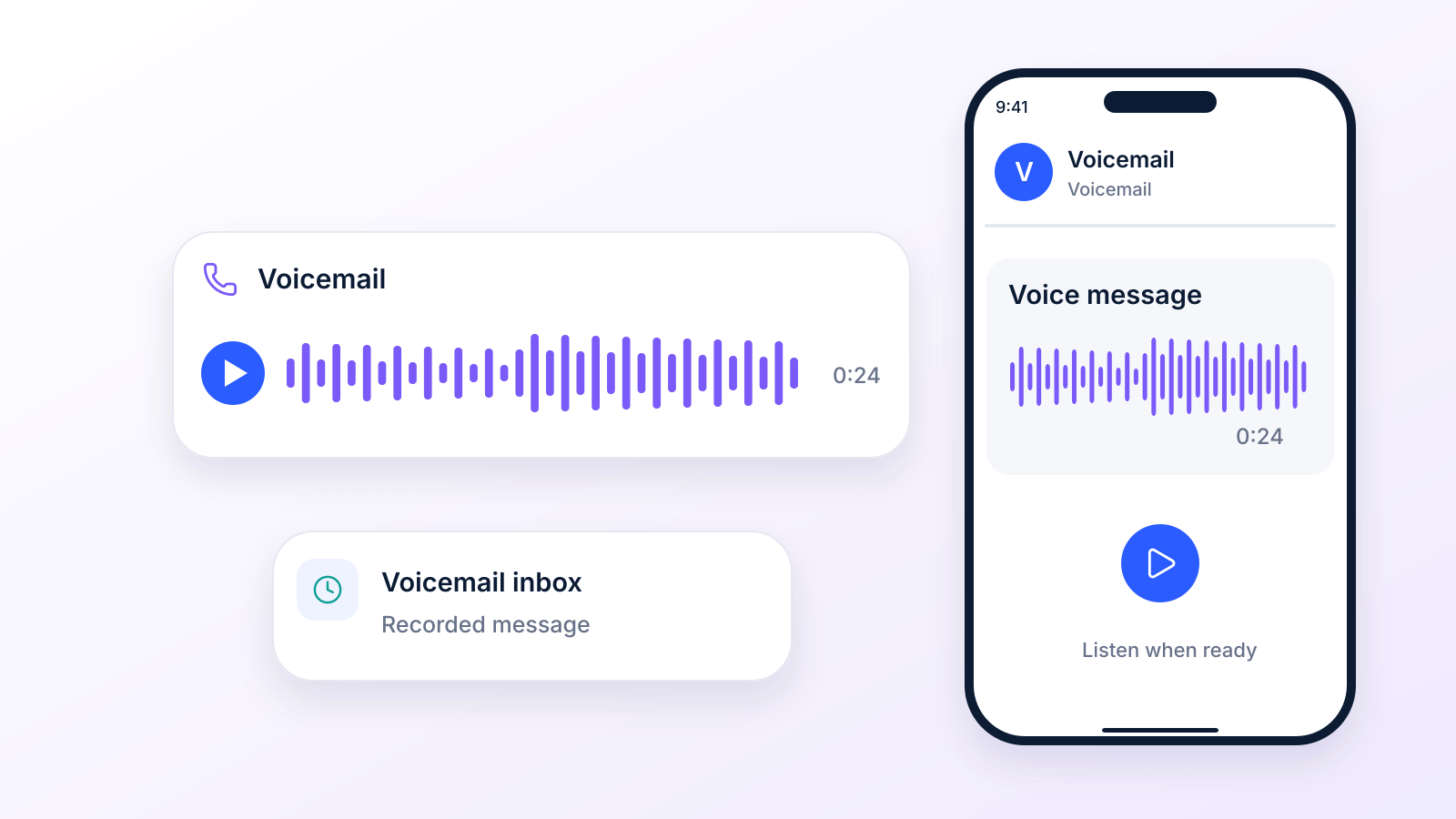
A ringless voicemail platform does not dial the phone the usual way. It connects to the carrier's voicemail system and leaves the recorded message there, so the contact usually sees a new voicemail without hearing a ring. The FCC describes this delivery method in its 2022 ruling, which quotes one provider's software as creating "a landline to landline session directly to the telephone company's voicemail server" (FCC 22-85, para. 3).
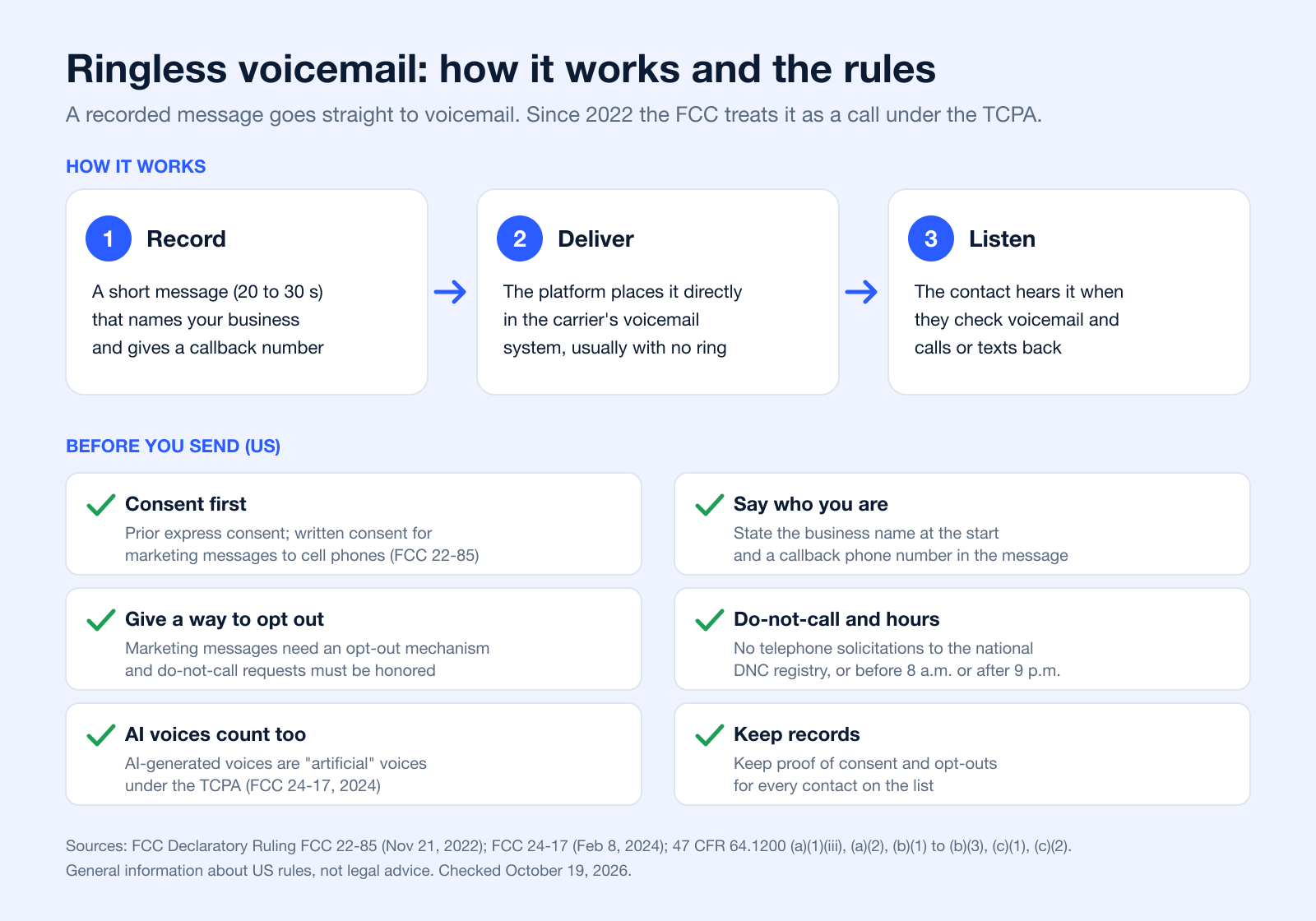
Delivering to voicemail changes how the message arrives, not how the law sees it. Since November 2022 the FCC treats ringless voicemail to cell phones as a "call" made with a prerecorded voice (FCC 22-85). The rules section below explains what that means in practice. For a broader overview of the channel, see our guide to ringless voicemail.
Myths of Sending Messages Straight to Voicemail
Not making actual phone calls to potential clients has its risks, or so it would seem. Before getting into the process, benefits, and uses, let’s go over some of the myths associated with voicemail messaging. These reasons often prevent companies from considering it as an option for marketing.
Using pre-recorded voice messages makes our business no better than the spammers who already use it. Anyone who has ever gotten a call about a credit card, Google business listing, or any other manner of spam call may think of them when looking at voicemail messaging. But it doesn’t have to be that way. What separates a legitimate voicemail drop from spam is permission and relevance: your business sends it only to people who agreed to hear from you, says who is calling, and targets very specific groups of people. Legally, though, a voicemail drop is in the same family as a robocall: the FCC ruled in 2022 that ringless voicemail is a call made with a prerecorded voice (FCC 22-85).
Myth: ringless voicemail is not regulated like calls. Older guides, including an earlier version of this one, said pre-recorded voicemail was regulated separately from phone, text or email, classified as an "enhanced" information service because the recipient is never charged and the message never goes over the cell phone network, and therefore compliant with the TCPA. The FCC rejected each of those arguments in November 2022: it found that ringless voicemail "to wireless phones requires consumer consent because it is a ‘call’ made using an artificial or prerecorded voice," that the TCPA applies whether or not the consumer is charged, and that the provider's technology "involves placing calls, not providing voicemail service" (FCC 22-85, paras. 1, 17 and 19).
Benefits of Ringless Voicemail Drops
In an age where there are do not call lists and spam folders, getting your business’ message through is a bigger challenge. Any tactic must be compliant with all applicable laws, and direct to voicemail is not an exception: no channel is compliant by itself. In the US, ringless voicemail follows the TCPA consent rules, and telemarketing messages also follow the do-not-call and calling-hour rules (47 CFR 64.1200). Other countries, such as Canada, have their own rules. See the rules section before your first send.
Messages are easy to customize. If a voicemail drop is being sent to a former customer or someone who has shown interest in a product or service, a personalized message increases the likelihood of a callback. Plus it sets the interaction on a positive footing.
Direct to Voicemail allows the business to control the flow of returned calls. Select when to call and how many people you want to reach. Depending on the configuration of the business, return 20 phone calls or 2,000 at any one time.
Words of Caution
As with any marketing tool, there are also some potential downsides to be on the lookout for. The completion rate for calls may be lower than initially expected. People who have unpaid cell phone bills won’t have access to their voicemail after a certain period of time. The same is true for those who let their voicemail box fill up. No messages can be left after a certain point.
With reporting tools, some of these targets can be avoided in order to eliminate waste. But just as with other advertising methods, businesses looking at this option should use it thoughtfully. Voicemail messaging is regulated like other prerecorded calls, and the FCC has pointed out a real cost of abuse: voicemail boxes "filling with unwanted messages, which may prevent other callers from leaving important wanted messages" (FCC 22-85). Used the correct way, with consent and a relevant message, voicemail messages are a very good marketing tool.
Understanding The Process
The primary benefit of using this service is that the phone will not ring. Your business is not dialing the customer in the usual way: the technology leaves the message in the carrier's voicemail system. Because of that, providers used to argue that no phone call was being made, that the FCC classified the communication differently as an "enhanced" service, and that lighter rules applied. That is no longer the case. The FCC ruled in FCC 22-85 (released November 21, 2022) that ringless voicemail to wireless phones is a call under the TCPA and needs the consumer's consent; its announcement summarizes the decision.
Being able to effectively target clients with marketing is very important. It can also be very expensive in more traditional forms of marketing like the web. Not only is call-less voicemail cost-effective but it can also target specific groups of potential clients. This makes advertising and marketing dollars stretch further because less time is spent on marketing to clients who won’t convert. When a voicemail is paired with an automatic text message, you give people a second, easy way to respond.
Ringless Voicemail Rules: Consent and Identification
Because ringless voicemail is a call made with a prerecorded voice, the FCC's TCPA rules for prerecorded calls apply to it. These are the US rules to check before your first campaign, from the rule text (47 CFR 64.1200, checked October 19, 2026).
| Rule | What it means for a voicemail drop | Source |
|---|---|---|
| Consent | Prerecorded calls to cell phones need the person's prior express consent | 64.1200(a)(1)(iii), FCC 22-85 |
| Written consent for marketing | If the message advertises or is telemarketing, consent must be written (prior express written consent) | 64.1200(a)(2) |
| Say who is calling | State the business name clearly at the beginning of the message (the name it is registered under) | 64.1200(b)(1) |
| Give a callback number | State a telephone number during or after the message (not a 900 number) | 64.1200(b)(2) |
| Opt-out | Telemarketing messages must offer an automated opt-out mechanism, explained within two seconds of the identification | 64.1200(b)(3) |
| Calling hours | No telephone solicitations before 8 a.m. or after 9 p.m., recipient's local time | 64.1200(c)(1) |
| Do-not-call | No telephone solicitations to numbers on the national do-not-call registry, except as the rule allows | 64.1200(c)(2) |
| AI voices | AI-generated voices count as "artificial" voices, so the same consent rules apply | FCC 24-17 (2024) |
Some states add their own telemarketing rules. For a deeper look, read our guides to ringless voicemail compliance and express written consent.
How it Works and What to Look For
Employing voicemail messaging as a marketing technique for your business is fairly straightforward:
- Record a message
- Choose a provider
- Pick a subscription or pricing plan that suits your business
- Determine your target client base
- Have the voicemails sent
- Set your response flow
- Analyze the effectiveness of the campaign
- Make adjustments as necessary
- Repeat steps 4-8
As with any business decision, it’s important to map out criteria to determine which straight to voicemail service is the right one for your business. Those who are looking into voicemail drop for the first time should avoid any sort of commitment. Find a provider that offers the service on an as needed or monthly basis. If the service does not fit your business, the investment will not be very high.
Where are you in the messaging process? At this point, some businesses may only be researching the possibility of using voicemail messages. However, it is still a good idea to have a message drafted and to know if it needs to be recorded or not. Some drop message providers include help with scripts or have voice talent available to record a message. Look at every plan offered to figure out if these features are included or cost extra.
Ringless Voicemail Getting-Started Checklist
The list above is the basic flow. Before your first send, run through this checklist, which adds the consent and identification steps the rules require:
- Confirm every contact gave consent, and that marketing contacts gave written consent (64.1200(a)(2)).
- Remove anyone who opted out, and check telemarketing lists against the national do-not-call registry.
- Write a script of 20 to 30 seconds that starts with your business name and includes a callback number.
- For marketing messages, include a clear way to opt out.
- Record it in a natural voice (or confirm consent covers an AI voice: the same rules apply).
- Schedule sends between 8 a.m. and 9 p.m. in each contact's time zone.
- Set up the response flow: who answers callbacks, and a follow-up text if you have SMS consent.
- Track deliveries, callbacks and opt-outs, then adjust the message and the list.
Questions to Ask a Ringless Voicemail Provider
- How do you store proof of consent for each contact?
- How are opt-outs captured and applied across campaigns?
- Can I schedule by the contact's local time zone?
- What caller ID and callback number will contacts see and hear?
- What delivery and callback reports do I get?
- Is pricing month to month or pay as you go, and are scripts or voice talent included?
Broadcast's ringless voicemail page shows how the channel works in our platform.
Elements of a Great Pre-Recorded Voice Message
Now that we’ve established how the voicemail messaging process works and how to go about making one, what makes messages effective?
Keep it Short
Messages should be 30 seconds at most. The ideal message length is between 20 and 30 seconds. Anything longer than that increases the likelihood of the message getting deleted. And even if it doesn’t get deleted, the target client will start to lose interest or tune out completely. So craft that message wisely!
Start with Relevant Information
Since voicemail messages like these are customizable, consider opening the message with something related to the potential client or customer. Ask a question or start with a relevant tidbit of information. A long introduction may prompt the recipient to delete the message before it starts, but you cannot skip your name: the rules require every prerecorded message to state the business's identity at the beginning (47 CFR 64.1200(b)(1)). Say your name in one short line, then get to the relevant point. If you do ask a question, make it very specific to the person receiving the message.
Voicemails Matter
Pairing pre-recorded messages with other lead generating tools raises the callback rate. If you decide to pair it with a cold call, be sure to leave the voice message too. As in the last point, the message should be really specific. But if you call several times and leave the same custom message, a potential client will be more likely to call back.
Don’t Sell
People hate being sold-to in an obvious way. The best way to avoid “selling” is to not use a sales-y tone of voice. Speak in a normal tone of voice and personalize it to the recipient. If it sounds like you’re trying to get 50 sales calls per day in and that’s all, your target customer won’t feel the need to respond.
Sample Ringless Voicemail Script (About 25 Seconds)
Uses for Voice Message Drops
Businesses choose straight to voicemail for all manner of reasons. Some use it to follow up with new leads who asked to be contacted, much like a cold call. Others may choose to call past customers or those who are looking for products or services similar to the ones that your business offers. Real estate teams are a common example (see our voicemail drops guide for real estate investors and agents). Other reasons include:
- Use them to spread the word about sales or promotions.
- You’re partnering with another company to offer a new service.
- Newly established businesses can use voicemail messaging to spread the news about their grand opening.
- Opening your business up to a new client base or industry.
- No matter what your reason is for wanting to use pre-recorded voicemail, it is a versatile tool that can be used for any occasion.
Not many people like to make sales calls. The time spent doing it can be used doing other equally important business tasks. Pre-recorded voicemails streamline the sales call process. A business owner has more control over who they contact and they create connections with potential clients. This, in turn, leads to increased follow-up calls. Pre-recorded messages are also cost-effective which is at the forefront of any organization’s mind. Take a chance on straight to voicemail messages today!
Sign up for your free 14-day trial of Broadcast to start sending ringless voicemails today!
How to Send a Call Straight to Voicemail on Your Phone
Many people searching for "straight to voicemail" want the opposite of a voicemail campaign: they want certain calls to skip the ring on their own phone. On iPhone, Apple documents these options (iPhone User Guide, checked October 19, 2026):
- Decline one call: press the side button twice quickly, or swipe up on the call banner and tap Voicemail. "If you decline a call, it goes to voicemail," although in some countries or regions declined calls are disconnected instead (Apple).
- Send all unknown numbers to voicemail: go to Settings > Apps > Phone and set unknown callers to Silence. "Calls from unsaved numbers will be silenced, sent to voicemail, and appear in the Recents list" (Apple).
- Spam calls: with the Spam filter on, calls your carrier identifies as potential spam are silenced and sent to voicemail (Apple).
- Stop a specific person: in the Phone app, open the contact and tap Block Contact (Apple).
Codes such as *86 are carrier voicemail codes, not a way to divert someone else's calls: Verizon's voicemail support page lists *86 for setting up voicemail (Verizon).
Frequently Asked Questions
Is ringless voicemail legal?
Yes, with consent. The FCC ruled in 2022 that ringless voicemail to cell phones is a call under the TCPA, so it needs the recipient's prior express consent, and written consent when it is marketing (FCC 22-85; 47 CFR 64.1200(a)(2)). This is general information, not legal advice.
Does the phone ring with ringless voicemail?
Usually not. The message is placed in the carrier's voicemail system, so the contact sees a new voicemail. The FCC's ruling notes that, according to one provider, a carrier will sometimes still signal the phone (FCC 22-85, footnote 50).
What must a prerecorded voicemail say?
At the beginning, the name of the business responsible for the message; during or after the message, a callback telephone number. Telemarketing messages also need an opt-out mechanism (47 CFR 64.1200(b)).
Can I use an AI voice for ringless voicemail?
An AI-generated voice is treated as an "artificial" voice under the TCPA, so the same consent rules apply as for a recorded human voice (FCC 24-17).
How long should a ringless voicemail be?
Keep it to about 20 to 30 seconds, as covered in Keep it Short: name, reason, one action and a callback number.
Can I send a specific contact straight to voicemail on iPhone?
You can decline their call (it goes to voicemail in most regions) or block the contact. To send all unsaved numbers to voicemail, set unknown callers to Silence in Settings > Apps > Phone (Apple).
What happens if you dial *86?
On Verizon, *86 is the voicemail code; Verizon's voicemail support page lists it for setting up voicemail (Verizon). It does not send other people's calls to voicemail.