
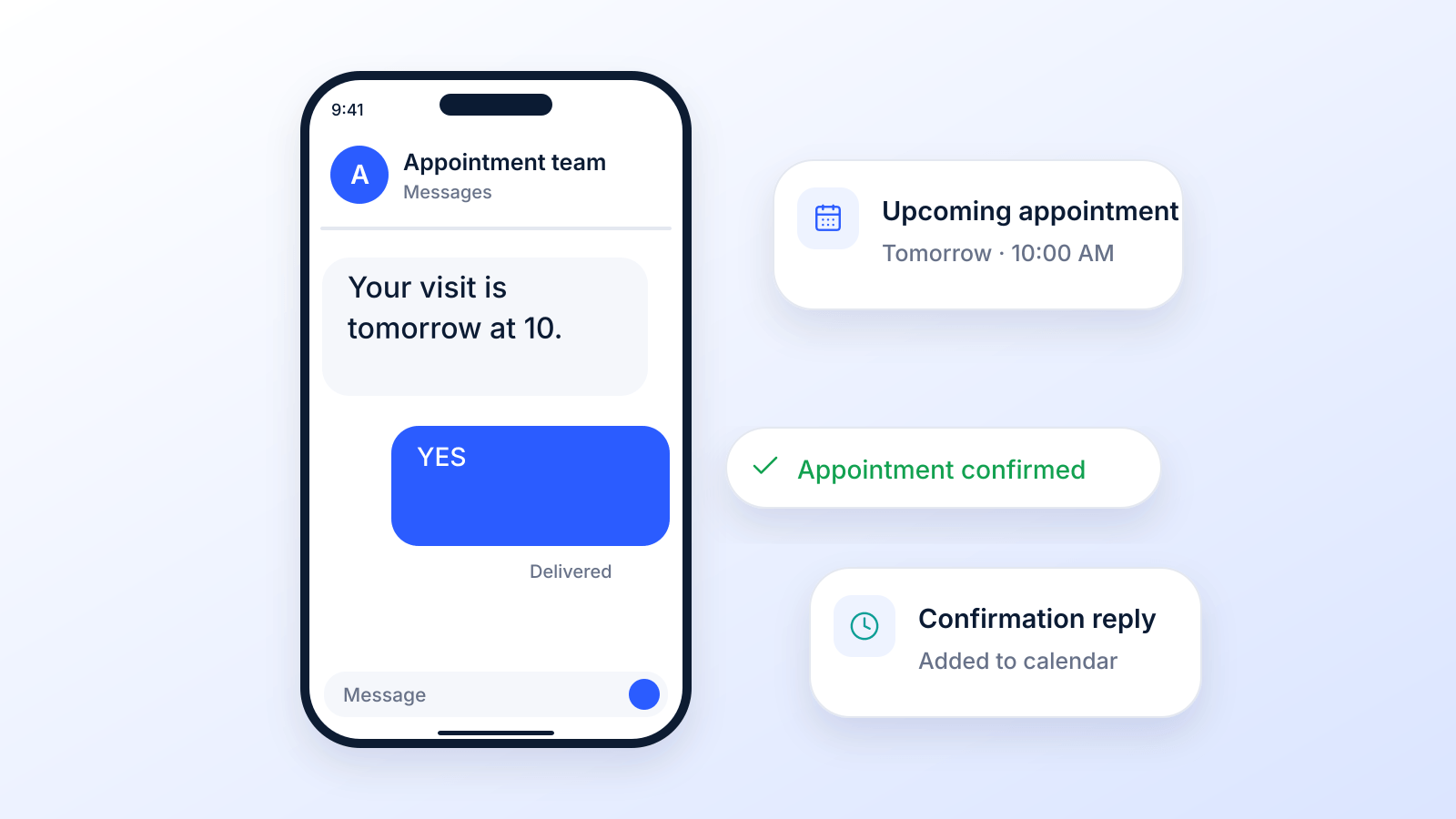
In a world saturated with notifications, a generic "Your appointment is tomorrow" message is easily ignored. No-shows and last-minute cancellations directly impact your bottom line, and a poorly crafted confirmation can be worse than sending nothing at all. This guide moves beyond basic templates to provide a strategic blueprint for crafting the perfect appointment confirmation text.
We will explore 8 distinct strategies, from simple and effective messages to sophisticated multi-channel sequences, then add templates by industry, reply handling, timing and consent. You'll learn not just what to send, but how and when to send it for maximum impact, ensuring your clients feel valued and prepared. To prevent lost revenue and wasted time, it's crucial for businesses to implement strategies to effectively reduce no-show appointments.
This article provides more than just copy-and-paste scripts. We will dissect the strategy behind each example, offering actionable takeaways you can implement immediately. We will also cover advanced tactics, like using ringless voicemail for a personal touch without the interruption, and discuss critical compliance factors like HIPAA and TCPA to keep your communications both effective and legal. By the end, you'll have a playbook of replicable examples and automation recipes, using tools like Broadcast, to dramatically cut down on no-shows, improve communication, and enhance the overall customer experience from the moment they book.
What Is an Appointment Confirmation Text (and What Should It Include)?
An appointment confirmation text is the message a business sends right after someone books, confirming the details of the appointment. It is different from a reminder, which goes out closer to the date (see our guide to automated text message reminders). Many businesses combine the two: one confirmation at booking, one or two reminders before the visit.
| Element | Example | Why |
|---|---|---|
| Who it is from | Bright Smile Dental | People ignore texts from numbers they do not recognize |
| What was booked | Cleaning, consultation, service call | Lets the customer catch a booking error (leave it out for sensitive health visits) |
| When | Tue, Nov 4 at 10:30 AM | Use the customer's time zone and a day of the week |
| Where | 12 Oak St., or a video link | Add parking or entry notes if they matter |
| One clear action | Reply C to confirm or R to reschedule | One ask is easier to answer than several |
| How to opt out | Reply STOP to opt out | Carrier guidance asks senders to explain how to opt out (CTIA) |
Keep it short. One SMS holds 160 standard characters, or 70 if the text includes an emoji or other special characters; longer texts are split into segments (Twilio Docs). The templates below are written to fit in one or two segments once your details are filled in.
The basic template
1. Simple Confirmation with Appointment Details
The simple confirmation is the foundation of every effective appointment communication strategy. It strips away all non-essential information, delivering only the critical details your client or patient needs: your business name, the appointment date, the time, and the location. This direct, no-fluff approach ensures clarity and reduces the chance of miscommunication, making it a universally reliable format for any business that schedules appointments. Its core purpose is to provide an immediate, easy-to-reference record of the booking.
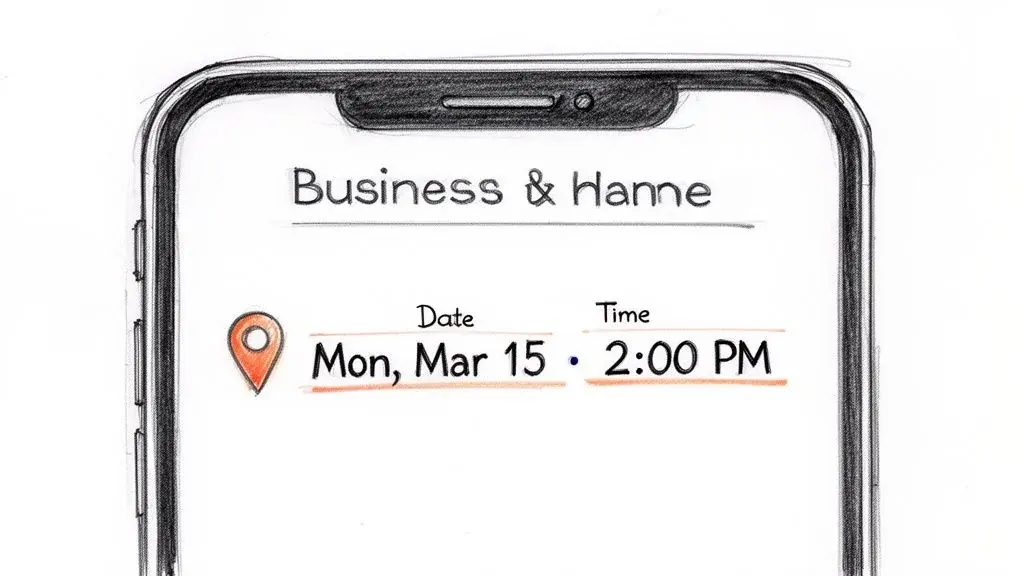
It is the format most booking tools and clinics start with. By focusing solely on the essentials, it creates an appointment confirmation text that is hard to misunderstand and easy to save for future reference.
Strategic Breakdown
The power of this template lies in its simplicity and efficiency. It answers the client's most immediate questions: "Who is this from?", "When is my appointment?", and "Where do I need to be?".
- Clarity and Brevity: The message is short, scannable, and gets straight to the point. Clients don’t have to search through promotional language to find the information they need.
- High Deliverability: Minimalist text messages are less likely to be flagged by carrier filters, ensuring your confirmation reaches the recipient.
- Foundation for Automation: This template is the perfect starting point for more complex automated sequences, such as reminder texts or follow-up ringless voicemail drops.
Actionable Takeaways & Examples
To implement this effectively, focus on personalization and clear formatting. Use merge tags to automatically insert customer-specific details, creating a tailored and professional message every time.
Key Tactic: Use merge tags like
[FirstName]and[AppointmentDate]in your Broadcast dashboard to dynamically populate each message. This not only saves time but also significantly reduces the risk of manual error.
Healthcare Example: Hi [PatientFirstName]. This is a confirmation of your appointment with Dr. Smith at Springfield Dental on [AppointmentDate] at [AppointmentTime]. Our office is located at 123 Main St.
Service Business Example: Hello [ClientName], your service call with Apex Plumbing is confirmed for [AppointmentDate] between 10 AM - 12 PM at [ClientAddress].
Class Registration Example: Welcome to Peak Karate! Your first class is confirmed for Monday, [ClassDate], at 5:00 PM. We're excited to see you!
2. Confirmation with One-Click Confirmation/Reply Options
Moving beyond a simple notification, the interactive confirmation empowers clients to take immediate action directly from their text messages. This approach uses two-way SMS to ask recipients to reply with a simple keyword like "CONFIRM," "YES," or "RESCHEDULE." By doing so, you transform a passive message into an active engagement, streamlining the confirmation process and significantly reducing the administrative burden of follow-up calls or emails. This method gives clients a sense of control and makes managing their appointments incredibly convenient.
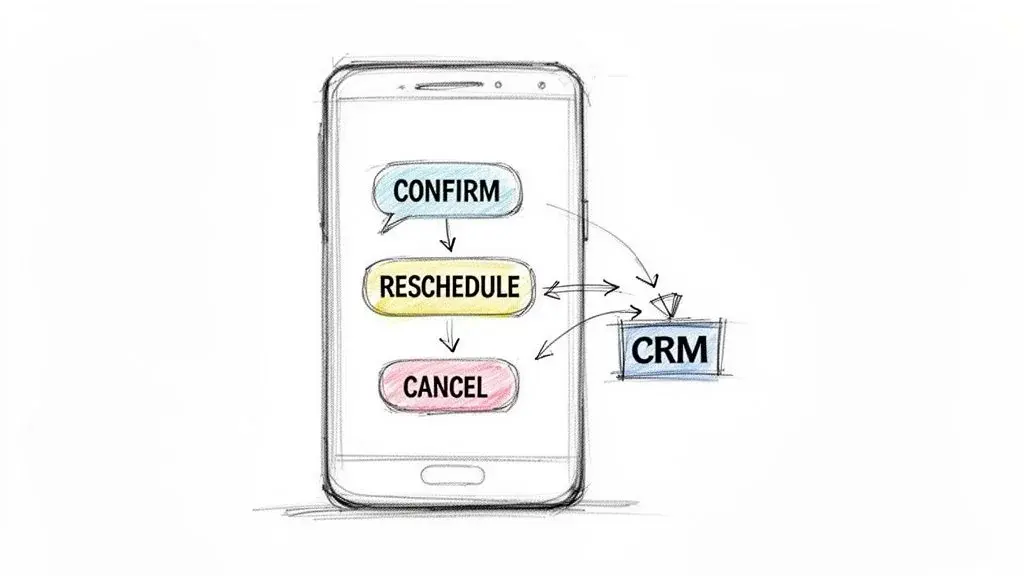
This strategy is common among healthcare providers and high-volume service businesses that need to minimize costly no-shows, because it makes confirming effortless. An effective appointment confirmation text of this type not only confirms the slot but can also update your calendar or CRM in real time, creating a closed-loop, automated workflow.
Strategic Breakdown
The core advantage of this method is its ability to turn a one-way alert into a two-way conversation, which actively engages the recipient and provides you with valuable, real-time data on appointment statuses.
- Reduced No-Show Rates: Requiring a direct response creates a small psychological commitment, making clients more likely to attend.
- Improved Operational Efficiency: Automated responses instantly update appointment statuses in your system, freeing up staff from manual confirmation calls and data entry.
- Enhanced Customer Experience: Clients appreciate the simplicity and speed of confirming or changing their appointment with a single word, without needing to make a call or log into a portal.
Actionable Takeaways & Examples
Success with this template depends on clear instructions and automated backend processes. Use simple, intuitive keywords and ensure your system is configured to handle the responses and update records automatically.
Key Tactic: In Broadcast, use the "Triggers" feature to set up automated workflows. For example, a reply of "CONFIRM" can tag the contact as confirmed in your CRM, while a reply of "RESCHEDULE" could trigger a follow-up text with a scheduling link or add them to a callback list.
Medical Office Example: Hi [PatientFirstName]. Your appointment with Dr. Evans is scheduled for [AppointmentDate] at [AppointmentTime]. Please reply CONFIRM to keep this time or RESCHEDULE to change it.
Salon/Spa Example: Hello [ClientName]! Your massage at Serenity Spa is booked for [AppointmentDate] at [AppointmentTime]. Text YES to confirm or CALL to reschedule. We look forward to seeing you!
Event Registration Example: You're registered for the "Digital Marketing Basics" webinar on [EventDate]! To hold your spot, please reply GO. Can't make it? Reply NO and we'll free your seat.
3. Personalized Confirmation with Customer Name and Service Details
Moving beyond the basics, a personalized confirmation elevates the client experience by including specific, individual details. This approach uses merge tags to insert the customer's name, the exact service they booked, and often the name of the provider or specialist they will see. This creates a much more personal and reassuring message, demonstrating that your business pays attention to detail and values each customer individually. Its purpose is to build rapport and trust from the very first interaction.
This method gained popularity with healthcare providers aiming to improve patient engagement and beauty studios focused on building strong client relationships. By referencing specific services and providers, they transformed a generic appointment confirmation text into a tailored communication that feels both professional and personal.
Strategic Breakdown
The power of this template lies in its ability to build an immediate connection while confirming critical information. It reassures the client that you have their specific needs correctly recorded, which reduces anxiety and pre-appointment friction.
- Enhanced Customer Experience: Using a client's name and referencing their specific service makes them feel seen and valued, not just like another number in your schedule.
- Improved Accuracy: Including the service and provider name gives the client an extra opportunity to spot a booking error, such as being scheduled for the wrong service or with the wrong stylist.
- Foundation for Relationship Building: This personal touch is the first step in a longer customer journey, setting a positive tone for future interactions and automated follow-ups.
Actionable Takeaways & Examples
To implement this, leverage the custom fields in your CRM or scheduling software. Ensure your data is clean and your merge tags are tested thoroughly to avoid embarrassing personalization errors.
Key Tactic: Use Broadcast’s custom fields to store service names or provider details. This allows you to create a dynamic appointment confirmation text that automatically pulls the correct information for each unique booking.
Salon/Spa Example: Hi [FirstName]! Just confirming your [ServiceBooked] with [StylistName] on [AppointmentDate] at [AppointmentTime]. We can't wait to see you at The Urban Spa!
Healthcare Example: Hello [PatientFirstName]. Your [AppointmentType] with Dr. Martinez at Oakwood Clinic is confirmed for [AppointmentDate] at [AppointmentTime]. Please arrive 15 minutes early.
Consulting/Agency Example: Hi [ClientName], your strategy call with [AccountManager] is set for [AppointmentDate] at [AppointmentTime]. The meeting link will be sent separately. Talk soon!
4. Confirmation with Direct Link to Reschedule/Manage Appointment
Empower your clients by giving them direct control over their bookings. This advanced appointment confirmation text includes all the essential details plus a unique, clickable link that allows recipients to reschedule, cancel, or manage their appointment on their own time. This self-service approach significantly reduces no-shows and frees up your administrative staff from manually handling schedule changes, making it a highly efficient strategy for modern businesses.
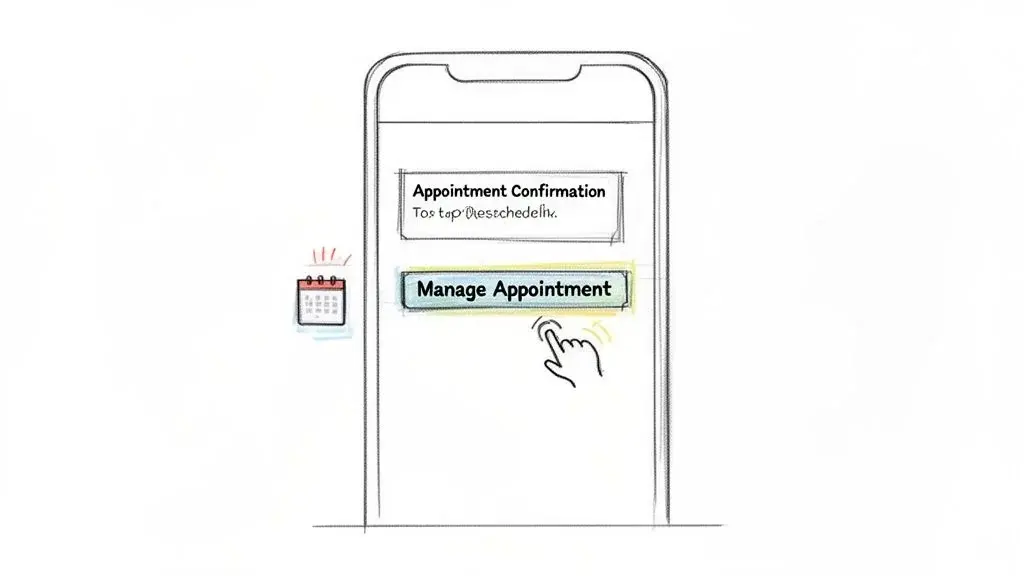
This method was popularized by SaaS booking platforms like Calendly and modern patient portals, which recognized the need to streamline the customer experience. By providing a direct management link, businesses can reduce friction, improve client satisfaction, and gain valuable data on customer engagement through link tracking.
Strategic Breakdown
The core benefit of this template is the blend of confirmation and empowerment. It confirms the appointment while simultaneously offering a simple, immediate solution for potential conflicts, which clients greatly appreciate.
- Reduces Administrative Burden: By automating the reschedule and cancellation process, you drastically cut down on phone calls and emails your team needs to manage.
- Lowers No-Show Rates: Giving clients an easy way to reschedule makes them less likely to simply not show up. They can adjust the appointment to fit their schedule with a single click.
- Provides Actionable Data: Using trackable links reveals which clients are engaging with your messages, allowing you to refine your communication strategy and identify potential issues.
Actionable Takeaways & Examples
Success with this method depends on a seamless user experience. Ensure the link directs to a mobile-friendly, fast-loading page. Most booking tools generate these links for you; we compare them in our list of the best appointment reminder software.
Key Tactic: Use your SMS platform's built-in link shortener to create clean, trackable URLs. Monitor click-through rates to understand how and when your clients prefer to manage their appointments.
Healthcare Portal Example: Hi [PatientFirstName]. Your appointment with Dr. Evans is confirmed for [AppointmentDate] at [AppointmentTime]. To manage your appointment or complete pre-visit forms, please visit: [PortalLink]
Salon/Spa Example: Hi [ClientName]! Your massage at Serenity Spa is booked for [AppointmentDate] at [AppointmentTime]. Need to change it? Manage your booking here: [ShortLink]
Webinar Registration Example: You're registered for the "Marketing Mastery" webinar on [WebinarDate]! Can't make it? Reschedule or get the recording here: [ManageLink]
5. Multi-Channel Confirmation (SMS + Email + Calendar Invite)
A multi-channel confirmation strategy elevates your communication by engaging clients across their preferred platforms. This sophisticated approach sends an appointment confirmation text for immediate impact, followed by a more detailed email and an automatic calendar invite. It creates a robust, layered notification system that ensures your appointment is seen, acknowledged, and saved, drastically reducing no-show rates. By coordinating these touchpoints, you cater to different client habits, from those who live by their text inbox to those who rely on their digital calendar.
Large healthcare systems and webinar platforms commonly use this layered approach to manage high volumes of appointments and attendees. By orchestrating SMS, email, and calendar invites, they build a communication sequence that is both persistent and helpful.
Strategic Breakdown
The power of this strategy lies in its redundancy and user-centric design. It acknowledges that different people prefer different communication channels, and it covers all the bases to maximize visibility and action.
- Layered Reinforcement: The SMS provides instant confirmation, the email offers space for detailed attachments (like pre-visit forms or webinar links), and the calendar invite integrates the event directly into the client's schedule.
- Reduced No-Show Rate: By placing the appointment in multiple locations, you make it significantly harder for a client to forget. The calendar invite, in particular, acts as a persistent, automated reminder.
- Professionalism and Trust: A well-orchestrated, multi-channel approach signals a high level of organization and customer care, building client confidence in your business. Learn more by exploring a complete multi-channel communication strategy.
Actionable Takeaways & Examples
To implement this, stagger your communications for maximum effect. Send the SMS first for immediate notification, followed by the email and calendar invite a few minutes later. This prevents overwhelming the client while ensuring all information is delivered.
Key Tactic: Use Broadcast's drip campaigns to build an automated multi-channel sequence. You can set the SMS to send instantly, trigger an email five minutes later, and even incorporate a ringless voicemail drop the day before the appointment as an additional reminder.
Medical Practice Example:
- SMS:
Hi [PatientFirstName]. Your appt with Dr. Evans is confirmed for [AppointmentDate] at [AppointmentTime]. You will receive an email shortly with pre-visit forms. - Email: Contains a detailed confirmation, a link to new patient forms, and office policies.
- Calendar Invite: An ICS file is attached to the email for one-click adding to their calendar.
Webinar Platform Example:
- SMS:
You're in! Your seat for the 'Marketing Mastery' webinar on [WebinarDate] is confirmed. Check your email for the Zoom link. - Email: Includes the unique join link, a session agenda, and a "Add to Calendar" button.
- Calendar Invite: Automatically sent upon registration to block off the time.
Karate Studio Example:
- SMS:
Welcome to Apex Martial Arts, [StudentName]! Your first trial class is confirmed for [ClassDate] at 6 PM. An email with what to expect is on its way. - Email: Details what to wear, where to park, and includes a link to the student waiver.
- Calendar Invite: Sent via email to ensure the parent's calendar is updated.
For the email part of the sequence, borrow wording from these sample reminder emails.
6. Time-Sensitive Reminder Series with Escalating Urgency
A single confirmation is good, but a strategic sequence of reminders is exponentially better for reducing no-shows. This method involves creating an automated drip campaign that sends multiple messages at key intervals before an appointment, with each message subtly increasing in urgency. This proactive, multi-touch approach keeps the appointment top-of-mind and provides multiple opportunities for the client to confirm, cancel, or reschedule, drastically cutting down on missed appointments.
This strategy was perfected by industries with high no-show costs, like healthcare providers and event organizers. By implementing an escalating series of communications, they found a powerful way to hold clients accountable and improve attendance rates. An effective appointment confirmation text series ensures your message gets through even the busiest schedules.
There is research behind the idea of more than one touch. In a randomized study at Kaiser Permanente Washington, adding a text 3 business days before high-risk visits, on top of the usual text 2 business days before, reduced no-shows by 7% in primary care and 11% in mental health (The Permanente Journal, 2022).
Strategic Breakdown
The effectiveness of this sequence comes from its psychological impact and layered convenience. It moves from a gentle nudge to a firm, final reminder, respecting the client's time while underscoring the appointment's importance. This automated flow addresses forgetfulness, scheduling conflicts, and last-minute changes head-on.
- Systematic Engagement: Spacing out reminders (e.g., 7-day, 48-hour, 2-hour) keeps the appointment on the client’s radar without being overwhelming.
- Escalating Tone: The messaging evolves from purely informational to action-oriented, prompting a final confirmation and reducing ambiguity.
- Maximized Response: Providing multiple touchpoints increases the likelihood of a client engaging, whether to confirm, ask a question, or reschedule. Learn more about how to reduce no-show appointments with these strategies.
Actionable Takeaways & Examples
Use an automation platform to build a timer-based drip campaign. It's crucial to configure the sequence to automatically pause if a client confirms or cancels early to avoid sending redundant messages and causing annoyance.
Key Tactic: In Broadcast, set up a drip campaign with specific time delays between each SMS. Vary the message content at each step; for example, make the first reminder informational and the final one more direct and urgent.
Dental Practice Example:
- 7 Days Out:
Hi [PatientFirstName]. A friendly reminder of your dental cleaning at Smile Bright Dental on [AppointmentDate] at [AppointmentTime]. - 48 Hours Out:
[PatientFirstName], your appointment with Smile Bright Dental is in 2 days. Please reply C to confirm or call us at 555-1234 to reschedule. - Morning Of:
See you soon! Your appointment is today at [AppointmentTime]. Our address is 123 Main St.
Webinar Platform Example:
- 24 Hours Out:
Reminder: The webinar "Marketing Mastery" starts in 24 hours! Get ready to join us tomorrow at [WebinarTime]. - 1 Hour Out:
It's almost time! Your webinar begins in 1 hour. Use this link to join: [WebinarLink]
Karate Studio Example:
- Day Before:
Hi [StudentName], your karate class is tomorrow at 5:00 PM. We're excited to see you at Peak Karate! - 30 Mins Before:
Class starts in 30 minutes! Time to get your gi on. See you on the mat!
7. HIPAA-Compliant Confirmation for Healthcare Providers
For healthcare providers, an appointment confirmation text is more than just a convenience; it's a regulated communication that must adhere to the Health Insurance Portability and Accountability Act (HIPAA). This type of confirmation is carefully crafted to protect patient privacy by omitting any Protected Health Information (PHI) like diagnoses, treatment details, or specific medical conditions. Its primary function is to confirm the logistics of an appointment while maintaining the strictest confidentiality standards.
The adoption of this secure messaging protocol was driven by HIPAA-covered entities, including telehealth platforms and specialized clinics, that needed to leverage the efficiency of SMS without risking compliance violations. By standardizing a minimal-information format, they established a safe and effective way to reduce no-shows and engage patients securely.
Strategic Breakdown
The core strategy here is risk mitigation. HHS treats appointment reminders as part of treatment, so a provider can send them without a separate patient authorization, but it advises keeping the information in a message to a minimum (HHS HIPAA FAQ 198). A text that confirms only the logistics protects the patient if someone else sees the phone.
- Privacy and Security: The message confirms the appointment without revealing anything about the patient's health, protecting their privacy from anyone who might see the message.
- Reduced No-Show Rates: Even without specific details, a timely reminder significantly improves attendance, protecting the provider's revenue and schedule.
- Clear Consent Trail: This method necessitates a documented opt-in process, creating a clear audit trail that demonstrates compliance and respect for patient communication preferences.
Actionable Takeaways & Examples
Success here hinges on consent and stripping messages down to the bare essentials. HIPAA does not require a written authorization for reminders, but texting rules do require the patient's prior express consent (47 CFR 64.1200), so ask for the mobile number and permission to text at intake and record it in their file. Patients can ask to be contacted another way, and providers must accommodate reasonable requests (45 CFR 164.522(b)).
Key Tactic: Keep any information that could be considered PHI out of the text: no diagnoses, test results or treatment details. Also skip clinic or doctor names that reveal a specialty (e.g., "City Oncology Center") and any medical terminology. Keep the appointment confirmation text generic and logistical.
General Clinic Example: This is a message from your healthcare provider. You have an appointment confirmed for [AppointmentDate] at [AppointmentTime]. Reply YES to confirm or call [OfficeNumber] to reschedule.
Dental Practice Example: Hi [PatientFirstName]. A reminder of your appointment at our office on [AppointmentDate] at [AppointmentTime]. Please call us at [OfficeNumber] with any questions.
Telehealth Example: Your upcoming virtual consultation is scheduled for [AppointmentDate] at [AppointmentTime]. You will receive a secure link 15 minutes prior.
If your texting vendor will handle protected health information, HIPAA requires a business associate agreement first (45 CFR 164.502(e)). Our guide to HIPAA-compliant texting platforms covers what to check.
8-Point Appointment Confirmation Comparison
| Approach | Implementation Complexity | Resource Requirements | Expected Outcomes | Ideal Use Cases | Key Advantages |
|---|---|---|---|---|---|
| Simple Confirmation with Appointment Details | Very Low | Basic SMS platform, minimal template setup | Clear appointment details; high deliverability | Healthcare, service businesses, studios | Fast to send; mobile-friendly; low cost |
| Confirmation with One-Click Confirmation/Reply Options | Medium | Two-way SMS, CRM integration, response routing | Higher confirmation rates; reduced no-shows | Medical offices, events, webinars | Low-friction customer action; captures intent |
| Personalized Confirmation with Customer Name and Service Details | Low–Medium | Clean CRM data, merge tags, template testing | Improved engagement and trust; fewer no-shows | Beauty/wellness, healthcare, agencies, studios | Feels personal; boosts satisfaction and loyalty |
| Confirmation with Direct Link to Reschedule/Manage Appointment | Medium–High | Scheduling portal/landing page, link shortener, click tracking | More self-service reschedules; lower staff workload | Healthcare, salons, webinars, ecommerce | Self-service convenience; analytics on clicks |
| Multi-Channel Confirmation (SMS + Email + Calendar Invite) | High | SMS + email system + calendar (.ics) + integrations | Broad reach; calendar visibility; reduced no-shows | Enterprise healthcare, webinars, large events | Redundant delivery; better attendance and records |
| Time-Sensitive Reminder Series with Escalating Urgency | Medium | Drip automation, sequencing rules, monitoring | Significantly reduced no-shows; staged awareness | Medical offices, events, webinars, studios | Timed escalation; customization per stage |
| HIPAA-Compliant Confirmation for Healthcare Providers | Medium–High | Secure messaging stack, consent tracking, staff training | Regulatory compliance; protected patient privacy | Medical practices, telehealth, specialty care | Reduces legal risk; audit trails and encryption |
| Confirmation with Social Proof and Customer Reviews Link | Low–Medium | Shortened review links, post-appointment timing | Increased reviews and local SEO; reputation growth | Salons, studios, local services, ecommerce | Captures feedback when satisfaction is high; boosts trust |
Appointment Confirmation Text Templates by Industry
Copy these and replace the brackets. Each one confirms the booking, gives one action and shows how to opt out. Business names in brackets are placeholders.
Healthcare and dental
Salons, spas and wellness
Home services (HVAC, plumbing, cleaning)
Legal and professional services
Keep case, matter and account details out of texts; a confirmation only needs the logistics.
Auto, real estate, education and others
If you confirm by phone: a short call script
Some customers do not text. For them, a confirmation call can follow the same structure: "Hi, this is [Name] from [Business], calling to confirm your [Service] on [Date] at [Time]. Can you still make it? If you need a different time, I can move it now." Reminders by text and by phone call both improved attendance in healthcare research (Cochrane review).
How to Handle Replies: C to Confirm, R to Reschedule
Asking for a reply only works if something happens when the customer answers. Decide in advance what each reply does, and set your reminder platform (for example Broadcast) or your team to follow it.
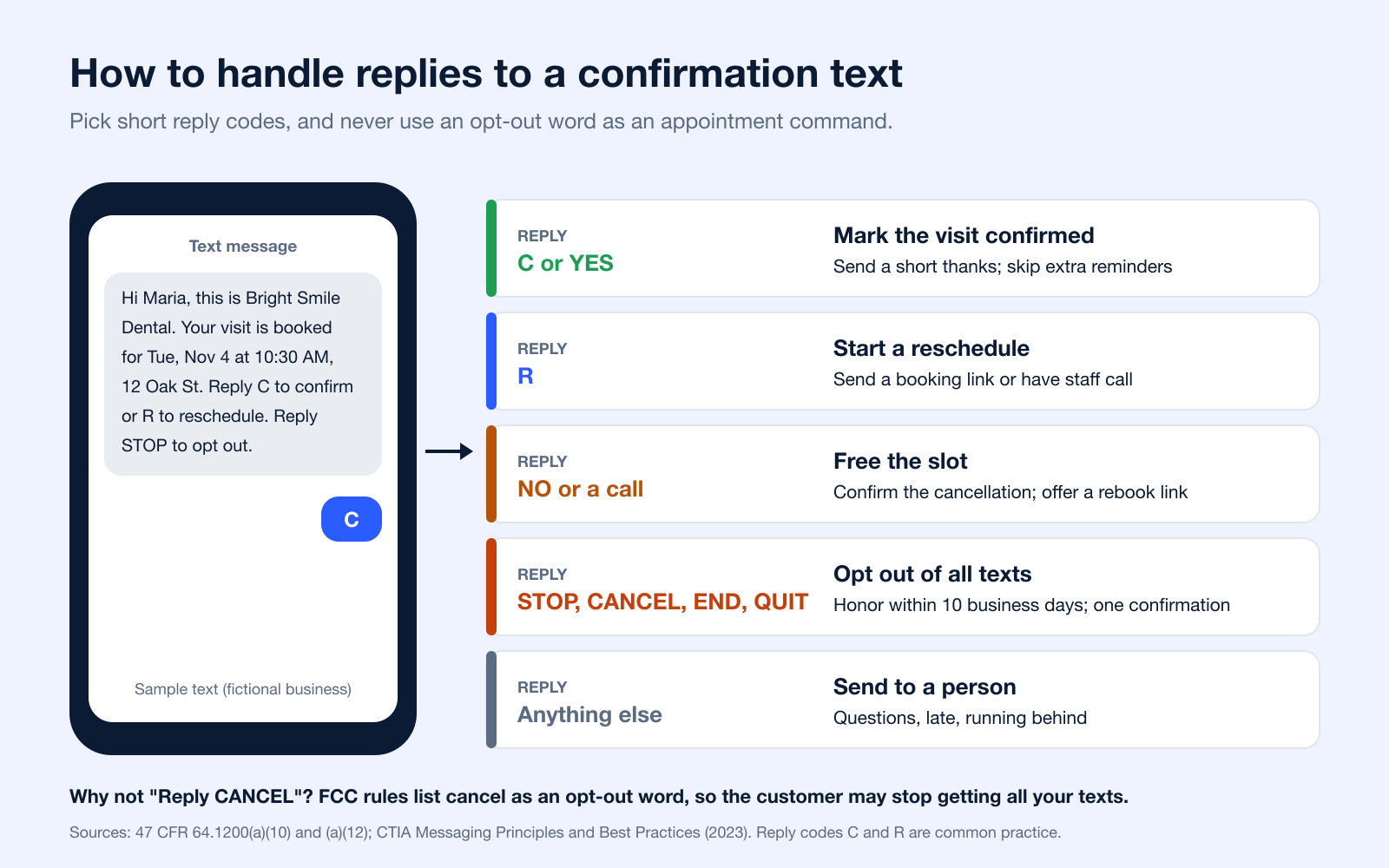
| Reply | What it means | What to do | Source |
|---|---|---|---|
| C, YES, Y | Confirmed | Mark the appointment confirmed; send a short thank-you; stop extra reminders if you like | Common practice |
| R | Wants a new time | Send a booking link or have staff call back | Common practice |
| NO | Cannot make it | Free the slot, confirm the cancellation, offer a rebook link | Common practice |
| STOP, QUIT, END, REVOKE, OPT OUT, CANCEL, UNSUBSCRIBE | Opt-out from your texts | Stop texting them within 10 business days; you may send one confirmation with no marketing | 47 CFR 64.1200(a)(10), (a)(12) |
| HELP | Needs information | Reply with your business name and how to reach you | CTIA Messaging Principles |
| Anything else | A question or a note | Route it to a person the same day | Common practice |
Auto-reply templates
When to Send Appointment Confirmation Texts
| Message | When | What the evidence says |
|---|---|---|
| Confirmation | Right after booking | Common practice; confirms the details while the customer is still engaged |
| Reminder with a reply request | 1 to 3 days before | In a randomized study, adding a text 3 business days before to the usual one 2 business days before cut no-shows 7% (primary care) and 11% (mental health) for high-risk visits (Permanente Journal) |
| Day-of nudge | 1 to 3 hours before | Common practice; useful for directions, parking and video links |
| Review or feedback request | 1 to 2 hours after the visit | Common practice; send it to every customer |
In healthcare, text reminders raised attendance from 67.8% with no reminder to 78.6% in a Cochrane review of 8 trials (Gurol-Urganci et al., 2013). Outside healthcare there is less research, so track your own confirmation and no-show rates. Send during normal waking hours in the customer's time zone: the federal 8 a.m. to 9 p.m. window applies to marketing texts, but it is a sensible default for confirmations too (47 CFR 64.1200(c)(1)). For full sequences, see automated text message reminders.
Consent and HIPAA Rules for Appointment Confirmation Texts
| Topic | Rule | Source |
|---|---|---|
| Consent | Automated texts to cell phones need prior express consent; marketing texts need prior express written consent. Health care messages from HIPAA covered entities need prior express consent, not written consent | 47 CFR 64.1200(a)(1)-(2) |
| Opt-out | Honor STOP and similar replies (including CANCEL) within 10 business days; one confirmation text allowed | 47 CFR 64.1200(a)(10), (a)(12) |
| Carrier guidance | Informational messages need express consent, promotional ones express written consent; explain how to opt out | CTIA Messaging Principles |
| Healthcare details | Reminders are part of treatment; no authorization needed, but keep details to a minimum | HHS HIPAA FAQ 198 |
| Texting vendors | A vendor that handles PHI needs a business associate agreement | 45 CFR 164.502(e) |
| Ringless voicemail | Treated as a call under the TCPA; needs consent | FCC 22-85 (2022) |
In practice: ask for permission to text when the customer books ("Yes, text me about my appointments"), keep confirmations about the appointment only, and send promotions in a separate list with written consent. If a confirmation also pushes an offer, treat it as marketing.
Appointment Confirmation Text FAQs
We get asked a lot about the nuts and bolts of setting up a text confirmation system that actually works. Below are some of the most common questions that pop up, along with some practical, real-world advice to get you on the right track.
What Is the Best Time to Send a Confirmation Text?
Timing is everything. A multi-step approach is common practice and covers all your bases.
First, send an initial confirmation the moment a client books. This gives them immediate peace of mind that their spot is locked in. It's their first chance to double-check the details and pop it right into their calendar.
Then, follow up with a reminder 24-48 hours before the appointment. This is the sweet spot. It gives them enough of a heads-up to reschedule if a conflict has popped up, saving you from a last-minute scramble to fill that slot.
Finally, a quick nudge 1-3 hours before their scheduled time is your secret weapon against the simple "I forgot!" no-show. This last-minute ping puts the appointment top-of-mind right when they need it.
Can I Use Text Reminders for Patients in Healthcare?
Absolutely, you just have to be smart about it and stay HIPAA compliant. This is non-negotiable.
The golden rule is to avoid including any Protected Health Information (PHI) in the text. That means no mention of specific treatments, test results, or the reason for the visit. Keep it general and to the point.
A minimal text looks something like this: "You have an appointment with Dr. Smith's office on [Date] at [Time]. Reply C to confirm." HHS treats reminders as part of treatment and advises limiting the details (HHS HIPAA FAQ 198).
What Is Ringless Voicemail and How Does It Fit In?
Think of ringless voicemail as your friendly, non-intrusive personal assistant. It's a neat piece of tech that lets you drop a pre-recorded message directly into someone's voicemail box without their phone ever ringing.
It's a way to add a human touch that a text message can't quite capture. For example, you could send a text 48 hours out and then drop a friendly, personal voicemail reminder from the doctor or stylist 24 hours before the appointment. Note that the FCC treats ringless voicemail as a call under the TCPA, so it needs the same consent as an automated call (FCC 22-85).
How Do I Get Customers to Opt In for Appointment Texts?
Make it a natural part of your booking process. The simplest and most compliant way is to add an unchecked checkbox to your online scheduling form or intake paperwork.
The language needs to be crystal clear. Something like, "Yes, I'd like to receive appointment reminders via text message." is perfect. Always be upfront about what they're signing up for and make it easy to opt out at any time; texting rules require prior express consent for automated texts and honoring STOP replies (47 CFR 64.1200). Transparency builds trust.
How Should I Handle Cancellations and Rescheduling via Text?
Make it dead simple. The goal is to avoid a frustrating back-and-forth that wastes your team's time. Don't ask open-ended questions; give clear, easy options.
- For Cancellations: A simple keyword is your best friend, but avoid CANCEL: FCC rules treat it as a request to stop all texts. Something like "Reply NO if you can't make it" works. Your system can then handle the cancellation and send back a link to your booking page to encourage them to rebook later.
- For Rescheduling: The absolute best way is to send them a direct link to your online calendar. A quick message like, "Need a different time? Reschedule here: [link]" lets them find a new spot on their own terms.
This self-service approach is a win-win. It frees up your staff from administrative headaches and empowers the client, which always leads to a better experience.
Should I Charge a Fee for Last-Minute Cancellations?
Yes, charging a fee for last-minute cancellations is a standard and effective way to cut down on no-shows. Your time is valuable. The key is to be consistent and completely transparent about it from the moment they book.
Think of a cancellation fee less as a penalty and more as a way to encourage respect for your schedule. For your best, long-term clients who have a genuine emergency, consider offering a one-time waiver. It shows you value the relationship over a single fee.
This approach lets you enforce your policy while still showing a human touch when it counts.
How do you confirm an appointment through text?
Send a short text right after booking with your business name, the date, time and place, and one action: "Reply C to confirm or R to reschedule." When the customer replies C, mark the appointment confirmed and send a quick thank-you. Most booking tools and reminder platforms can do this automatically.
How do you write an appointment confirmation text?
Start with who you are, then what was booked, when and where, then one clear action and how to opt out. Keep it under 160 characters when you can. Use the basic template above and adapt it with the industry examples.
What do you say when confirming an appointment by text?
Be specific and friendly: "Hi Sam, this is Oak Street Salon. You're booked for a haircut with Ana on Friday at 3 PM. Reply C to confirm or R to reschedule." Use the customer's name, the day of the week and the exact time, and ask for one reply.
Can appointment reminders be sent via text?
Yes, to customers who gave you their mobile number and agreed to get texts. Automated texts need prior express consent under FCC rules, and you must honor STOP replies (47 CFR 64.1200). Healthcare providers can send reminders as part of treatment under HIPAA, keeping details to a minimum (HHS FAQ 198).
What language in confirmation messages increases response and reduces cancellations?
We did not find a study that compares wording for business confirmations, so treat this as practice guidance: name your business first, give the exact day and time, ask for one short reply (C or YES), offer an easy way to reschedule so people move the visit instead of skipping it, and state your cancellation policy plainly. On timing, there is research: an extra text a few days before helped in the Kaiser study.
What is the difference between an appointment confirmation and a reminder?
A confirmation goes out when the appointment is booked and confirms the details. A reminder goes out before the appointment, usually 1 to 3 days and again a few hours ahead, and often asks the customer to confirm they are still coming. Compare tools that send both in our list of the best appointment reminder software.
Appointment Cancellation Message Templates
Figuring out the right words to cancel an appointment without sounding cold or robotic is half the battle. A clear, friendly message can keep your client relationship strong, even when their plans change.
Let's walk through a few solid templates you can swipe and adapt for different channels. These aren't just about canceling; they're designed to be polite, direct, and nudge the client toward rescheduling, turning a lost slot into a future booking.
The Go-To SMS Reminder With a Cancellation Option
Think of this as your workhorse. It’s a simple, automated reminder that gives clients an easy out if they need it. The goal here is a fast, clear response that saves you a last-minute no-show.
Template: "Hi [Client Name]. Just a friendly reminder about your appointment with [Your Name/Business Name] on [Date] at [Time]. Please reply YES to confirm or NO if you need to cancel. We look forward to seeing you!"
This one is perfect for your initial reminder, typically sent 48-72 hours out. It sets clear expectations and makes canceling a simple, one-word text (NO rather than CANCEL, which counts as an opt-out from all texts).
The Friendly Ringless Voicemail Script
A ringless voicemail drop lands in their inbox without ever making their phone ring. It feels a lot more personal than a text but is way less intrusive than a live call. This is a great touch for a final reminder 24 hours before, especially for high-value appointments.
Template: "Hello [Client Name], this is [Your Name] from [Your Business Name]. I'm just calling to remind you about your appointment tomorrow, [Date], at [Time]. If you need to make any changes, please give our office a call back at [Your Phone Number]. We’re looking forward to seeing you!"
The warm, personal tone here often gets clients who need to cancel to actually call you, giving you enough notice to fill the spot. Using a ringless voicemail makes sure your message gets heard without interrupting their day. Like texts, ringless voicemail needs the customer's consent: the FCC treats it as a call under the TCPA (FCC 22-85).
A great cancellation message isn't just about informing; it's about guiding the client toward the next best action, whether that's confirming, calling back, or rescheduling.
The Cancellation Confirmation (With a Rescheduling Nudge)
When a client follows through and cancels, your automated response is your last, best chance to win back that business. This message needs to confirm their cancellation and, in the same breath, give them an effortless way to rebook.
Template (SMS or Email): "Your appointment for [Date] at [Time] has been successfully canceled. We're sorry we'll miss you! When you're ready to reschedule, you can view our availability and book a new time here: [Your Booking Link]. We hope to see you soon."
This template neatly closes the loop on the cancellation while immediately opening the door for their next appointment. It’s a simple but powerful way to keep your schedule full.
From Confirmation to Conversation: Your Next Steps
We've explored a comprehensive playbook of appointment confirmation text strategies, moving from the foundational, detail-oriented message to sophisticated, multi-channel sequences. Throughout these examples, from a simple salon reminder to a HIPAA-compliant healthcare notification, a clear theme emerges: a well-crafted confirmation message is far more than a logistical tool. It is your first, best opportunity to reinforce a client’s decision, build trust, and proactively manage your schedule to protect your bottom line.
The journey from a basic reminder to a fully automated communication workflow may seem daunting, but it starts with a single, strategic step. The core principle is not to implement every tactic at once but to understand the "why" behind each one. Why does a direct link to reschedule help with no-shows? Because it removes friction. Why does personalizing with a client's name and service provider increase engagement? Because it makes the interaction feel human, not robotic.
Key Strategic Takeaways: From Theory to Practice
Mastering the art of the appointment confirmation text boils down to a few critical, actionable principles. Let's distill the most important takeaways from this guide:
- Clarity Above All: Every message, regardless of its complexity, must clearly state the essential details: who, what, when, and where. Without this foundation, all other optimizations are meaningless. Your client should never have to guess or search for this core information.
- Empower the User with Action: The most effective confirmations empower clients to manage their own appointments. Including simple reply commands (
Confirm,Reschedule) or direct links to a management portal transforms a passive notification into an interactive, two-way conversation. This simple shift in control dramatically reduces administrative workload and client frustration. - Personalization Builds Relationships: Moving beyond a generic template is non-negotiable. Using merge tags for
[Client Name],[Service Type], or[Provider Name]creates an immediate sense of recognition and value. It shows you see them as an individual, not just a time slot on your calendar. - Compliance is a Cornerstone of Trust: For industries like healthcare, finance, and legal services, compliance isn't an option; it's a requirement. Adhering to regulations like HIPAA and TCPA by securing explicit consent and protecting sensitive information is fundamental to building and maintaining client trust.
Your Action Plan for Implementation
You are now equipped with the templates and strategies to overhaul your appointment management process. The next step is to put this knowledge into action. Don't aim for perfection on day one; aim for progress.
- Start with Your Biggest Pain Point: Are no-shows your primary concern? Begin by implementing a confirmation that requires an active reply. Is your front desk staff overwhelmed with calls? Introduce a template with a direct link to reschedule. Solve your most pressing problem first.
- Layer on Technology and Automation: Once you have a solid template, use a platform to automate the entire sequence. Schedule a confirmation to go out instantly, a reminder 24 hours before, and a final notice two hours prior. This "set it and forget it" approach ensures consistency and reliability without manual effort.
- Expand Your Communication Channels: Consider adding a non-intrusive follow-up to your most valuable appointments. A strategically timed ringless voicemail can add a powerful personal touch, delivering a warm, pre-recorded message directly to their voicemail box without ever making their phone ring. This enhances the client experience and makes your business memorable.
- Test, Measure, and Refine: Your first draft is never your last. Use A/B testing to experiment with different message phrasing, calls to action, and timing. Track your no-show rates and confirmation percentages. Data-driven decisions will guide you toward the perfect appointment confirmation text for your unique audience.
Ultimately, optimizing your confirmation process is an investment in efficiency, client satisfaction, and revenue protection. Each confirmed appointment is a promise kept, and each prevented no-show is income secured. By transforming your confirmations from simple reminders into strategic conversations, you build a more resilient, client-centric, and profitable business.
Ready to automate these powerful strategies and eliminate no-shows for good? Broadcast provides the tools you need to send personalized SMS confirmations, automated reminders, and even ringless voicemail drops, all from one easy-to-use platform. Start your free trial today and see how effortless it is to implement the exact appointment confirmation text templates we've covered. Visit Broadcast to begin.


