
You're staring at a phone number in one tab, a clock in the other, and you need to get a message out now. Maybe a lead is cooling off, maybe your kid changed numbers, maybe a client is waiting for a confirmation you should've sent ten minutes ago. That's the core reason people search send SMS online without login, not because they love “free tools,” but because they need a fast way to get a text out without creating another account, installing another app, or digging for a SIM card.
The appeal is obvious. A browser-based send feels like the shortest path between intent and delivery, especially when the message is one-off and the pressure is high. The problem is that the shortcut comes with trade-offs most guides gloss over, and those trade-offs decide whether your message lands, gets delayed, or gets buried by filters.
A lot of the category's growth came from broader web-based texting tools that use virtual or disposable numbers, browser access, and no-registration use cases like verification and anonymous texting. Some are international: one roundup lists a receive-only verification site with temporary numbers from more than 50 countries. All of it sits inside a huge texting habit: Americans alone exchanged nearly 2.2 trillion SMS and MMS messages in 2024 (CTIA).
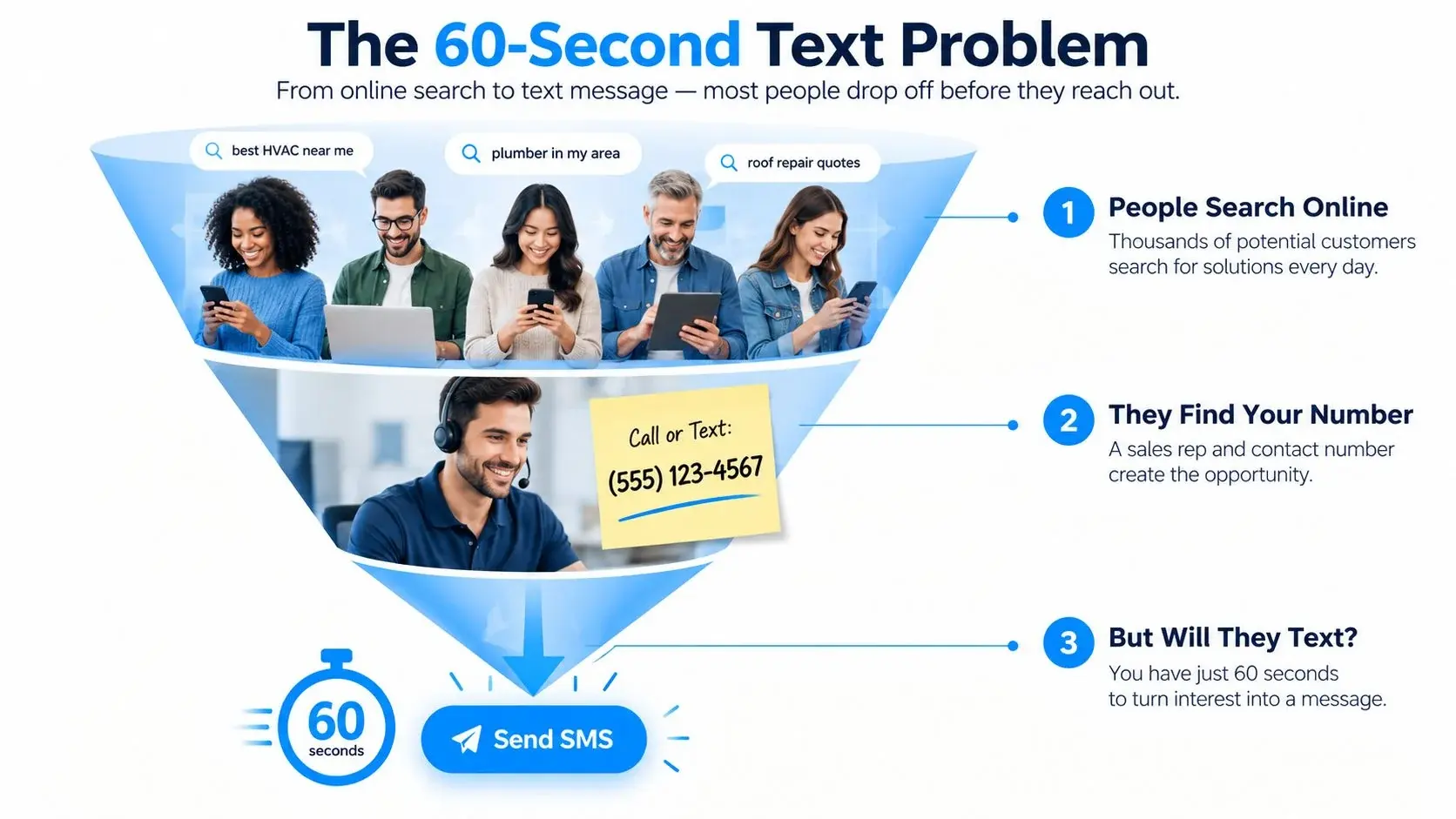
The 60-Second Text Problem
A sales rep finds a hot lead, copies the number, and wants to send a quick text before the contact clicks away. A parent needs to reach a teen who's on a new number and doesn't want to fuss with an app. A marketer wants to ping a prospect before a competitor does. In all three cases, the first instinct is the same, find a free browser form and blast the message out before the moment disappears.
That instinct makes sense. No login sounds like speed, and speed feels like an advantage when the gap between “maybe interested” and “gone” is tiny. The catch is that the shortcut only helps if the service truly supports the destination, accepts the message length, and delivers fast enough to matter.
Practical rule: if the text needs certainty, support, or a paper trail, a free no-login form is the wrong first move.
The four trade-offs show up fast. Volume is limited, country support is spotty, delivery can be slow, and sender identity is often unclear. That's before you deal with the annoying part, the service may be built for convenience, not for accountability, so there's no meaningful support path if the send fails.
The category exists because people need quick browser-based messaging without installing software, but that doesn't make it a clean fit for every job. If the message is time-sensitive, sensitive, or business-related, you need to know what you're giving up before you paste the number. Otherwise, you're not choosing speed, you're gambling on a thin layer of convenience.
If what you really need is to text from a computer with your own number, there are free ways that keep replies coming back to you; see safer free ways to text from your computer below.
Three Real Ways to Send Without Logging In
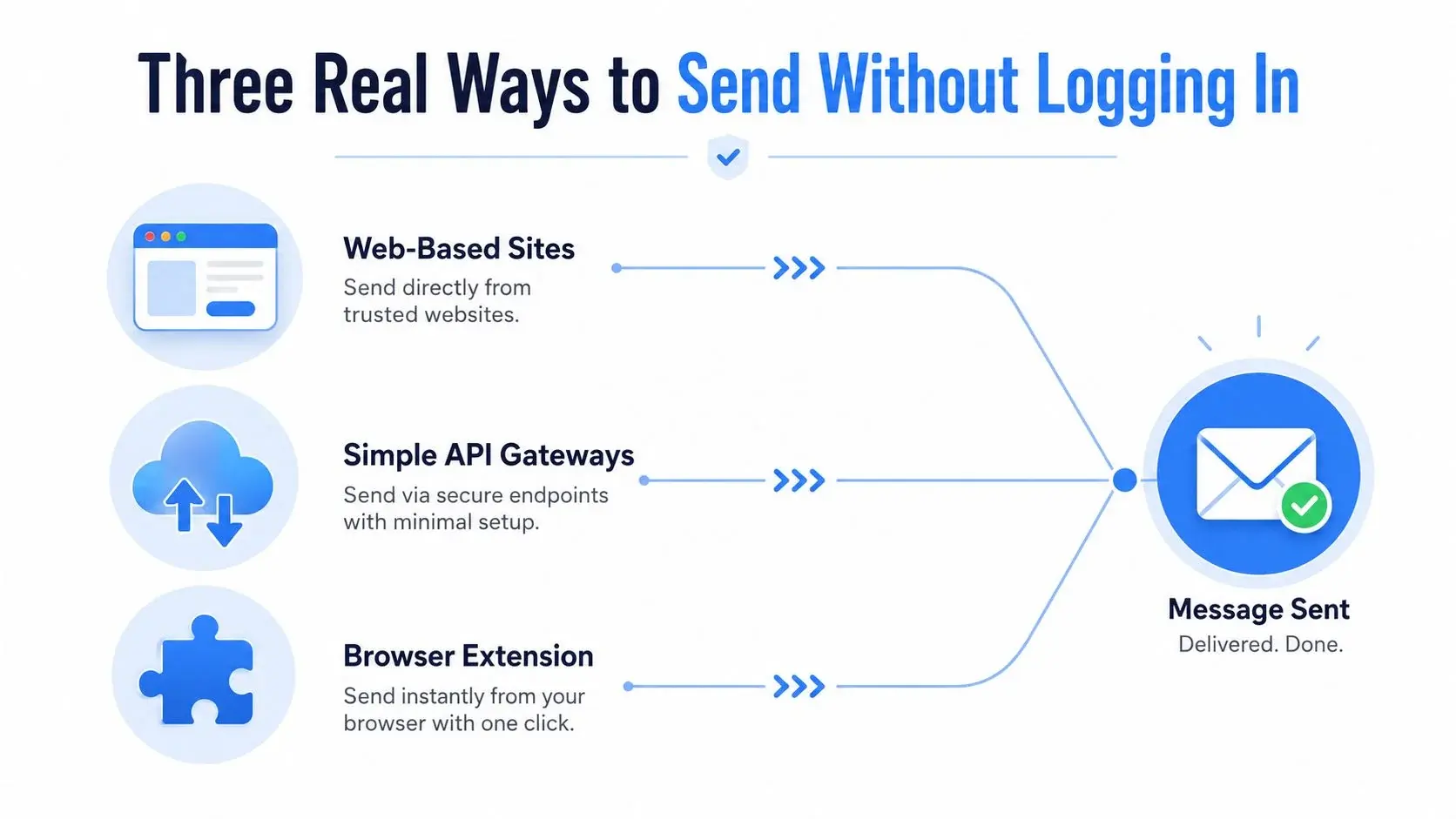
The first path is the obvious one, a free web-based SMS site. You paste in the number, type your message, solve whatever gate they throw at you, and hit send. The recipient usually sees a short code, shared sender ID, or a generic web-originated message, which is fine for a quick one-off and bad for anything that needs a trusted reply path.
The second path is email-to-SMS. You send an email to a carrier-specific address, like the kind covered in this email-to-SMS walkthrough, and the carrier converts it into a text. That used to be useful if you already live in email and need a low-friction one-shot send, but it falls apart when you don't know the carrier or the recipient expects a real back-and-forth. It is also going away: AT&T ended email-to-text on June 17, 2025 (AT&T), and Verizon expects to finish shutting down vtext.com and vzwpix.com by March 31, 2027 (Verizon).
The third path is a temporary or virtual number service. You rent or use a disposable number, send from it, and retire it when the job is done. Some anonymous web-based SMS services route messages through a shared pool of sender IDs, and pricing and payment methods vary by service, so read the terms before you pay. That setup works when you need a throwaway identity, but it's weak if the message needs consistent replies or if the recipient may call back later.
For a practical comparison of use cases, a wedding planner coordinating vendors might prefer a single browser-based send for a one-time confirmation, while a team handling recurring outreach needs a structured platform. Think in terms of the whole workflow, not just the send button: if the same people will hear from you again, a free group texting option or a proper platform beats a fresh anonymous form every time.
The right path depends on the job. If you need speed, use the lightest option that can still reach the recipient reliably.
Safer Free Ways to Text From Your Computer
If the reason you want "no login" is that you don't want another app or another account, you may already have a better option. These are free, they send from a number the recipient can reply to, and they are documented by the companies that run them. They do need a sign-in, usually one you already have.
| Option | How it works | Limits | Source |
|---|---|---|---|
| Google Voice | Free US number for personal use; text from voice.google.com or the app | Personal, consumer use; texting needs a Google Voice number; groups up to 8 people; "not intended for bulk messaging" | Google Voice Help, plans |
| Google Messages for web | Pair your Android phone with a browser; texts go out from your own number | One computer active at a time; your phone sends the texts, so carrier fees apply | Google Messages Help |
| Messages on Mac | Turn on Text Message Forwarding on your iPhone; SMS, MMS and RCS appear on your Mac | Same Apple Account on both; the iPhone must be on and connected | Apple Support |
| Free no-login SMS site | Paste a number, type, pass a CAPTCHA, send | Short messages, delays, daily caps, often no replies; some only pretend to send | Software Testing Help |
| Carrier email-to-text | number@carrier-domain from any email account | Closing: AT&T ended it June 17, 2025; Verizon ends it by March 31, 2027 | AT&T, Verizon |
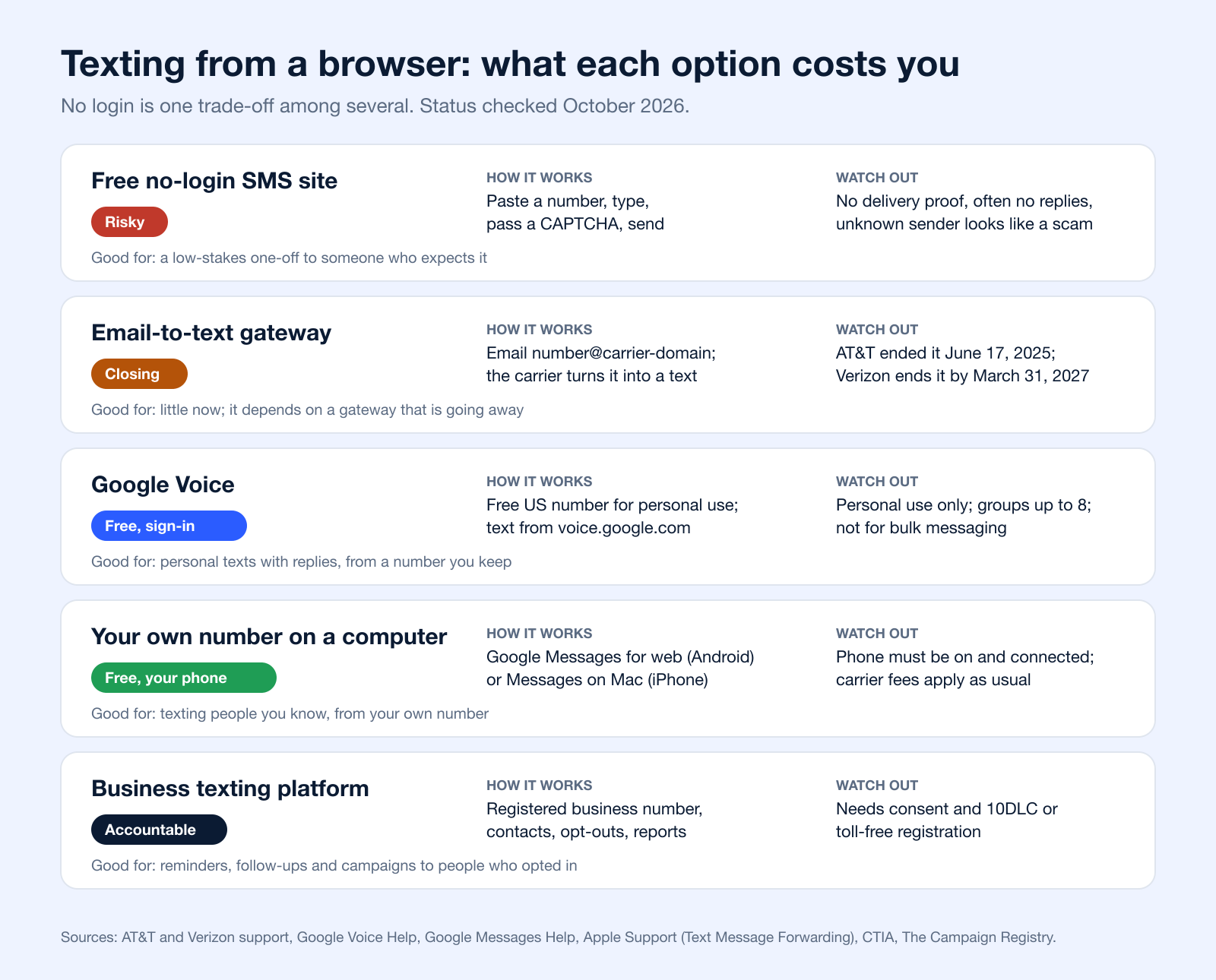
For a business, none of these personal options is the answer: Google Voice says its messaging is meant for interactive conversations, not bulk sends (Google Voice Help). Our guide to sending bulk texts from a computer for free covers where each free route stops.
What No-Login Tools Quietly Limit
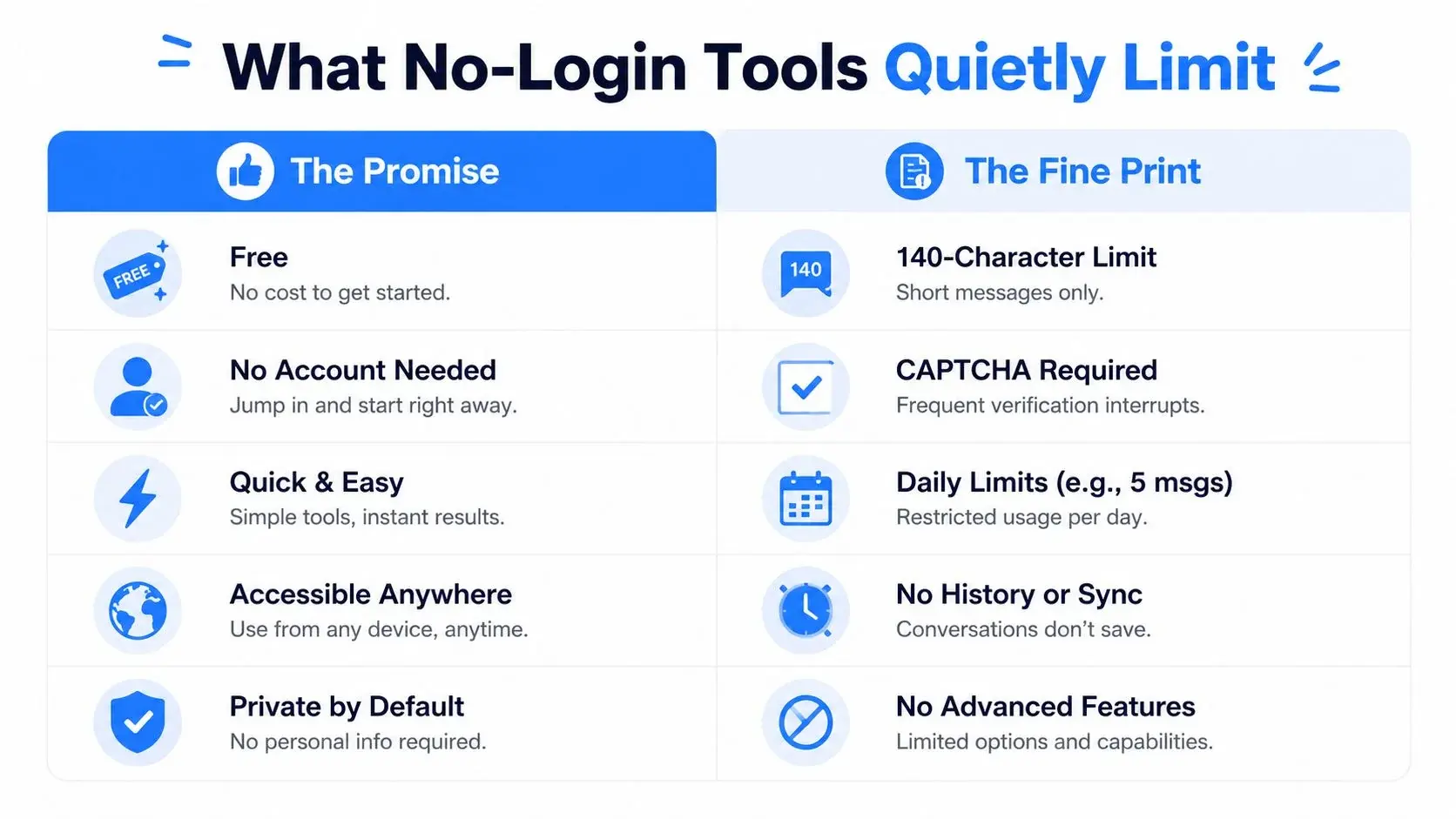
Free no-login tools look generous until you push them even a little. In one guide's walkthrough of a free site, messages are capped at 140 characters, you pass a CAPTCHA, and delivery takes 30 seconds to 10 minutes. The same guide notes that no-registration sites have limited daily traffic capacity, often just a few messages a day, because they can't behave like full-scale messaging platforms.
The hardest limit is usually geography. Free no-signup sites support only the countries their routes reach, and the list can be short, which means your message can be dead on arrival if your recipient sits elsewhere. That's the part many overlook. They assume the form is universal, then find out the service narrowed the target list long before they clicked send. Check the destination list before you paste the number.
The failure mode is boring, and that's the problem
A lot of sends don't “fail” with a dramatic error. They just disappear into a delay, a filter, or a bad destination rule. A message can look sent on your side and still never land cleanly on the other end, which is why free tools are poor choices for anything you can't afford to miss.
The sender side usually gives you no real recovery path. There's no support desk, no retry queue, no deliverability report, and no audit trail you can use to prove the text went out. If you need certainty, the right question isn't “Can I send it?” It's “Can I predict whether it will arrive?”
No Login Is Not the Same as No Trace
The word anonymous gets used too casually in this space. No-login services can keep you from creating an account, but that doesn't mean the service treats you like a ghost. Many platforms still review content for abuse, some share sender pools, and some require an email address if you want replies, which ties the message right back to an identity.
The recipient side matters too. A text from a number they don't know is exactly what the FTC tells people not to answer: Americans reported $470 million in losses to text scams in 2024, and the FTC's advice is never to click links or respond to unexpected texts (FTC), and to forward such texts to 7726 (SPAM) (FTC). So an anonymous message may be read as spam, or not read at all. See our spam message examples for what recipients learn to ignore.
Anonymity also has a legal edge. Sending an ordinary message without an account is one thing, but faking caller ID on a text with intent to defraud, cause harm or wrongfully obtain anything of value is illegal under federal law (47 U.S.C. 227(e), 47 CFR 64.1604), and the FCC can fine up to $10,000 per violation. This is general information, not legal advice.
That's why the phrase no login needs a narrower meaning. It means no account creation on your side, not zero data collection, not invisible sender identity, and not a guaranteed callback path. If a recipient can't see who really sent the text, that might be fine for a utility message, but it's a weak foundation for any relationship you care about.
Rule of thumb: if the recipient needs to trust the message, don't hide behind a throwaway sender model.
The compliance issue gets sharper for businesses. A one-off message to someone who already expects it is one thing. Repeated outreach that starts to resemble marketing is another, especially when the sender is using a service that wasn't built for consent management, retention controls, or reply tracking. Carrier guidelines expect every business sender to get consent first, and express written consent for promotional texts (CTIA). The privacy illusion becomes a liability the moment the outreach looks systematic.
That's where the distinction between no login and no trace matters most. In the earlier section, the point was speed. Here, the point is that speed doesn't erase responsibility. A service may help you avoid account creation, but it doesn't remove your obligation to know who you're contacting, why you're contacting them, and whether the channel is appropriate.
For anyone comparing message privacy with platform-level protection, this encryption overview is worth reading alongside your vendor review. It reinforces the core idea that transport, storage, and sender identity are separate questions, and you can't assume one because you saw the other.
When Ringless Voicemail and Drip Platforms Do It Better
A lot of people searching this term don't really want a “texting trick.” They want a response. They want a callback, an appointment confirmation, or a fast follow-up that doesn't get buried. That's where the tool choice changes, because ringless voicemail and structured drip platforms are built for outreach, not improvisation.
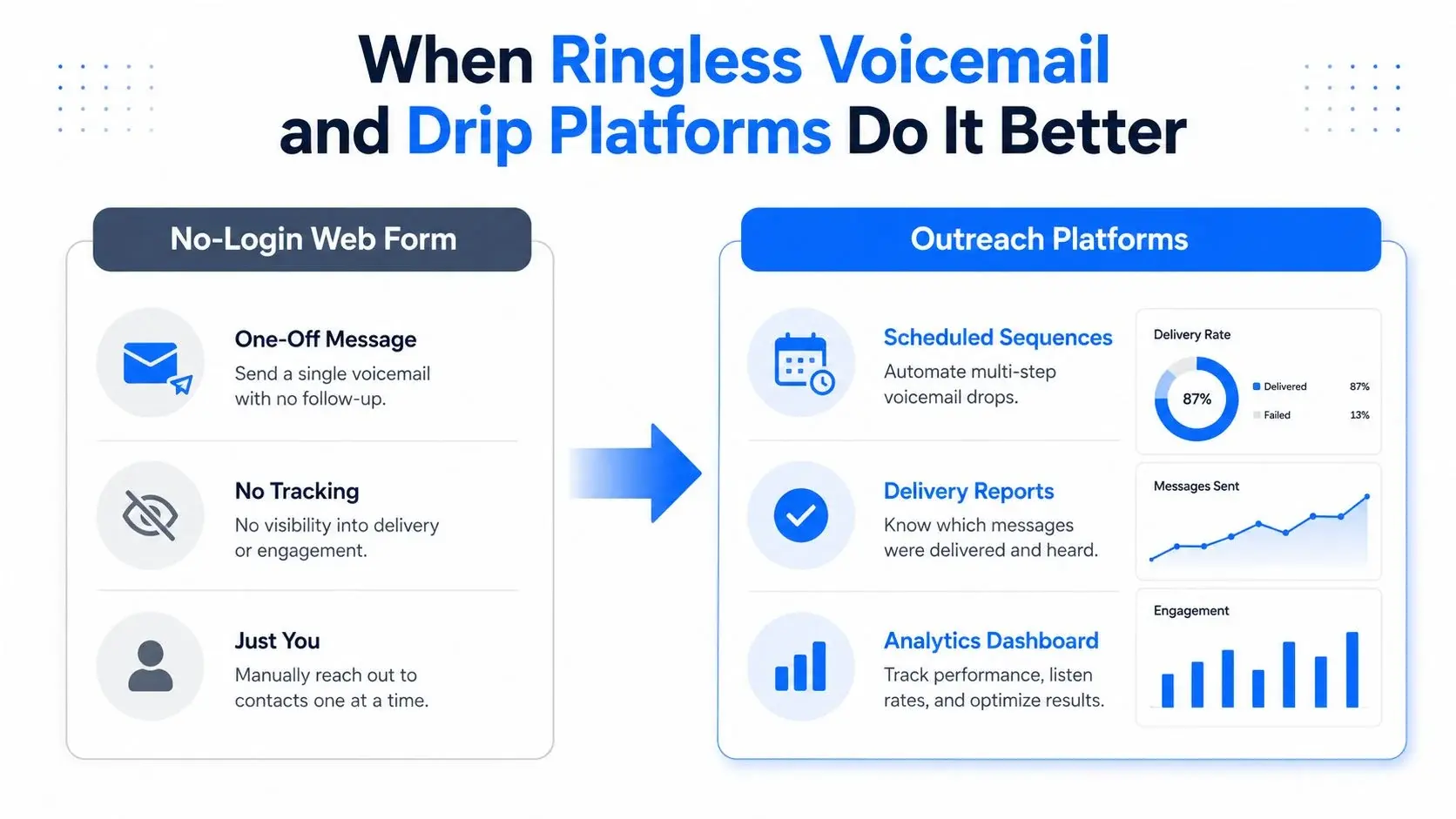
A no-login web form is fast, but it's fragile. Ringless voicemail drops a pre-recorded message directly into the voicemail inbox without ringing the phone, and it's built for mobile and landline reach with scheduled delivery and repeatable campaigns. It is not a loophole: since 2022 the FCC treats ringless voicemail to a cell phone as a call that needs the recipient's consent (FCC; see our ringless voicemail compliance guide). A structured SMS drip is different again, it sequences messages over time, segments by audience, and keeps the workflow organized instead of one-off and disposable.
Match the channel to the job
- Use a no-login web form when you're sending a low-stakes, one-time message to someone you already know and you don't need tracking.
- Use ringless voicemail when the goal is to leave a message that can be heard later without interrupting the recipient.
- Use a drip platform when timing, segmentation, and follow-up matter more than raw speed.
The internal logic is simple. One-off browser texting is a tactical convenience. Outreach platforms are operational tools. If you're a sales team, a clinic, or an agency, anonymous web messaging is the wrong place to run repeatable follow-up. Ringless voicemail marketing is a better fit when you need a controlled drop without the chaos of ad hoc sending.
Broadcast is one of the platforms in that category. It supports SMS, voice broadcasting, and ringless voicemail, with scheduling, segmentation, merge tags, and compliance features that make it useful when the job is repeatable rather than improvised. That's the difference between sending a message and running a campaign.
The Secure Path for Teams and Small Businesses
If you're running a business, the right move is to stop trying to force a throwaway tool into a workflow it wasn't built for. Start with opt-in capture, then use double opt-in if you want a clean proof trail. From there, move into toll-free verification, list segmentation, scheduling, and link tracking so you can see what happened after the message left your dashboard.
Two rules shape that stack. Federal rules require prior express written consent for many marketing texts and give you 10 business days to honor a STOP (47 CFR 64.1200), and texts from local business numbers (10DLC) must be registered through The Campaign Registry; unregistered 10DLC traffic to the US has been blocked since September 1, 2023 (Twilio). This is general information, not legal advice.
That stack sounds heavier than a free web form, but it's cleaner. You're not guessing whether the message landed, you're not improvising sender identity, and you're not relying on a tool that can vanish the moment abuse controls tighten. For healthcare, agencies, ecommerce, and event-driven teams, that extra setup is the difference between a useful communication system and a deliverability headache.
Broadcast is built with HIPAA compliance and integrates with ActiveCampaign, HubSpot, Keap, and more than 4,000 apps via Zapier, which makes secure outreach practical for teams that need more than a throwaway text box. That matters most when messages need to move through existing systems instead of living in a one-off browser tab.
If the message matters tomorrow, set it up like it matters today.
Questions About Sending SMS Online Without Login
How Do I Send a Text Without Logging In?
Use a free web SMS form: enter the number, type a short message, pass the CAPTCHA and send. Expect a character cap, a delay, a daily limit and usually no way to get a reply (Software Testing Help). If you can sign in to something you already have, Google Voice, Google Messages for web or Messages on Mac send from a real number instead (see the table).
Can I Send an SMS Online for Free?
Yes. Google Voice is free for personal use in the US (Google Voice Help); Google Messages for web is free but your phone sends the texts, so normal carrier fees apply (Google Messages Help); and Messages on Mac relays texts through your iPhone (Apple Support). Free no-login sites cost nothing but give no delivery guarantee.
Can I Send SMS From Gmail?
Not directly. The old route was emailing number@carrier-domain, but AT&T ended that on June 17, 2025 and Verizon is shutting it down by March 31, 2027 (Verizon). With the same Google Account you can use Google Voice instead, which has its own web app (Google Voice Help). More in our guide to sending texts from email.
Can I Send SMS Without a Mobile Number?
Every text goes out from some number; the question is whose. A no-login site uses its own shared numbers, Google Voice gives you a free number, and texting in Google Voice only works once you have one (Google Voice Help). Businesses send from a number their platform provides, which must be registered for 10DLC (The Campaign Registry).
Is It Legal to Send an Anonymous Text?
The federal caller ID rule does not target texting without an account; it targets faking caller ID on a text to defraud, cause harm or wrongfully get something of value (47 U.S.C. 227(e)), and business texts need consent whatever tool sends them (CTIA). This is general information, not legal advice.
Your No-Login Decision Checklist
Use a no-login tool only when the message is low-stakes, the recipient already expects it, and you can live without tracking. If the message is marketing, touches a list, or involves healthcare, skip the free form and use a compliant platform instead. If you need replies, scheduling, or proof of delivery, you've already outgrown anonymous browser texting.
The direction of travel is clear. Browser-based texting is getting tighter, carriers are filtering harder, and the anonymous options are getting thinner. Since 2023 the FCC has required mobile carriers to block texts that appear to come from invalid, unallocated or unused numbers (FCC 23-21), and AT&T and Verizon are closing their free email-to-text gateways. Casual senders are moving toward opt-in systems because that's the only way to keep deliverability and avoid constant guesswork.
If you need fast outreach without gambling on a no-login form, use a platform that was built for consent, timing, and follow-up. Broadcast gives you SMS, voice, and ringless voicemail in one place, so you can stop improvising and start sending messages that have a chance to land.


