
You usually notice text message history when you need one message right now. It's the appointment reminder you forgot to screenshot. The address your friend sent last week. The order update with the pickup code. In personal life, missing text history is annoying.
In business, it's a recordkeeping problem.
A missing business message thread can mean you can't confirm consent, can't explain why a reminder failed, can't prove an opt-out was honored, and can't reconstruct what a customer received. That's why the phrase text message history has two very different meanings. On a phone, it means old conversations. In operations, it means a searchable log with status, timestamps, and subscriber actions that people can use.
This guide covers both. First the personal side: how to find old texts, where your history is stored, how to recover deleted messages, and what your carrier can and cannot give you. Then the business side: why phone and carrier logs fall short and how to manage message records.
Why Your Text Message History Matters More Than You Think
Texting started as something simple. The first text message was sent on 3 December 1992, when a Vodafone engineer in the UK sent "Merry Christmas" to test the technology (BBC). Within a few years texting became part of everyday life, and once a channel reaches that level of everyday use, it stops being optional for businesses.
That shift changed what message history means.
For a person, text message history is mostly about retrieval. You want to find the message and move on. For a business, message history has to answer harder questions. Was the message sent? Did it get delivered? Did the contact opt out later? Which campaign triggered it? Who on the team can access it? How long should it be retained?
Personal convenience versus business recordkeeping
A phone thread gives you fragments. A business log gives you context.
That difference matters most when teams use texting for reminders, promotions, support updates, or follow-up sequences. Once customer communication touches regulated data, appointment logistics, or revenue-generating campaigns, history stops being a convenience feature and starts functioning like an operational record.
Practical rule: If a text can affect compliance, revenue, or customer trust, treat its history like business data, not like a casual inbox.
Those searching this topic still expect recovery tips. That makes sense. They're trying to find something lost. But the more useful question for organizations is whether the system behind those messages creates a reliable trail.
What good history actually gives you
A useful message history helps teams do four things well:
- Verify consent: You need to know when someone subscribed, what they received, and whether they later opted out.
- Troubleshoot delivery: A raw phone log won't tell a manager much when a customer says, “I never got it.”
- Review performance: Marketing teams need campaign-level visibility, not a pile of screenshots.
- Protect access: Sensitive communication shouldn't live only on one employee's device.
If messages are not arriving at all, see why text messages are not being delivered.
Many teams commonly get stuck here. They start with texting as a fast communication tool, then realize later that they never built the audit trail around it.
Finding Your History on Personal Devices
If your immediate goal is simple, find an old text on your own phone, start with the built-in search tools. They're usually faster than endless scrolling, especially when you remember a phrase, name, date range, or business name.
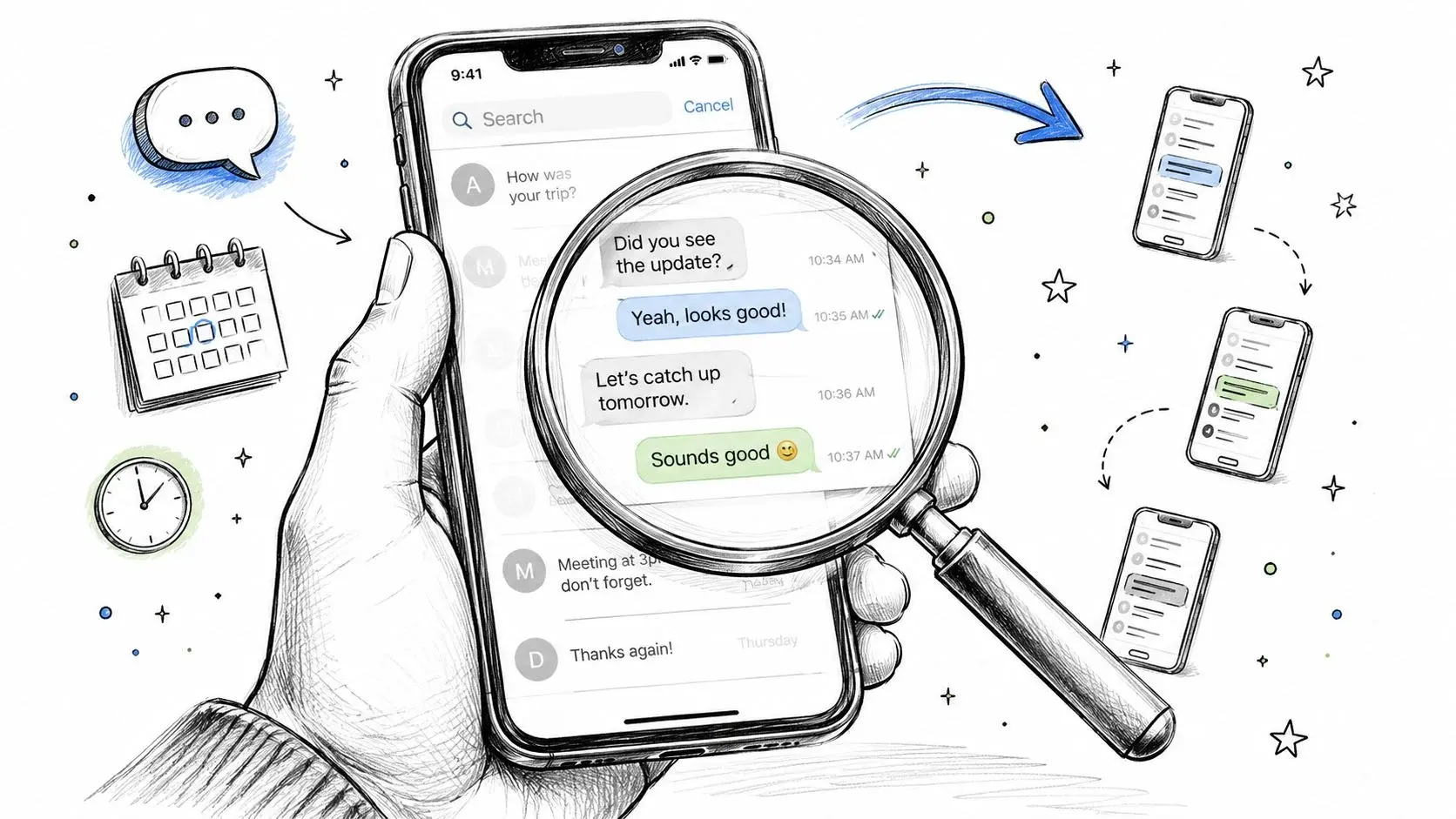
On iPhone
The Messages app and Spotlight search are your two fastest options.
- Open Messages Swipe down on the conversations list to reveal the search bar if you don't see it immediately.
- Search for a keyword Use a name, phone number, business name, confirmation code, street name, or a phrase you remember from the message.
- Tap the matching conversation iPhone will usually jump into the thread near the relevant result, which saves time compared with scrolling from the latest message.
- Try Spotlight if Messages search misses it From the home screen, swipe down and search there. Sometimes Spotlight surfaces message results more quickly, especially when you remember a unique word.
On Android
Most Android users rely on Google Messages, though the exact layout can vary by device maker.
Use this process:
- Open Google Messages
- Tap the search icon
- Enter a keyword, contact name, or number
- Open the matching thread and review the surrounding messages
If your phone uses a different messaging app, the search tool may sit behind a menu icon rather than on the main screen. The logic is the same. Search first, then narrow by contact or phrase.
On a computer, Google Messages for web shows the conversations on your Android phone after you pair it with your Google Account or a QR code (Google Messages Help). On a Mac or iPad, Messages in iCloud keeps the same history on every device signed in to your Apple Account (Apple).
Search works best when you use uncommon words. “Appointment” may return too much. A clinic name, pickup code, or product name usually works better.
When search isn't enough
Sometimes the issue isn't finding a thread. It's finding a message that no longer exists on the device. That's where backups help, but only within the limits of the phone ecosystem.
A few practical options:
- iPhone backups: an iCloud backup includes your iMessage, SMS and MMS messages only if Messages in iCloud is turned off; with it on, messages sync to iCloud instead (Apple).
- Android backups: Google’s Android backup includes SMS and MMS messages, and RCS messages when you use Google Messages (Android Help).
- Desktop sync tools: if you’ve synced messages across devices, an older thread may still be visible somewhere else even if it’s gone from your phone.
The consumer solution has a ceiling
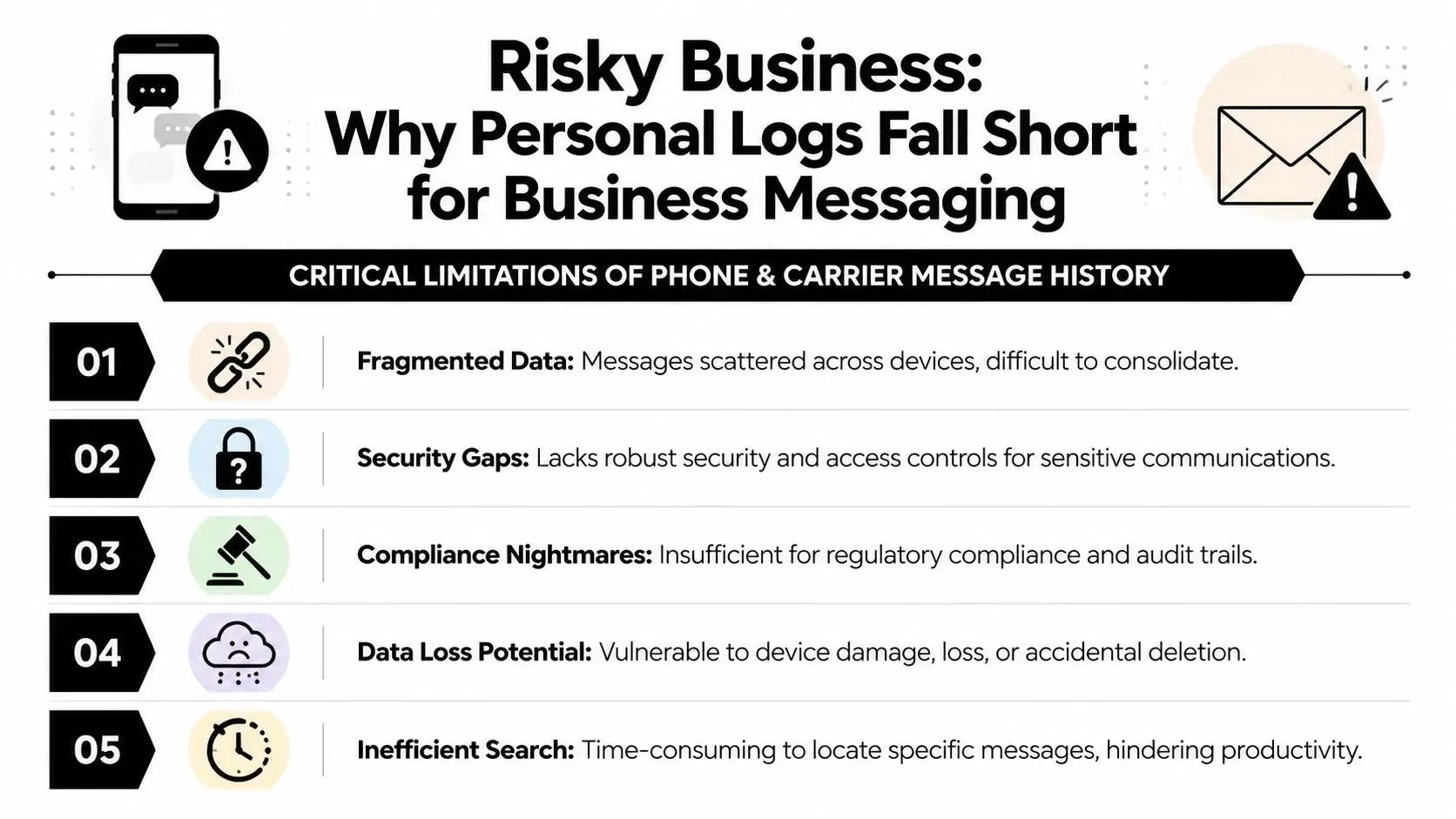
For personal recovery, this is usually enough. Search the device, check your backups, and recover what you can. But these tools were built for individuals, not for teams managing campaigns, customer consent, or regulated communication.
That's where the trouble starts. A personal device can help you find one missing message. It can't reliably serve as your organization's source of truth.
Where Your Text Message History Lives (and How to Get It)
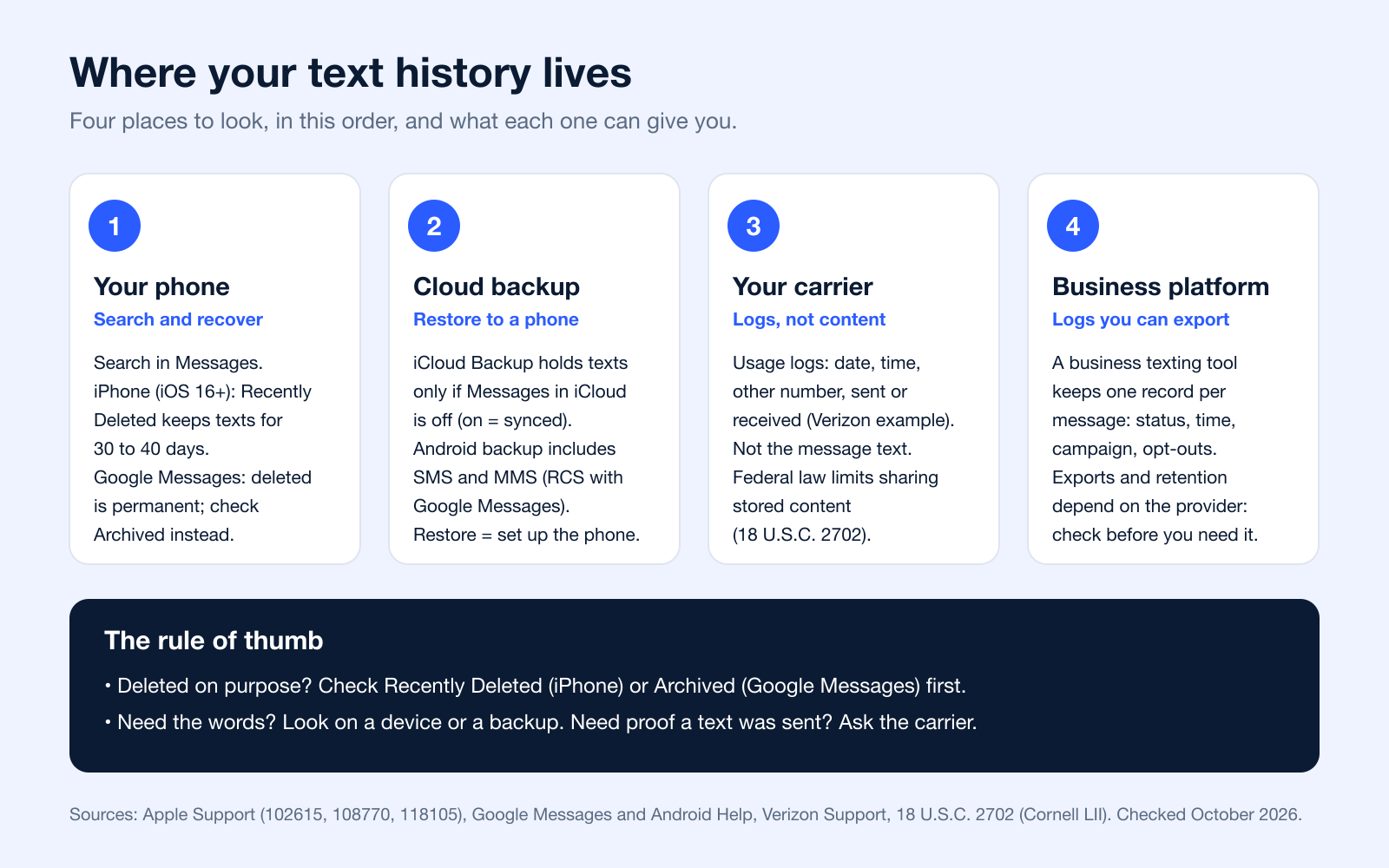
Text history is not stored in one place. Each copy gives you something different, so start with the one that matches what you need: the words of a message, or proof that it was sent.
| Where | What it holds | How to get it | Limits | Source |
|---|---|---|---|---|
| Your phone (Messages app) | Full conversations, photos and attachments | Search in Messages; on iPhone, Recently Deleted; in Google Messages, Archived | iPhone: deleted texts recoverable for 30 to 40 days (iOS 16 or later). Google Messages: a deleted conversation cannot be recovered | Apple; Google |
| Cloud backup or sync | A copy of your messages as of the last backup, or synced across your devices | iCloud Backup or a computer backup (iPhone); Google backup (Android); restored when you set up the phone | iCloud Backup includes messages only when Messages in iCloud is off. Restoring means setting up or erasing the phone | Apple; Apple restore; Android |
| Your carrier | Usage logs: date, time, the other number, sent or received | Your online account or bill (for example My Verizon usage); older records on request | Logs, not the text of the messages. Carriers must verify it is you before releasing call detail records | Verizon; 47 CFR 64.2010 |
| A business texting platform | A log of messages sent through the platform, with status and subscriber actions | Search or export from the platform | Only messages sent through that platform; retention and export options vary by provider | Your provider’s documentation |
How to Recover Deleted Text Messages
Act quickly. Recovery depends on two things: a recently deleted folder on the phone, and a backup made before the message was deleted.
On iPhone: Recently Deleted
With iOS 16 or later, Apple says you can recover messages and conversations you deleted within the last 30 to 40 days (Apple Support):
- Open Messages. On the conversations page, tap Filters (on iOS 18, tap Edit).
- Tap Recently Deleted.
- Choose the conversations with the messages you want, then tap Recover.
- Tap Recover Message (or Recover [Number] Messages).
If you use Messages in iCloud, a recovered conversation comes back on all your devices where Messages in iCloud is on. Messages removed with Undo Send are permanently deleted, and you cannot recover messages on anyone else’s device (iPhone User Guide).
On iPhone: Restore a Backup
If the text is past the Recently Deleted window, an older backup is the remaining option. An iCloud backup contains your iMessage, SMS and MMS messages only if Messages in iCloud was off; with it on, messages are synced to iCloud rather than stored in the daily backup (Apple). To restore from iCloud, Apple’s steps start from the Hello setup screen, and a phone you already set up has to be erased first (Apple). That replaces what is on the phone now, so make a fresh backup of the current state before you try it. A backup on a Mac or PC works the same way: you restore the whole phone, not one conversation.
On Android: Archived, Then Backup
In Google Messages, archived conversations are not deleted: tap More, then Archived, and unarchive them. A deleted conversation is different. Google says: "If you delete a conversation or message, it cannot be recovered. This action is permanent" (Google Messages Help).
What remains is your Google backup. It includes SMS and MMS messages, and RCS messages when you use Google Messages; it is restored when you set up a phone with the same Google Account, and the new phone must be on the same or a later Android version (Android Help). If your phone uses another messaging app, such as the one your phone maker installs, check that app’s help pages for a trash folder or its own backup.
Can You Get Text Message Records From Your Carrier?
Yes for a log, usually no for the content. That is the short answer to "how to get text message records".
What Your Carrier Shows You
Carriers list texts as usage. Verizon, for example, says its usage logs show whether a message was sent or received with the time and date, the number of messages, and the sender and recipient numbers. You can see usage in the My Verizon app or download a report, and Verizon asks you to contact it for usage and billing history older than 18 months; charges may apply (Verizon Support). Verizon also notes that if your phone is off, texts sent to you are stored for up to 5 days and delivered when it is back on service (Verizon). That is a delivery queue, not an archive.
We could not confirm the current policies of other carriers on their own pages, so check your online account or ask your carrier what it keeps and for how long.
What the Rules Say
- Your records are protected. Under the FCC’s rules on customer proprietary network information (CPNI), call detail information covers the numbers, time, location and duration of calls (47 CFR 64.2003). A carrier may give it over the phone only if you provide a password, online only after authenticating you without easy-to-find personal details, and in a store if you show a valid photo ID that matches the account (47 CFR 64.2010).
- You can send them to someone else. A carrier must disclose CPNI to any person you designate when you make an affirmative written request (47 U.S.C. 222(c)(2)).
- Content is different. Federal law says a provider of an electronic communication service to the public "shall not knowingly divulge" the contents of a communication in electronic storage, with listed exceptions such as the consent of the sender or recipient and legal process (18 U.S.C. 2702). In practice, the words of a text usually have to come from a phone or a backup.
If you need texts as evidence, read can text messages hold up in court for how they are usually collected and authenticated.
A Central Hub for Your Business Message History
A business-grade messaging log should work more like an operations dashboard than a chat app. You should be able to search by contact, list, campaign, date, and status. You should be able to confirm what happened without hunting through personal devices. And you should be able to see more than SMS alone if your outreach includes MMS, voice, or ringless voicemail.

What a central log should show
At minimum, the system should capture message status clearly enough that a marketer, coordinator, or compliance lead can use it without interpretation.
A practical setup includes:
| Need | What the log should show |
|---|---|
| Send visibility | Sent records tied to a campaign, workflow, or user action |
| Delivery review | Delivered, failed, or otherwise unresolved message states |
| Subscriber actions | Opt-out activity tied to the contact record |
| Searchability | Filters by date, contact, segment, or campaign |
| Exportability | Clean exports for review, reporting, or retention workflows |
That structure is what turns text message history into something operational. It reduces guesswork. It also keeps teams from relying on memory or screenshots when a customer issue lands.
Why channel unification matters
A lot of businesses no longer communicate through SMS alone. They send image-based MMS, automated reminders, voice broadcasts, and ringless voicemail drops as part of the same customer journey. If those histories live in separate tools, nobody has a complete interaction record.
A unified platform offers greater utility than separate apps stitched together. For example, Broadcast supports outbound messaging across SMS, MMS, voice broadcasting, and ringless voicemail, so teams can review communication history in one system instead of splitting records across phones and disconnected tools. That matters when a customer says they missed the text but listened to the voicemail, or when a team wants to verify whether a sequence was completed across channels.
If you’re trying to solve small business communication problems, this unified record is one of the first upgrades that removes friction for both staff and customers.
The overlooked workflow win
A central message hub doesn't just store records. It changes response time.
When support, sales, and operations can pull the same history from a browser instead of asking who has the phone, routine work gets easier. Email visibility helps too. Some teams route notifications and message activity into inbox workflows so managers don't have to log in constantly. If that setup matters for your process, it helps to understand how messages can flow to email without turning the inbox into the system of record.
The best message history isn't the one with the most data. It's the one your team can search, trust, and act on quickly.
That's the difference between archived communication and usable communication.
Using Message History for Strategy and Compliance
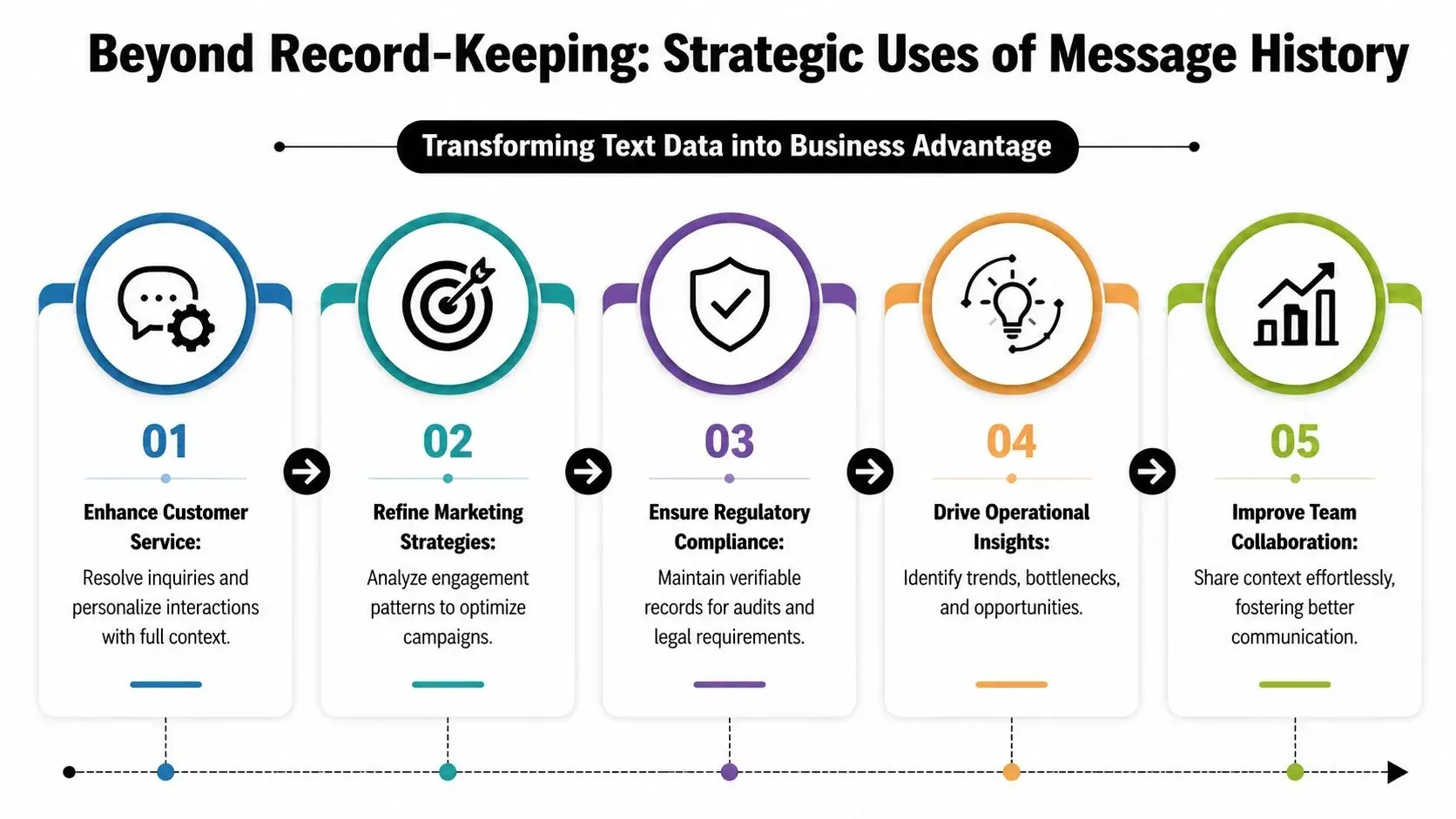
Once your history is centralized, the next step is to use it on purpose. Good teams don't just store message data. They apply retention rules, review outcomes, and use historical logs to improve campaigns, customer service, and compliance readiness.
Retention needs a policy, not a guess
If your organization operates under HIPAA or similar recordkeeping obligations, retention can't be left to individual users. The business needs a written rule for how long message logs are kept, who can access them, and what gets exported when records are requested.
A workable retention process usually includes:
- Role-based access: Limit who can view message content, exports, and subscriber history.
- Defined retention windows: Set a documented period based on internal policy and legal guidance.
- Export procedures: Make sure teams know how to retrieve records when needed.
- Opt-out verification: Keep suppression and consent events visible and reviewable.
Opt-out records matter for a specific reason: under the FCC rule, people can revoke consent to texts by any reasonable method, and the request must be honored within a reasonable time, no more than 10 business days (47 CFR 64.1200(a)(10)). A log that shows when the opt-out arrived and that nothing was sent afterward is the record you want. Healthcare teams have extra requirements; see HIPAA-compliant texting platforms.
For teams that want a concise baseline before setting internal policy, it helps to review our SMS compliance checklist and then adapt those practices to your actual workflows and legal requirements.
Use exports for diagnosis, not just storage
CSV export sounds boring until something goes wrong. Then it becomes one of the most useful features in the stack.
Exported logs help answer practical questions:
- Which campaign generated complaints You can isolate date ranges, lists, and copy variants to see where issues started.
- Which reminders created confusion If support keeps hearing the same question, the wording may need work.
- Which contacts should never have been messaged Export review is often where consent gaps and workflow mistakes become obvious.
- What happened before a dispute A clean history gives legal, operations, or management teams a timeline they can evaluate.
If your organization ever has to defend its messaging records, it's worth understanding when text messages can hold up in court and what makes documentation more credible.
Message structure affects the history you see
A single SMS holds 160 characters in the standard GSM-7 alphabet, or 70 if it includes an emoji or another character outside that set. Longer messages are split into segments of 153 (or 67) characters (Twilio). In practice, that means a customer may experience one long message while the system processes multiple related parts.
A professional log should group those parts correctly.
Without that grouping, teams end up reading fragmented records that look incomplete or out of order. On a personal phone, that's frustrating. In a business environment, it can distort what staff think was sent.
Compliance review gets messy fast when one customer message appears as several disconnected fragments.
History can improve strategy when you actually read it
The best operational teams review message history after campaigns, not only when there's a problem. They look for patterns in delivery issues, common reply themes, opt-out triggers, and timing problems. They also compare how text messaging and ringless voicemail are used together.
That's especially helpful when multi-step outreach is involved. A reminder text might work well for one segment, while ringless voicemail may fit another use case better, such as missed appointment follow-up, time-sensitive notices, or reactivation campaigns where hearing a voice adds context. History gives you the trail needed to judge sequence quality, not just whether something was sent.
Best Practices for Managing Your Message Data
Many teams don't need more messages. They need better control over message history.
The simplest way to get there is to treat messaging data like any other business system. Give it owners. Define the rules. Review it regularly. Don't let customer communication live only in the pockets of employees.
A practical operating checklist
Use this as a working standard:
- Set retention before you need it: Don't wait for a complaint, subpoena, or audit request to decide how long records should exist.
- Review opt-out activity often: Make suppression review part of routine operations, not an annual cleanup.
- Keep business texting off personal devices where possible: This reduces access confusion and lowers the risk of fragmented records.
- Export and review logs on a schedule: Message history is more useful when teams analyze it before problems pile up.
- Map history to customer records: Connecting messaging with your CRM gives support and sales much better context.
- Document channel usage: If you use SMS, MMS, and ringless voicemail, define when each should be used and how results are reviewed.
What works and what usually fails
What works is boring, consistent process. Centralized logging. Controlled access. Clear campaign naming. Subscriber status that staff can verify without asking around.
What fails is ad hoc messaging.
That includes shared phones with no ownership, screenshots used as records, one-off exports saved to desktops, and support teams trying to reconstruct history from memory. Those habits look harmless until a customer dispute, compliance review, or internal handoff exposes the gaps.
The real shift
When businesses start thinking clearly about text message history, they usually stop asking, “How do I find an old message?” and start asking, “How do we manage communication records correctly?”
That's the right question. It leads to better compliance, cleaner troubleshooting, stronger marketing review, and less operational mess. It also gives teams a better way to manage related channels like MMS and ringless voicemail without scattering records across tools and devices.
If your team needs a cleaner way to manage SMS, MMS, voice, and ringless voicemail records in one place, Broadcast is worth a look. It gives businesses a centralized messaging environment with searchable history, delivery tracking, opt-out visibility, and multi-channel communication workflows that are much easier to manage than phone-based logs.
Text Message History FAQ
Short answers to the questions people ask most about text history.
Can You Get a History of Text Messages?
Yes. Your phone keeps the full conversations, and you can search them in the Messages app. Your carrier can show a log of texts (dates, times and numbers) in your online account or on request, but not what the messages said (Verizon). Business texting platforms keep a log of the messages sent through them.
Can You Download an Entire Text Message History?
From your carrier you can download usage records, not message content. On your phone, the official tools are backups: iCloud or a computer backup on iPhone (Apple) and Google backup on Android (Android Help). These restore your messages to a phone; they are not a readable file. A business texting platform may let you export its message log; check what your provider offers.
Can I Get a Transcript of All My Text Messages?
Not from your carrier: logs show who, when and sent or received, not the words. The text itself is on your phone, in Messages in iCloud, or in a backup. If you need a transcript for a legal matter, ask a lawyer how it should be collected so it can be authenticated.
Can Text History Be Recovered?
Often, if you act fast. On iPhone with iOS 16 or later, check Recently Deleted: messages deleted in the last 30 to 40 days can be recovered (Apple). In Google Messages, a deleted conversation is permanent, so check Archived and then your Google backup (Google). Without a backup made before the deletion, recovery is unlikely.
Do Phone Carriers Keep the Content of Text Messages?
Carriers do not publish a message content archive for customers. Verizon’s usage logs, for example, list time, date and numbers, and texts waiting for a phone that is off are held for up to 5 days (Verizon). Federal law also limits when a provider can disclose stored content (18 U.S.C. 2702).


