
So you sent out a text campaign and the delivery rates are tanking. What gives? When you’re asking, "why are my text messages not being delivered," the answer usually comes down to three main culprits: aggressive carrier filtering, bad phone numbers, or compliance slip-ups.
Think of it like sending a letter. It can get lost for a few reasons: the address was wrong, the post office thought it was junk mail, or it broke some postal rule you didn't know about. Figuring out which of these is derailing your SMS campaigns is the first step to getting things back on track.
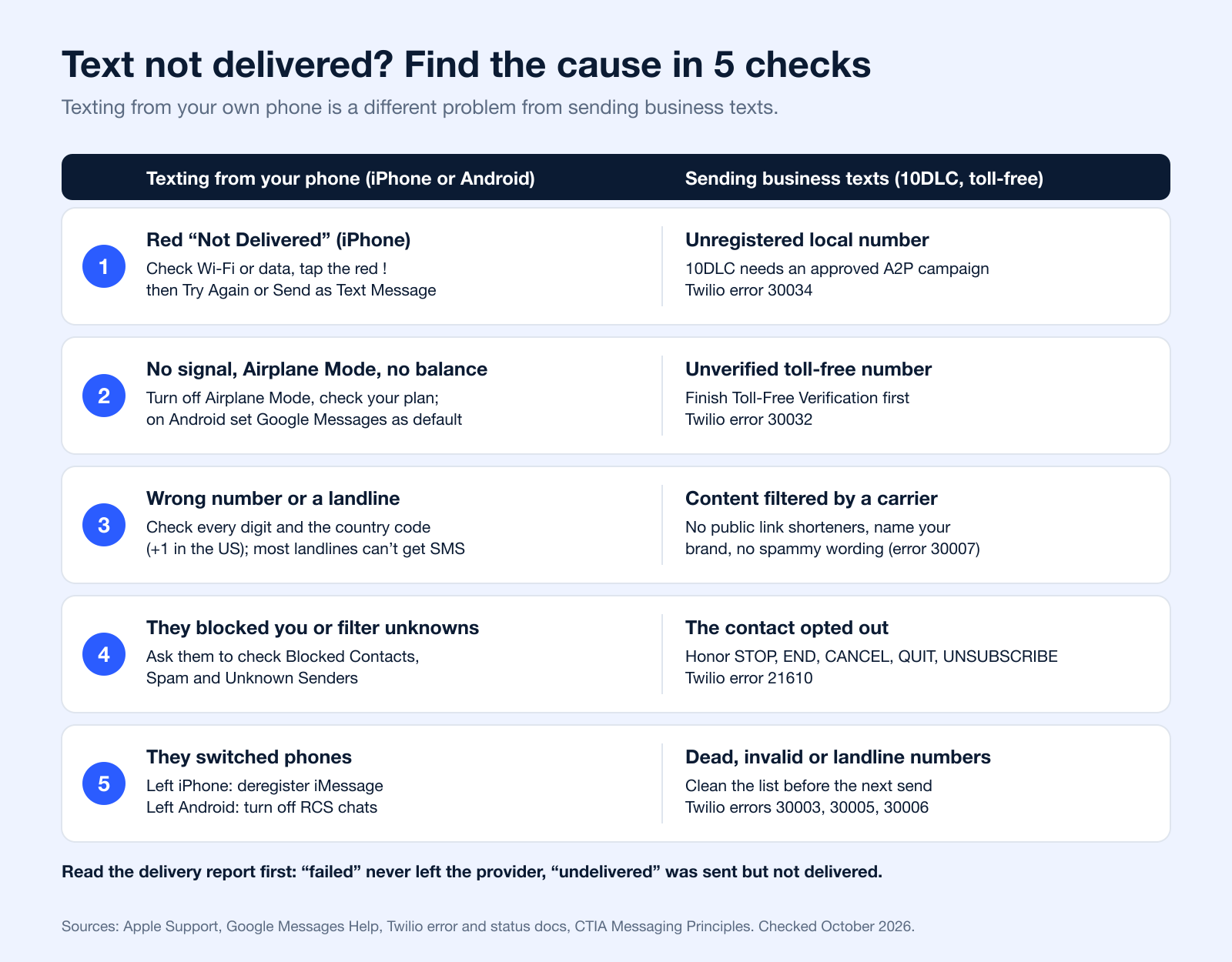
This guide covers both cases. If a text from your own iPhone or Android says it was not delivered, start with the phone checks. If you send business texts, the registration, opt-out and error code checks explain what each delivery status and error code means. And if the problem is texts you are not receiving, see our guide to not receiving texts from one person.
Text Not Delivered on iPhone or Android? Start Here
When the text comes from your own phone, the cause is usually on your phone, your line, or the other person's phone. Every fix below comes from Apple, Google or Twilio documentation checked in October 2026.
| What you see | Likely cause | What to do | Source |
|---|---|---|---|
| iPhone shows a red exclamation point and "Not Delivered" | No network connection, or iMessage could not reach the other person | Check Wi-Fi or cellular data, tap the red exclamation point, then Try Again. If it still fails, tap it again and choose Send as Text Message. | Apple |
| Nothing sends from your phone at all | No signal, Airplane Mode, or no balance on your plan | Turn off Airplane Mode, check signal, and check your plan or credit balance. Restart the phone. | Apple, Google |
| Android texts fail, or picture messages fail | Google Messages is not the default app, or mobile data or APN settings are wrong | Set Google Messages as the default texting app, update it, turn on mobile data for MMS, and reset APN settings. | |
| Texts to one number fail every time | A typo, a missing country code, or a number that no longer exists | Check every digit and save the number with its country code (+1 in the US). | Google, Twilio 30005 |
| Texts to an office or home number fail | Most landlines cannot receive SMS | Call instead, or confirm the number is a mobile line. | Twilio 30006 |
| Your texts to one iPhone friend stopped after they moved to Android | Their number is still registered with iMessage, so your iPhone keeps sending iMessages | They need to deregister iMessage, on the old iPhone or with Apple's online tool. Until then, Send as Text Message can get a single text through. | Apple |
| Texts to someone who left Android for iPhone stopped | RCS chats are still active for their number | They turn off RCS chats on the old phone, or deactivate RCS online if they no longer have it. | |
| Your texts look sent but the person never sees them | They blocked your number, or their phone filtered you as spam or an unknown sender | On iPhone, a blocked contact gets no notification that a message was blocked. Ask them to check their blocked list and their Spam and Unknown Senders folders. | Apple, Apple |
| Group texts with Android users fail on iPhone | MMS Messaging is off, or the carrier does not support it | Turn on MMS Messaging in Messages settings. If the option is missing, contact your carrier. | Apple |
What changed for iPhone and Android texting
- Since iOS 18, iPhones can text Android phones over RCS when the carrier supports it, so a failed text between the two can come from RCS settings as well as iMessage (Apple).
- In Google Messages, group chats can split into separate SMS or MMS conversations when a member temporarily loses their RCS connection (Google).
- On iPhone with iOS 26, spam filtering is on by default and texts from unknown senders can be screened into a separate list, which is why the other person may never see your first text (Apple).
If the problem is on the receiving side (someone's texts never reach you), our guide to not receiving texts from one person walks through blocked lists and filters on iPhone and Android step by step.
Your Quick Guide to Solving SMS Delivery Failures
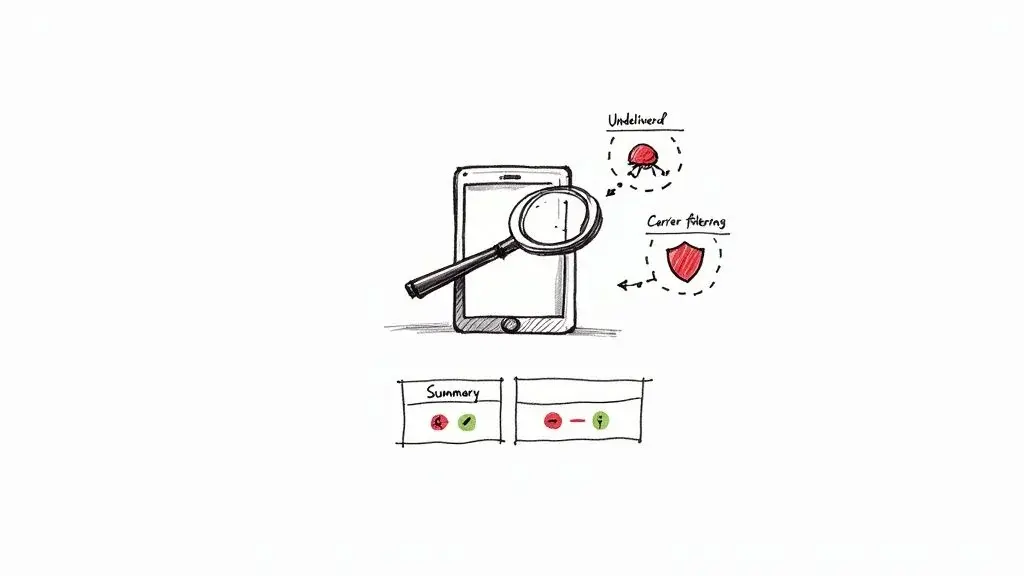
Hitting "send" on a text seems so simple, doesn't it? But behind the scenes, your message has to pass a whole series of checkpoints before it ever lands in someone's inbox. Mobile carriers like Verizon and AT&T are the gatekeepers here, and their number one job is shielding their customers from spam.
And they've gotten really serious about it. The explosion of smishing attacks and fraudulent messages has forced their hand. In the US, people reported $470 million in losses to text scams in 2024, more than five times the 2020 number, according to the FTC. Since 2023, the FCC has also required mobile providers to block texts that appear to come from invalid, unallocated or unused numbers (FCC 23-21). To fight back, carriers have built some incredibly sophisticated filtering systems.
The only problem? Sometimes, these systems get it wrong and flag legitimate business messages as spam. The FTC's top text scams of 2024 shows what carriers are up against.
The Most Common Delivery Blockers
A few key issues are responsible for the vast majority of delivery failures. Get to know them, and you'll be able to diagnose problems in no time.
- Aggressive Carrier Filtering: Carriers use complex algorithms to spot and block anything that looks like spam. This could be anything from certain keywords to suspicious-looking links.
- Invalid or Inactive Numbers: If you text a number that's a landline, has a typo, or simply isn't in service anymore, that message is going nowhere. It’s an instant dead end.
- Opt-in and Compliance Issues: This is a big one. Texting people who never gave you explicit permission, or sending marketing texts to numbers on the National Do Not Call Registry without their permission, is a surefire way to get your messages blocked and your number flagged.
Here’s a good way to think about it: your SMS platform is the car, your message is the passenger, and the carrier network is the entire highway system. If the car's registration is expired (a non-compliant sender ID), the passenger looks shady (spammy content), or you punched in the wrong address (invalid number), you're never going to reach your destination.
This is also why having a backup plan with tools like ringless voicemail can be a smart move. This technology, also known as a ringless voicemail drop, bypasses many SMS roadblocks, ensuring your message is heard even when texts fail.
To give you a head start on troubleshooting, we’ve put together a quick-reference table. It breaks down the most common issues, what they usually look like in your reports, and the very first thing you should do to fix them.
Common Reasons for SMS Delivery Failure at a Glance
| Issue | Common Symptom | First Action Step |
|---|---|---|
| Carrier Filtering | Messages marked "Undelivered" with no specific error code. | Review your message content for spam triggers like shortened URLs or all-caps words. |
| Invalid Number | An immediate "Delivery Failed" error message or bounceback. | Clean your contact list using a number validation tool before your next send. |
| Opt-Out Status | A spike in complaint rates or a specific carrier blocking your number. | Double-check that the contact hasn't previously unsubscribed from your list. |
| Sender ID Issues | Widespread delivery failures happening across all carriers at once. | Confirm your sending number (like a 10DLC) is fully registered and verified. |
| Unregistered 10DLC or unverified toll-free number | Every message from that number fails with a registration error (Twilio 30034 or 30032). | Register the A2P 10DLC campaign or finish Toll-Free Verification before sending again. |
| Recipient switched phones | Texts to one iPhone user fail after they moved to Android. | Ask them to deregister iMessage; see the phone checks above. |
This table should help you quickly diagnose the most likely culprit, so you can stop guessing and start fixing the real problem.
Business Texts Not Delivered? Check Registration, Opt-Outs and Error Codes
If you send texts from a business platform, three things decide whether a message can be delivered at all, before content filtering even starts: the sending number is registered, the contact has not opted out, and the number can receive texts. Your delivery report tells you which one failed.
Register your 10DLC or toll-free number
- Local numbers (10DLC): since September 1, 2023, Twilio requires all SMS and MMS sent to US numbers from +1 10DLC numbers to go through an approved A2P campaign. Unregistered traffic is blocked with error 30034 (Twilio). See our 10DLC compliance guide for the registration steps.
- Toll-free numbers: since January 31, 2024, texts from unverified toll-free numbers to US and Canadian mobile numbers are blocked with error 30032 until Toll-Free Verification is approved (Twilio).
- Short codes: if you send from a short code, the recipient's wireless plan may not support short code messages, which shows up as an unreachable handset error (Twilio 30003).
Respect opt-outs and the Do Not Call Registry
CTIA expects senders to treat STOP and normal-language requests such as end, unsubscribe, cancel and quit as opt-outs, send one confirmation, and then stop (CTIA). Messaging providers enforce it: Twilio rejects a message to a contact who opted out with error 21610 (Twilio). Since December 2023, the FCC also applies National Do Not Call Registry protections to marketing texts: you need the person's permission before sending a marketing text to a registered wireless number (FCC 23-107). For how to collect consent that holds up, see our guide to opt-in texts.
What each delivery status means
Platforms name statuses differently, but most follow the same steps. Twilio's definitions are a good reference (Twilio):
| Status | What it means | What to check |
|---|---|---|
| Failed | The message never left the provider (for example a queue overflow, an account suspension or a media error). | Your account, sending number and message format. |
| Sent | The nearest upstream carrier accepted the message. | Nothing yet; wait for the delivery receipt. |
| Delivered | The provider received confirmation of delivery from the carrier and, where available, the handset. | Nothing; if the person says they never saw it, the phone filtered or hid it. |
| Undelivered | A delivery receipt says the message was not delivered, for example because of carrier content filtering or an unreachable handset. | The error code that comes with it (table below). |
Our guide to delivery status notifications explains how these receipts work.
Common SMS error codes and the first fix
Error codes differ by provider. These are Twilio's, which many platforms pass through or mirror:
| Code | Meaning | First fix | Source |
|---|---|---|---|
| 30003 | Unreachable destination handset: the phone is off, has no service, or cannot receive SMS | Retry later; if it keeps failing, check the line type | Twilio |
| 30005 | Unknown destination handset: the number may no longer exist | Remove or re-verify the number | Twilio |
| 30006 | Landline or unreachable carrier | Text a mobile number instead | Twilio |
| 30007 | Message filtered by Twilio or a carrier as spam or for breaking carrier rules | Review content and use case; contact support with message IDs if compliant | Twilio |
| 30032 | Toll-free number has not been verified | Complete Toll-Free Verification | Twilio |
| 30034 | Message from an unregistered 10DLC number | Register an A2P 10DLC campaign and attach the number | Twilio |
| 21610 | The recipient opted out of messages from your number | Do not resend; the contact has to opt back in | Twilio |
Landline errors are common on older lists. If you want to know which landlines can get texts at all, see can you text a landline phone.
Your Step-By-Step Troubleshooting Checklist
When your text messages aren't getting delivered, just guessing at the problem won't get you very far. You need a clear process to figure out what's wrong without pulling your hair out. This checklist walks you through a logical sequence, starting with the easiest and most common fixes, to help you systematically find the issue.
Think of it like being a detective. Your first job is to rule out the obvious culprits before digging into the more complicated stuff. This approach saves a ton of time and helps you zero in on the exact reason your messages are hitting a wall.
Start with Your Contact Data
More often than not, an undelivered text has nothing to do with fancy carrier algorithms or your message content; it’s just a bad phone number. Before you look at anything else, check the quality of your contact list. An invalid number is an automatic failure.
- Check for Obvious Typos: Take a quick look at a few of the failed numbers. See any extra digits, missing area codes, or maybe a letter where a number should be? You’d be surprised how often simple data entry mistakes are the problem.
- Verify Number Type: Are you accidentally texting landlines? Most landlines cannot receive a standard SMS, and providers report it with a specific error (Twilio 30006). Many validation tools can easily tell you if a number is mobile or a landline.
- Confirm the Number is Active: People disconnect and change their numbers all the time. A contact that was perfectly valid last month might be out of service today. That’s why keeping your list clean on a regular basis is so important.
A clean contact list is the bedrock of good deliverability. If you're sending to a list full of bad numbers, you’re not just wasting money; you're also hurting your sender reputation, which makes it even more likely that carriers will start filtering your future campaigns.
Confirm Consent and Opt-In Status
Okay, so the numbers themselves look good. The next step is to make sure you actually have permission to text them. Sending messages to people who haven't asked for them is the quickest way to get your number blocked by carriers. Consent isn't just a good idea; it's a hard requirement.
- Review Opt-In Records: Can you pinpoint exactly when and how a user gave you permission? Look for proof from a web form, a text-to-join keyword they used, or some kind of written consent. If you can't prove they opted in, you shouldn't be sending them messages.
- Check Against Your Unsubscribe List: Make sure the failed numbers aren’t on your main suppression list. It’s pretty common for someone to opt out on one channel, but a glitch in the system keeps them active somewhere else.
- Look for DNC Flags: Have you checked your list against the National Do Not Call Registry? Since December 2023 the FCC has applied Do Not Call protections to marketing texts, so texting a registered number without permission is a major compliance issue (FCC).
This visual breaks down the two possible paths your message can take once it enters the carrier network.
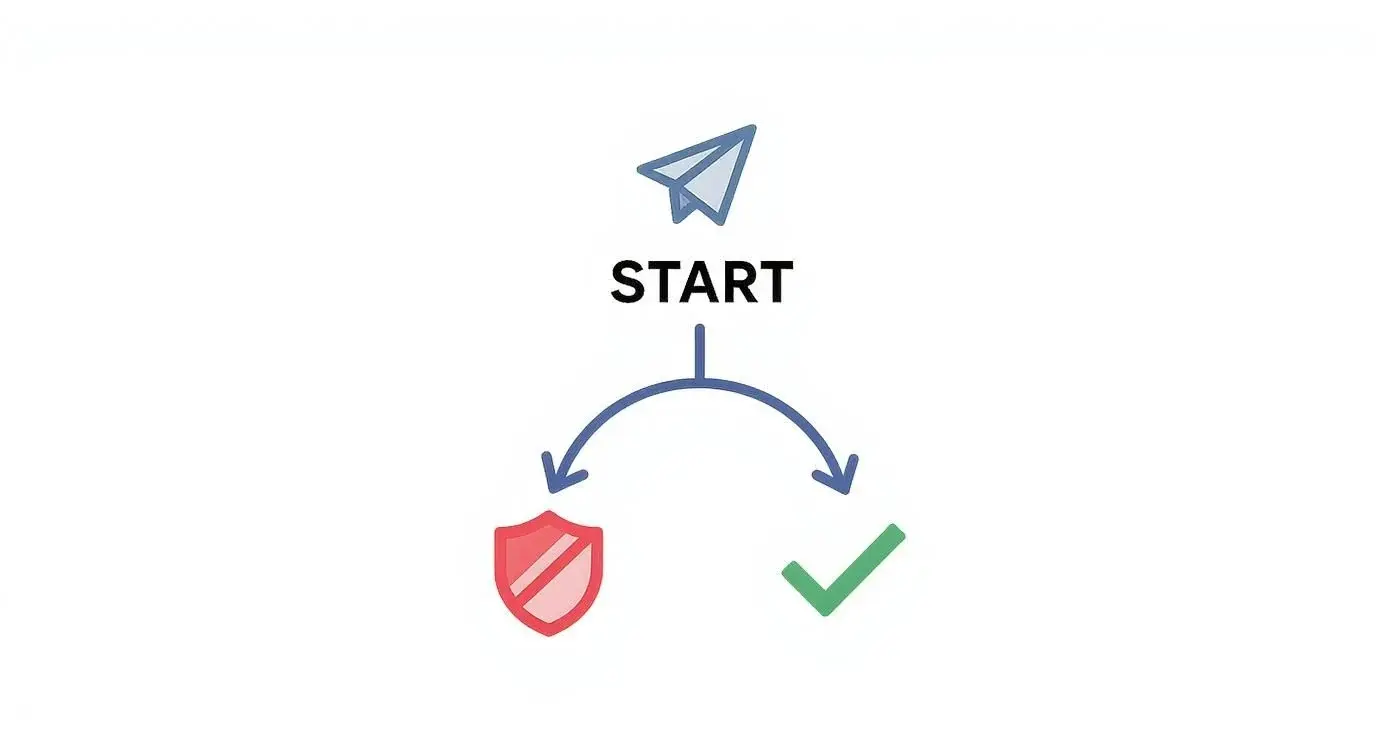
This simple flow shows that your message's fate is in the hands of the carrier's filters, which is exactly why following the rules is so critical.
Audit Your Message Content and Sender ID
If your numbers are clean and your consent is solid, it’s time to put the message itself under the microscope. Like we’ve talked about, carriers are on high alert for anything that even smells like spam.
Your sender number (whether it's a Toll-Free number or a 10DLC) also carries its own reputation. If that number has been linked to spammy behavior before, carriers will be much quicker to block its messages now. A real audit means looking at what you're saying and who is saying it.
Start by checking your message for these common red flags:
- URL Shorteners: Ditch the public shorteners like bit.ly. They’re a huge red flag. Use your full domain or get a branded short domain instead.
- Spammy Words: Get rid of trigger words related to debt, loans, or shady "get rich quick" offers.
- Formatting: No ALL CAPS and don't go crazy with the exclamation points!!! It just looks like spam.
Finally, dive into your delivery reports. Do you see a pattern where failures are happening with one specific carrier? Deeper insights from SMS tracking and testing tools can show you patterns that point right to the problem, helping you make precise adjustments. If all your texts are failing on one network but getting through on others, you’ve likely got a reputation issue with that specific carrier.
When the report shows an error code, match it against the error code table above. A registration error (30034 or 30032) affects every message from that number, so fix it before you look at content.
Building a Proactive SMS Delivery Strategy
Playing whack-a-mole with delivery problems after they pop up is exhausting and inefficient. A far better game plan is to be proactive, building a strategy that stops these issues before they even start. It’s a shift in mindset: moving from fixing individual failures to creating a tough-as-nails SMS program designed for maximum deliverability from day one.
This isn't about some magic bullet. It’s about putting a series of best practices into play that, taken together, build trust with mobile carriers and make sure your audience actually wants to get your texts. Think of it as preventative maintenance for your campaigns. A little work upfront saves you a world of hurt later.
Cultivate a High-Quality List with Double Opt-In
The absolute foundation of a killer SMS program is a clean, engaged list of people who have explicitly agreed to hear from you. The single best way to get there? Double opt-in.
Instead of just adding a number to your list the moment they sign up, you send a confirmation text first. Something simple, asking them to reply "YES" to confirm.
This extra step is a powerhouse. First, it proves the phone number is real and active. Second, it gives you undeniable proof of consent, which is your ironclad defense against any spam complaints. A list built this way will always outperform others, with higher engagement and way fewer delivery fails.
Practice Regular List Hygiene
Contact lists aren't set-it-and-forget-it. They get stale over time as people switch numbers or just lose interest. That’s where regular list hygiene comes in. It's like weeding a garden: you have to pull out the unhealthy contacts so the whole system can flourish.
Make these tasks a regular part of your routine:
- Remove Invalid Numbers: Keep an eye out for hard bounces or carrier error codes that signal a number is out of service. Scrub them from your list continuously.
- Honor Opt-Outs Immediately: When someone texts back "STOP," "CANCEL," or "UNSUBSCRIBE," get them off your active list instantly. CTIA also lists "END" and "QUIT" and expects senders to act on plain-language requests like "please opt me out" (CTIA). Not doing so is a huge compliance no-no.
- Re-engage or Remove Inactive Subscribers: If a contact hasn't clicked a link or engaged with your texts for a few months, try a re-engagement campaign. If they still don't bite, it's usually best to let them go.
Segment and Schedule for Maximum Impact
Blasting the same generic message to your entire list at once is a surefire way to kill engagement and trip carrier spam filters. The smarter move is to use segmentation and thoughtful scheduling.
Segmentation is just dividing your audience into smaller, more focused groups based on things they have in common, like what they've bought, where they live, or how engaged they are.
This lets you send super-relevant, personalized messages that feel more like a one-on-one chat than a mass broadcast. For example, instead of a generic sale announcement, you could send a special offer to customers who previously bought a specific product. That kind of relevance sends open rates through the roof and cuts down on spam complaints.
The goal is to make every message feel expected and valuable to the recipient. When people look forward to your texts, they are far less likely to mark them as spam, which directly improves your sender reputation with carriers.
Likewise, scheduling your campaigns to go out at the right times (avoiding 2 AM texts or flooding the networks with huge spikes in volume) shows carriers you're a responsible sender. Many of the same ideas behind improving deliverability for other digital communications apply here. It all boils down to sending the right message to the right person at the right time.
For how carriers score sender reputation over time, see our guide to spam risk.
For anyone looking to put this into practice, exploring a solid SMS deliverability platform can give you the tools to automate segmentation and scheduling, making this whole process a lot easier.
Exploring Ringless Voicemail as a Strategic Alternative
Sometimes, even with the perfect strategy, your texts just won’t land. You've audited your content, scrubbed your lists, and you're still hitting that invisible wall of carrier filtering. It’s frustrating. When you’ve tried everything, it's time to think differently.
Instead of trying to smash through that wall, what if you could just go around it?
This is where having a strategic alternative in your back pocket is so valuable. A different channel can make sure your most important messages get through, especially when SMS is being difficult. One of the most effective and compliant options out there is ringless voicemail.
What Is Ringless Voicemail
Picture this: you can drop a personalized audio message directly into someone's voicemail box, but their phone never actually rings. That's the magic of ringless voicemail. It’s a non-intrusive way to connect that completely bypasses the live phone call, placing your message right where your contact can listen when it’s convenient for them.
Because it doesn't interrupt their day, it’s seen as a much more respectful way to communicate. But more importantly, it completely sidesteps the aggressive filtering systems that scrutinize every single SMS message you send.
Ringless voicemail doesn’t rely on carrier text gateways. This means common SMS delivery problems (like keyword flags, URL filtering, and volume throttling) simply don’t apply, offering a reliable path for your message.
This makes it an excellent tool to have ready to go, particularly when you’re troubleshooting why your texts aren't being delivered and you need a guaranteed way to reach your audience. For anyone looking to add this to their outreach, checking out a dedicated ringless voicemail service is the logical next step.
Key Advantages of Ringless Voicemail Drops
The upsides here go way beyond just getting around filters. This approach offers some unique advantages that can drive higher engagement and create a better experience for certain types of messages.
Here are the main benefits:
- Guaranteed Message Delivery: Since the technology connects directly to the voicemail server, it avoids all the carrier filtering that plagues SMS. If the voicemail box is active, your message gets delivered. Simple as that.
- Higher Engagement Rates: The personal touch of a real human voice can be far more powerful than plain text. Hearing your tone can build trust and drive a much stronger response, especially for follow-ups and reminders.
- Consent Rules Still Apply: Ringless voicemail is not exempt from the TCPA. In November 2022 the FCC ruled that ringless voicemail to wireless phones is a "call" made with a prerecorded voice, so it requires the consumer's consent (FCC 22-85). Used with consent for informational messages and follow-ups, it respects privacy and avoids the headaches of unsolicited calls.
- Cost-Effective Outreach: Most platforms only charge you for successfully delivered voicemails, so you're not burning your budget on inactive numbers or failed attempts.
These advantages make ringless voicemail an incredibly powerful tool for those specific, high-value communications. It’s not meant to replace SMS, but to act as a strategic partner that ensures your most important messages are always heard, no matter what hurdles the carrier networks throw in your way.
This is general information, not legal advice. Check consent requirements with counsel before you add a new channel.
Frequently Asked Questions About Text Message Delivery
Even after you've gone through the troubleshooting checklist, some lingering questions can pop up. You know, those tricky, "what about this specific scenario?" moments that can leave you scratching your head.
Let's dive into a few of the most common ones. Getting these details right is what separates the novices from the pros, helping you navigate the sometimes-weird world of carrier rules and get your messages delivered.
Why are my iPhone messages not delivering?
Check your Wi-Fi or cellular data first, because iMessage and RCS need a data connection. Then tap the red exclamation point next to the message and choose Try Again, or Send as Text Message if it still fails (Apple). If texts to only one person fail and they recently switched to Android, their number is probably still registered with iMessage; they need to deregister it.
Why are my text messages not sending to one person?
When everyone else gets your texts, the cause is usually that number: a typo or missing country code, a landline, a number that is no longer in service, a block on their side, or an old iMessage or RCS registration after they changed phones. Our guide to not receiving texts from one person covers what they can check on their phone.
Why does my text message say failed to send?
"Failed" means the message never left your phone or your provider. On a phone, that is usually no signal, Airplane Mode, no plan balance or a messaging app problem (Google). On a business platform, a failed status points to the account, the sending number or the message format, while undelivered means a carrier rejected it (Twilio).
Why is my message sent but not delivered?
"Sent" only means the first carrier accepted the message. It stays undelivered when the recipient's phone is off or out of service, the number no longer exists, or a carrier filtered the message (Twilio 30003, Twilio 30007). On iPhone, if the person blocked you, you get no notification of it (Apple).
Why are my business text messages not delivering?
Start with registration: unregistered 10DLC numbers and unverified toll-free numbers are blocked outright (Twilio errors 30034 and 30032). Then check opt-outs, invalid or landline numbers, and content that carriers filter, such as public link shorteners. The error code table above maps each code to its first fix.
Could My Phone Number Type Be the Problem?
Absolutely. The type of number you send from (whether it's a Toll-Free number, a local 10-digit long code (10DLC), or a dedicated short code) plays a massive role in deliverability. Carriers treat each one differently, and they’re all designed for different jobs.
Think of it like shipping a package. A short code is like a dedicated freight truck: it's the fastest and most reliable for huge volumes, but it’s also the priciest. A Toll-Free number is like a premium courier; it's fantastic for business messaging and way less likely to get filtered than an unregistered local number.
Using a standard 10DLC number for mass texting without the proper A2P (Application-to-Person) registration? That’s like trying to ship a package with the wrong postage. Carriers will flag it as suspicious traffic and will probably block it as spam. The bottom line: make sure your number type matches your sending volume and is correctly registered.
Registration applies to toll-free numbers too: since January 31, 2024, unverified toll-free numbers can't text US and Canadian mobile numbers until Toll-Free Verification is approved (Twilio).
What Are Carrier Error Codes and How Do I Find Them?
Carrier error codes are your single best diagnostic tool. They are specific messages sent back from the mobile carrier telling you exactly why a text failed. They take all the guesswork out of the equation.
Instead of wondering if it was a spam filter or a disconnected number, the error code gives you the straight answer. Common reasons you'll see include:
- The number is invalid or no longer in service.
- The recipient has blocked your number.
- The carrier flagged the message as spam.
- The recipient's phone is off or out of range.
You can almost always find these codes in the detailed delivery reports inside your SMS platform. Digging into them is a non-negotiable troubleshooting step. It lets you clean up your contact list and tweak your strategy based on direct, actionable feedback from the networks themselves.
Why Are Messages Delivered to Some Carriers but Not Others?
This is a super common scenario, and it can be really confusing. It all comes down to the fact that each mobile carrier (think AT&T, Verizon, and T-Mobile) is its own independent network with its own unique filtering rules.
What AT&T’s algorithms consider perfectly fine might get blocked by Verizon for any number of reasons. One carrier might be hyper-sensitive to certain keywords, while another might have stricter daily sending limits for your number type. This is exactly why you might see great delivery to subscribers on one network and a high failure rate on another, even when sending the exact same message.
This carrier-specific filtering is why monitoring your delivery reports broken down by network is so important. It helps you identify targeted delivery problems, allowing you to adapt your content or sending cadence to better align with the rules of the problematic carrier.
If you find that SMS delivery is consistently unreliable across certain networks, having an alternative like ringless voicemail becomes a powerful asset. Because a ringless voicemail drop delivers directly to the voicemail server, it completely sidesteps these carrier-specific SMS filters, ensuring your message is heard.
Do URL Shorteners in Texts Cause Delivery Issues?
Yes, this is a big one. Using generic, public URL shorteners (like bit.ly) is a huge red flag for carrier spam filters. Scammers have abused these services for years to hide malicious links, so carriers have gotten extremely aggressive about blocking messages that contain them.
While they're tempting for saving character space, the risk to your deliverability is just too high. Using them basically signals to carriers that you might be hiding something, which instantly kills trust. A much safer and more effective approach is to use a full domain you own or a custom short domain branded to your business.
This strategy does two key things:
- Builds Carrier Trust: It shows the networks you're a legitimate sender with nothing to hide.
- Improves User Confidence: People are far more likely to click a link when they can clearly see where it’s going.
Investing in a custom short domain is a small step that pays off big time with better delivery rates and campaign performance.
Ready to overcome SMS delivery hurdles and ensure your messages always get through? Broadcast provides the tools you need, from compliant Toll-Free numbers and advanced analytics to a powerful ringless voicemail system that bypasses carrier filters entirely. Start your free trial today and see how easy reliable outreach can be.


