
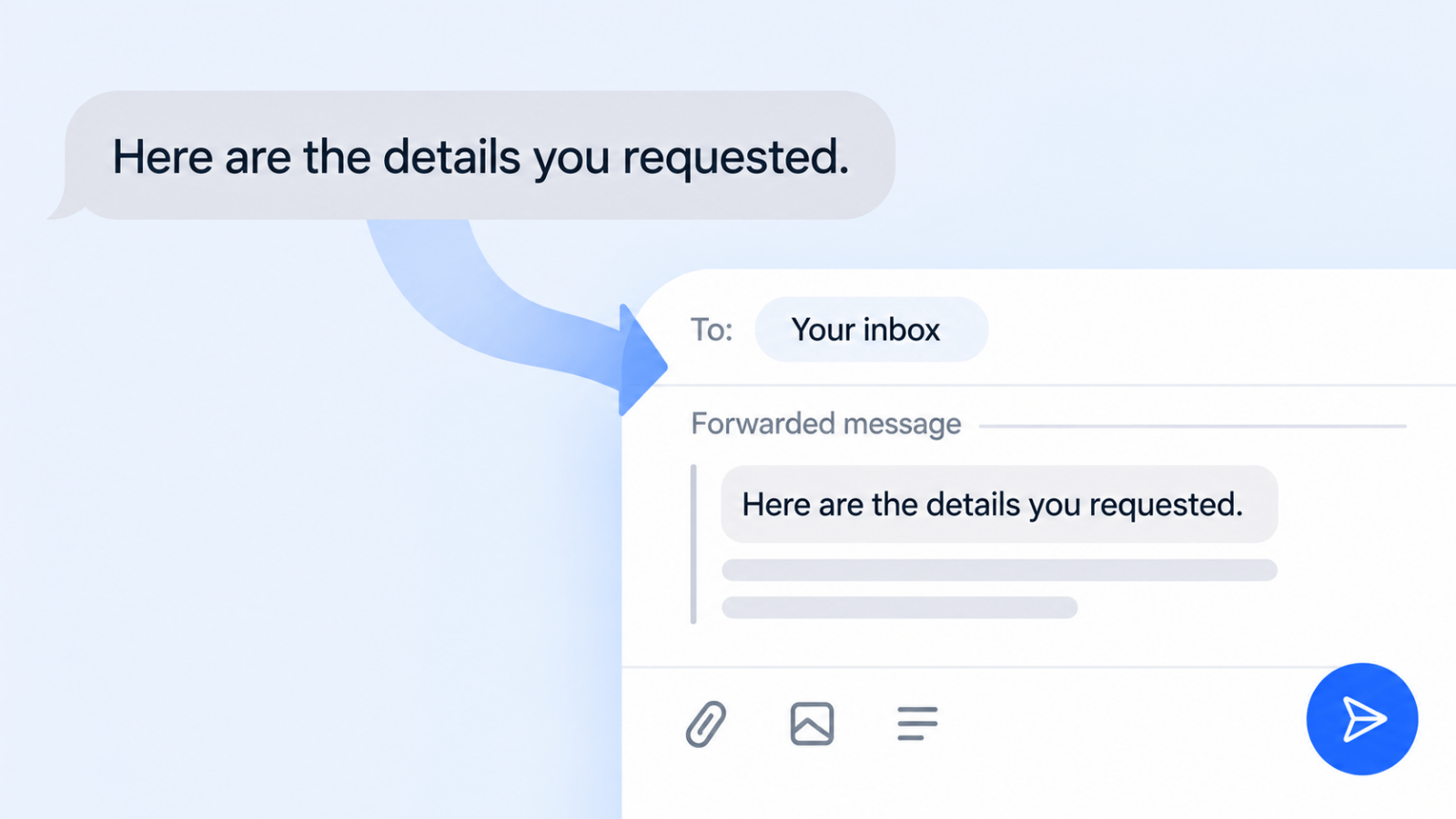
You already know the symptom. A customer text comes in after hours, a technician replies to the wrong thread, or a lead message sits on one phone while the person who usually handles it is out sick. By the time anyone notices, the context is half gone and the team is guessing. Forwarding a text message to email fixes that specific kind of failure, because it moves the message into the inbox where teams already sort, assign, archive, and escalate work.
The reason this matters is simple. Texting reaches almost everyone: 98% of U.S. adults own a cellphone, according to the Pew Research Center, and Americans exchanged nearly 2.2 trillion SMS and MMS messages in 2024, according to CTIA's 2025 Annual Survey. Those numbers don't measure forwarding itself, but they explain why businesses route text into email. SMS is the fast, visible channel, while email is still the working layer for routing, collaboration, and recordkeeping.
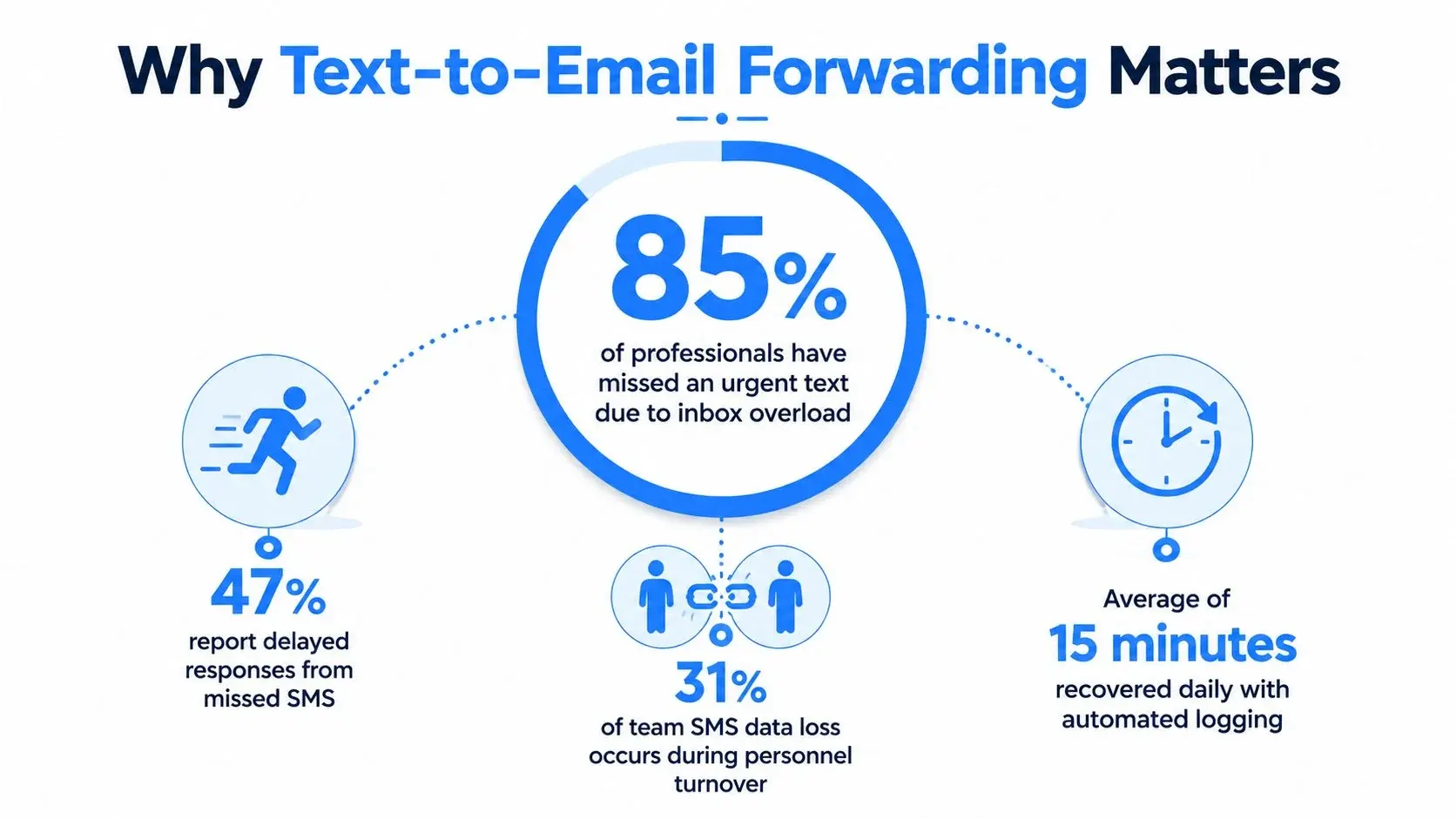
For an individual, forwarding can be a convenience. For a business, it's an operational control point. A missed SMS from a customer, dispatcher, or patient can become a missed handoff, and a missed handoff usually costs more than the message itself. The best method depends on whether you need a one-off transfer, a repeatable personal workflow, or a system that survives staff turnover and shift changes.
Why Forwarding Text Messages to Email Matters for Your Workflow
A missed text often shows up as a small mistake at first. Someone sees it later, replies from memory, and the thread becomes a mix of context, corrections, and follow-up questions. That's how a simple SMS turns into a longer admin problem, especially when the message was meant for a shared team rather than a single phone.
The operational value is in the handoff
Email solves the part SMS struggles with. It gives you archiving, routing, and collaboration, which is why forwarding is so useful when a message needs to land in a shared inbox or a CRM workflow. In practice, the team gets one place to review the message, assign it, and keep it tied to other records.
That matters most when the message is urgent. Support requests, appointment reminders, lead follow-up, dispatch notifications, and after-hours service issues all benefit from being visible where the team already works. The point isn't to replace SMS. The point is to keep the speed of SMS and remove the fragility of a single handset.
Personal convenience is not the same as business continuity
Manual forwarding on a phone works fine when one person wants a copy of an important text. It breaks down when a second person needs the same message, or when the original recipient is on vacation, in the field, or no longer with the company. Once a business depends on that message path, you need something more durable than a tap-and-forward habit.
Practical rule: if a text matters after the current shift ends, it needs to land somewhere shared.
That's a useful dividing line for any team. Occasional forwarding is a personal convenience problem. Shared forwarding is a workflow design problem. The rest of the methods below map to that split, from native phone features to automation and, eventually, broader messaging systems.
Native Forwarding Methods on iPhone and Android
A phone can still handle a one-off text-to-email handoff, and that is where native forwarding makes sense. One setting name causes confusion on iPhone: Text Message Forwarding (with Messages in iCloud) makes the SMS, MMS and RCS texts on your iPhone also appear on your Mac, iPad and Apple Vision Pro when they use the same Apple Account (Apple Support). It syncs texts to your own Apple devices; it does not send them to an email inbox. To get a text into email you forward, share, copy or screenshot it, as described below.
iPhone works best for occasional, controlled forwarding
Apple documents the forward flow in the iPhone User Guide: open the conversation in Messages, touch and hold the message bubble, tap More, select one or more messages, tap the Forward button, enter the recipient, and tap Send. Whether an email address works as the recipient depends on the address and your carrier, so the dependable routes to email are to copy the text and paste it into a new email, or to take a screenshot and share it to Mail. Apple's own tip: a screenshot shows the message bubbles and timestamps just as they appear in the conversation.
Manual taps do not scale once texts arrive faster than one person can forward them. The failure pattern is common: a team starts with a free, familiar workflow, then a message gets skipped during a busy shift, or the wrong thread gets copied because the operator is moving too fast.
Android usually relies on manual share or forward flows
On Android, the typical path is different. In Google Messages, touch and hold the message and tap Forward (or Select more to pick several), per Google Messages Help. Google describes Forward as sharing the message "with other contacts or groups". Typing an email address in the recipient field works with many carriers, which convert the text into an email, as Parseur describes, but not everywhere; if it fails, use Share, copy and paste, or a screenshot. That is fine for ad hoc use and quick personal copies, but it leaves the burden on the person at the screen to keep the record intact.
Google Messages also does not behave like a universal native forwarding system: Google's help documents no setting that forwards every text to email automatically (checked October 2026). Google Voice is separate. Google Voice users report a Forward messages to email option under Settings > Messages on voice.google.com (Google Messages community thread), and it only covers texts sent to your Google Voice number, not every SMS on the phone. That distinction matters because Android users often assume one device-wide rule exists when the actual behavior depends on the app, the account, and the forwarding path.
7 Ways to Get a Text Into Email, Compared
| Method | Works on | Automatic | What to know | Source |
|---|---|---|---|---|
| Forward in Messages (iPhone) | iPhone | No | Email as recipient may not work; best for Apple contacts | Apple |
| Forward in Google Messages | Android | No | Email recipient depends on the carrier | |
| Copy and paste into an email | Any phone | No | Works everywhere; add the sender and time yourself | Built into every phone |
| Screenshot shared to email | Any phone | No | Keeps bubbles and timestamps as they appear | Apple |
| IFTTT "Forward Android SMS to your Email inbox" | Android only | Yes | Needs the IFTTT Android app; carrier rates may apply | IFTTT |
| Google Voice | Google Voice number only | Reported by users for texts; official for voicemail | Covers texts to your Voice number, not your mobile number | |
| Business texting platform | Business number | Depends on the platform | Shared inbox and integrations instead of a personal phone | Vendor documentation |
If you need old conversations rather than one message, see how to find and keep your text message history.
A native workflow is short and manually controlled. It works for occasional copies, not for shared records, compliance review, or anything that has to survive shift changes and phone turnover. When the message needs to be reliable after the current handoff, the phone alone is the weak link.
The same gap shows up in internal workflows that need more structure, which is why some teams move to Broadcast's Zapier integrations once manual forwarding starts creating missed follow-ups.
Automating Text to Email with Zapier IFTTT and Google Voice
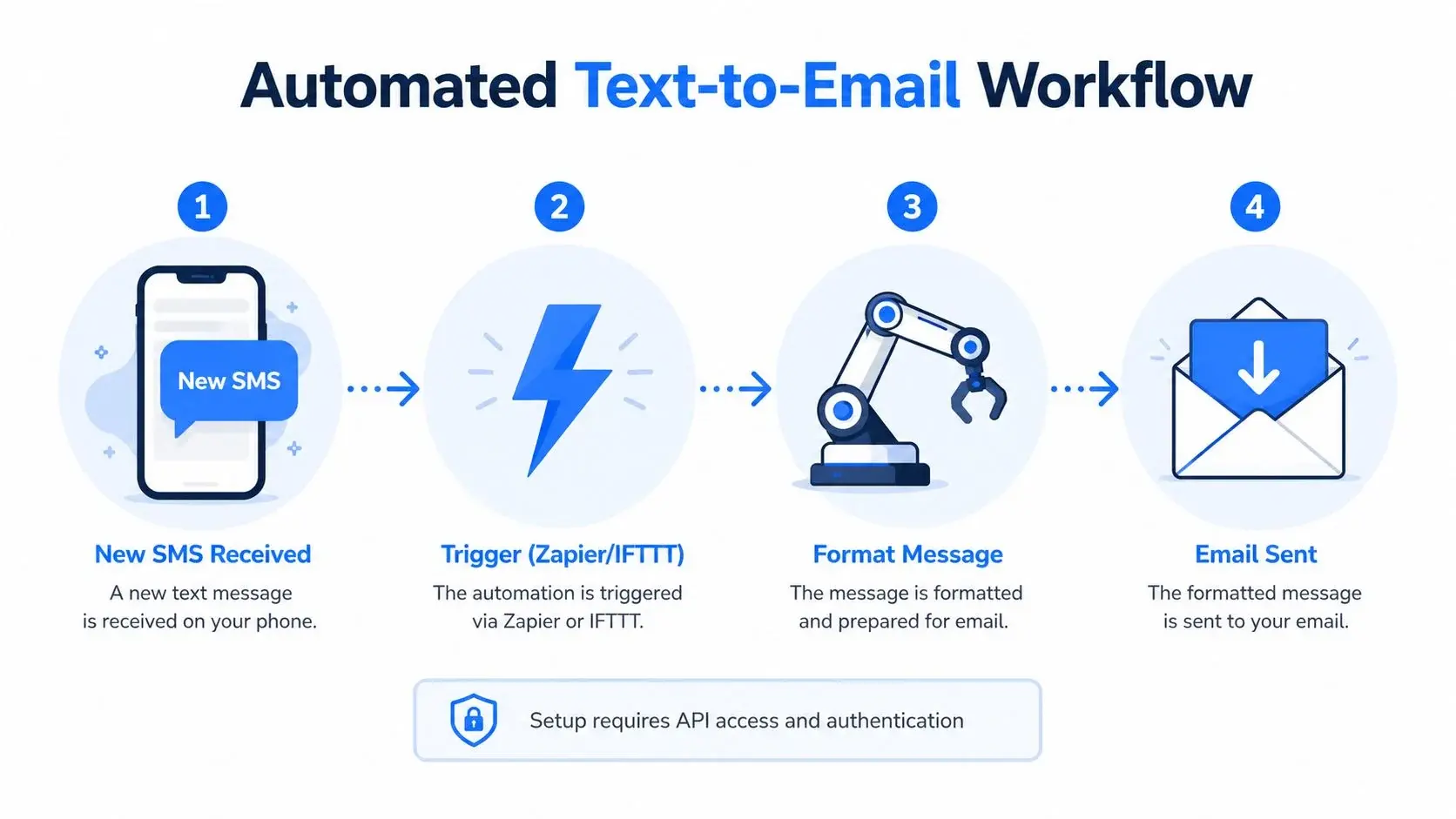
A forwarding rule only helps if it catches the text every time, keeps enough context to act on, and lands in an inbox people watch. Once a message has to be visible, searchable, and assigned without relying on someone's memory, the workflow needs to fire automatically the moment the SMS arrives. The better setups preserve the sender number, timestamp, and message body, then route a readable email to the right place instead of asking a person to copy the details by hand.
Build around the event, not the phone screen
Event-driven automation is the cleanest pattern. Capture the inbound SMS trigger, include metadata such as the sender number, timestamp, message body, and conversation ID, then build a subject line that gives the next person enough context to sort the message without opening extra tabs. On Android, IFTTT offers this as a ready-made applet, "Forward Android SMS to your Email inbox"; it needs the IFTTT app on the phone, and IFTTT has no equivalent SMS trigger for iPhone. That subject line carries more weight than it looks like, because a triage queue works faster when the case or account reference is visible before anyone opens the email.
Google Voice gives some users a built-in starting point for texts sent to a Google Voice number. Users report a Forward messages to email switch under Settings > Messages; Google officially documents the voicemail version (Settings > Voicemail > Get voicemail via email, per Google Voice Help). Either way, it needs a test run before anyone trusts it for live operations.
Filters and inbox design make the difference
IFTTT and Zapier become useful once you add rules. Automation tools can filter by contact or by keywords such as invoice, support, or urgent, and Android forwarding apps such as PhoneLeash (vendor page) let you narrow the flow to specific contacts before forwarding. Before installing any app that reads your texts, check what it can access and where it stores messages, because one-time codes and personal details pass through it. That keeps routine texts from flooding the same inbox and pushes only the messages that need action.
The destination matters just as much. Route messages to role-based inboxes like dispatch@, support@, ap@, or exceptions@, not to a single employee mailbox. That keeps the workflow alive when someone is out, leaves the team, or changes shifts. For teams already using automation in other systems, Broadcast's Zapier integration documentation shows how to tie the forwarding rule into a broader setup without leaving the record stranded in one person's inbox.
Practical rule: if the email subject does not tell the next person what to do, the workflow is too thin.
Test the failure cases before rollout. Send duplicate texts, partial threads, and messages with attachments, then verify what the email contains. A forwarding workflow is only useful when it survives the messy cases, not just the clean ones.
Scaling Text Forwarding for Business with Broadcast
Once text forwarding becomes part of a sales queue, patient reminder flow, or support desk, the question changes. You're no longer choosing between manual forwarding and a simple automation rule. You're choosing a messaging system that can keep pace with volume, keep context attached, and fit the rest of the outreach stack without creating a new pile of exceptions.
Basic relay and business messaging are not the same thing
A plain SMS-to-email relay gives you visibility. It doesn't give you campaign control, segmentation, scheduled sends, keyword capture, or the other pieces that help teams manage outbound and inbound communication together. That's where a multi-channel platform makes more sense than a one-off forwarding trick, especially when the same team also needs follow-up messages, reminders, or callback sequences.
Broadcast is built around that broader operational use. Its SMS tools include text-to-join keywords, custom fields, merge tags, segmentation, scheduling, and rich media support, while built-in link shortening, click tracking, number validation, double opt-in, and toll-free compliance are designed to make delivery and tracking more dependable. It also integrates with ActiveCampaign, HubSpot, Keap, and 4,000+ apps via Zapier, which makes it easier to tie text activity back to the CRM and not leave it floating in an email inbox.
Voice and voicemail can cover the gaps email never will
For teams that need more than text forwarding, voice and voicemail matter. Broadcast supports live and machine answer detection, press-1 transfers, custom caller ID, recorded or AI text-to-speech audio, and DNC management. Its ringless voicemail feature delivers messages directly to voicemail inboxes, with mobile and landline delivery, flexible scheduling, and pricing charged per successful drop. That's useful when the right next step isn't another email thread, it's a voice touch that reaches the person where they already check messages.
The same platform also handles drip campaigns, appointment reminders, and coordinated SMS, voice, and ringless sequences with precise timers and calendar or custom-date triggers. That's a real difference from forwarding, because it turns communication into a managed sequence instead of a one-off relay. For teams that have outgrown manual forwarding, the internal overview at Broadcast SMS text messaging is the right place to compare the workflow pieces side by side.
Use the tool that matches the job
If you only need a copy of the occasional text, native forwarding is enough. If you need automated routing and metadata preservation, Zapier, IFTTT, or Google Voice can carry you a long way. If you need dependable multi-channel communication alongside texting, a business platform is usually the cleaner answer.
Privacy Compliance and Security Risks You Cannot Ignore
Most forwarding guides stop at the click path. That's not enough once you're handling patient communication, client records, or any other message that contains personal data. Email is less controlled than dedicated business messaging systems, and forwarding SMS content into email can create access-control problems, retention issues, and consent questions that the how-to articles skip over.
Regulated workflows need more than convenience
Healthcare is the clearest example. The HHS HIPAA FAQ on email with patients says providers may communicate electronically with patients if they apply reasonable safeguards, such as limiting the amount or type of information disclosed. That's the core problem with forwarding texts into a mailbox. A forwarded message can be easy to find, but it can also be easier to misroute, retain too long, or expose to people who never should have seen it.
That's why the right question isn't just how to forward a text message to email. It's whether forwarding is the right transport for that message at all. For HIPAA-covered entities and similar environments, the safer answer is often a platform with stronger controls rather than a generic inbox relay.
Control the workflow before you automate it
A forwarding policy should document consent, access restrictions, and retention. It should also define who can see forwarded content, who can edit forwarding rules, and how often those rules get reviewed. If the message contains sensitive details, filters should exclude or redact what they can, and the mailbox receiving the text should be restricted to people who need the information.
For teams comparing business tools, compliance features matter. Double opt-in, DNC management, and toll-free compliance are useful controls in broader messaging operations, and they're part of why some organizations move away from basic email forwarding. If the workflow needs stronger security framing, the discussion at Is SMS encrypted helps clarify why privacy expectations should stay conservative.
Practical rule: if you can't explain who can access the forwarded text and how long it stays there, the workflow isn't ready.
For healthcare teams, this overview of HIPAA-compliant patient communication covers the channel choices in more detail. This section is general information, not legal advice.
Troubleshooting Common Forwarding Failures and Choosing Your Method
The failures are predictable because the weak spots are predictable. A forwarded text arrives without the sender number. A photo vanishes. Two copies of the same message show up. The carrier delays one message long enough to make the thread look out of order. Or the app behaves differently because one message is plain SMS and another is an iMessage-style handoff.
Test the ugly cases before production
The clean-path test is too easy. Send one normal text and it works, so everyone assumes the workflow is safe. The true test is whether the system keeps context when the thread gets messy, because that's when operations usually break.
Use this checklist before you trust a forwarding rule:
- Preserve sender details: make sure the forwarded email includes the sender number, not just the message body.
- Keep the timestamp: verify the email shows when the text arrived, especially if your team works across shifts.
- Handle attachments: test photos and other non-text items to see whether they arrive, strip out, or need separate handling.
- Watch for duplicates: send repeated texts and confirm the inbox doesn't create noisy repeats that bury the intended message.
- Check delayed delivery: compare the sequence of messages when the carrier introduces a lag.
Users in Apple's community forum also report that forwarding to an email tied to an Apple ID can behave differently from forwarding to a non-Apple address, which changes the output and user experience Apple support discussion. That's the kind of quirk that gets missed in generic guides and then shows up as a support ticket later.
Choose the method by volume and risk
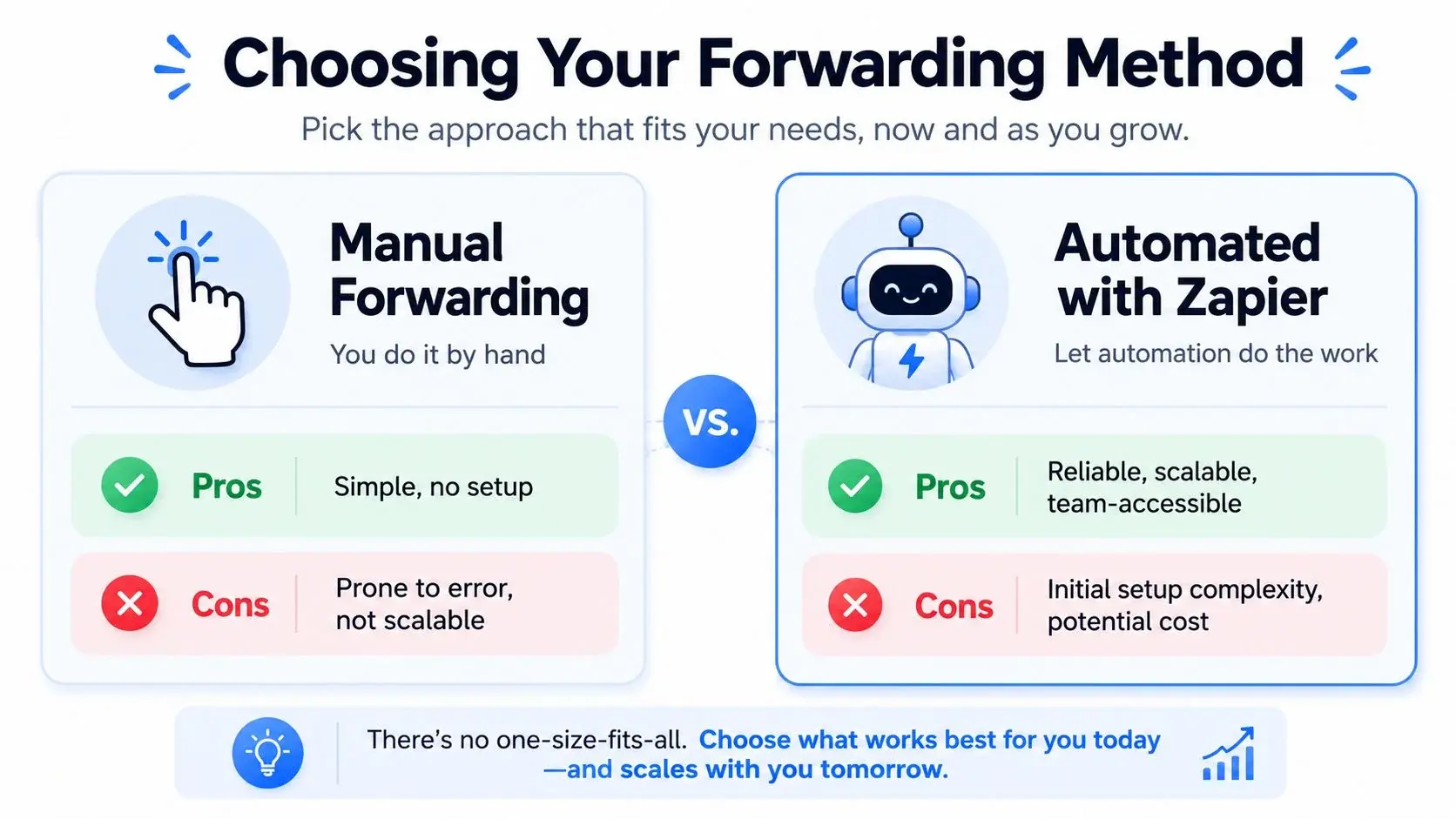
Manual forwarding is the simplest choice when the goal is personal convenience and the volume is tiny. Automation with Google Voice, IFTTT, or Zapier fits small teams that need repeatable forwarding and some filtering. A broader platform makes more sense when the team needs voice, ringless voicemail, scheduling, compliance controls, and workflows that don't depend on one employee's phone.
The decision is less about features on paper and more about failure tolerance. If losing one message is annoying, native forwarding is fine. If losing one message creates a missed sale, missed appointment, or missed handoff, build the workflow like it matters.
If you need a cleaner way to move SMS into shared workflows without losing context, Broadcast gives you a more complete path than basic forwarding. It combines SMS, voice broadcasting, ringless voicemail, scheduling, and CRM-friendly automation so the message doesn't just arrive, it gets routed where the team can act on it. Visit Broadcast to see how it fits your forwarding, follow-up, and compliance needs.
Forward a Text Message to Email: FAQs
Can I forward a text message to an email address?
Yes. Forward the message from your messaging app and type the email address as the recipient, or copy the text into a new email. Sending to an email address from the Messages app depends on your carrier and the address, so if it fails, copy and paste or share a screenshot instead.
How do I forward an entire text message thread to email?
Select several messages at once: on iPhone, touch and hold a message, tap More and tick each one (Apple); in Google Messages, touch and hold and use Select more (Google). For a long thread, screenshots shared to email keep the order and timestamps. For a full record, see how to find your text message history.
How can I automatically forward SMS messages to my email address?
On Android, the IFTTT applet "Forward Android SMS to your Email inbox" does it with the IFTTT app installed (IFTTT). iPhone has no built-in setting that emails incoming texts. Businesses usually get texts on a business number in a texting platform and route them from there.
Can I send a copy of my text messages to my email?
For a few messages, yes: copy, forward or screenshot them into an email to yourself. Text Message Forwarding on iPhone does not do this; it shows your texts on your other Apple devices (Apple).
Can I send a text message from email?
That is the opposite direction, and the options have changed as carriers closed their email-to-text gateways. See can you send text messages from email, or send SMS online for browser-based options.


