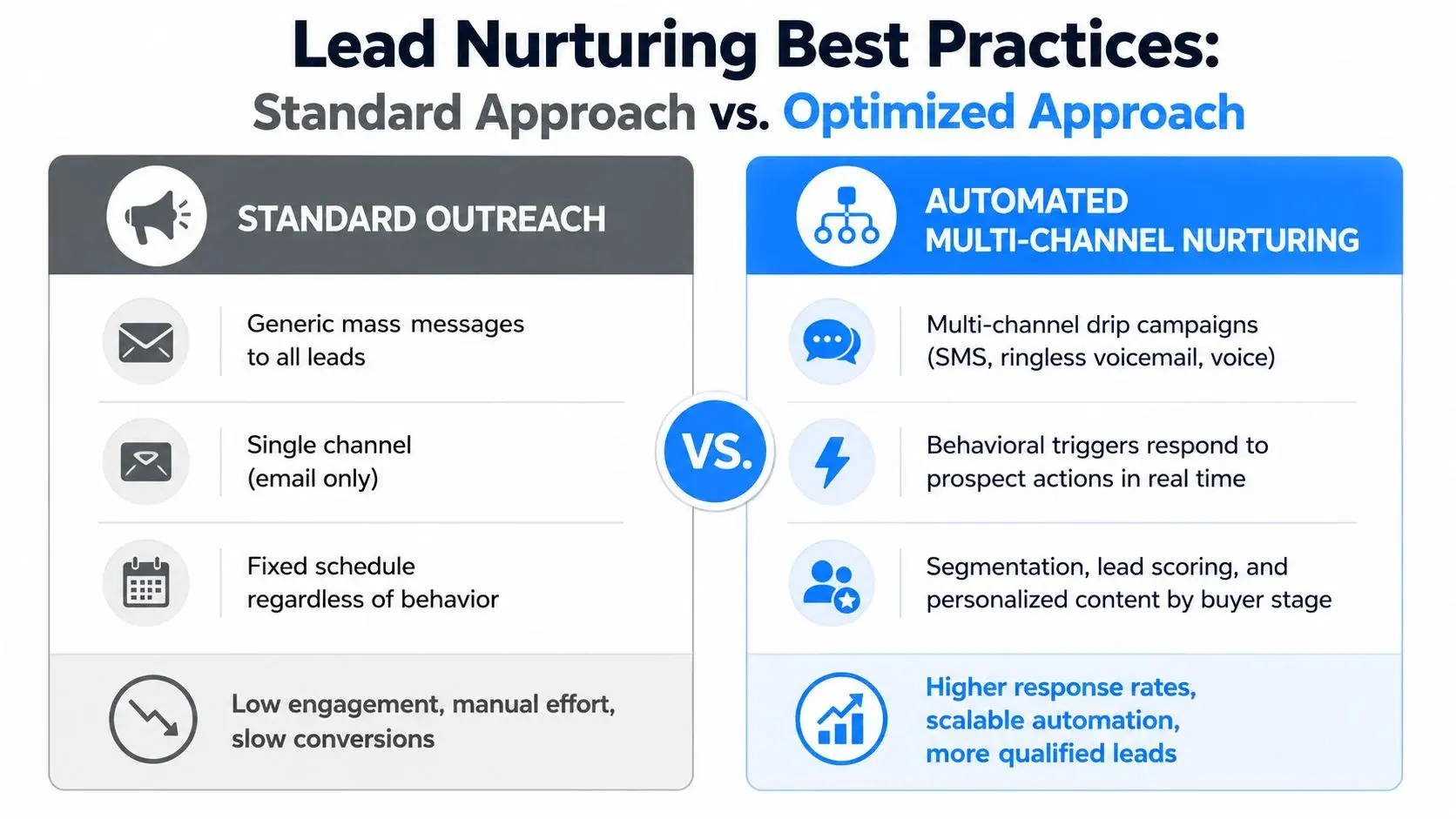
More touchpoints don't automatically create better nurture. A lead who receives an email, an SMS, a voice broadcast, and a ringless voicemail without any coordination doesn't experience a thoughtful journey. They experience repetition, fatigue, or, in the worst case, a compliance problem.
Effective lead nurturing best practices start with four operating rules: capture permission, make each message relevant, choose timing based on intent, and give every touchpoint a measurable next step. The right channel depends on the message. SMS can handle an urgent reminder, email can explain a complex decision, and ringless voicemail can add a human voice without forcing a live conversation. Each channel should have a job.
This roundup organizes nurturing as a working system rather than a collection of disconnected tactics. The ten practices cover automated drips, ringless voicemail, behavioral triggers, segmentation, text-to-join workflows, appointment follow-up, voice broadcasting, lead scoring, educational sequences, and win-back campaigns. Broadcast can bring SMS, voice broadcasting, ringless voicemail, scheduling, personalization, analytics, and integrations into workflows that SMB teams already use.
1. Automated Multi-Channel Drip Campaigns
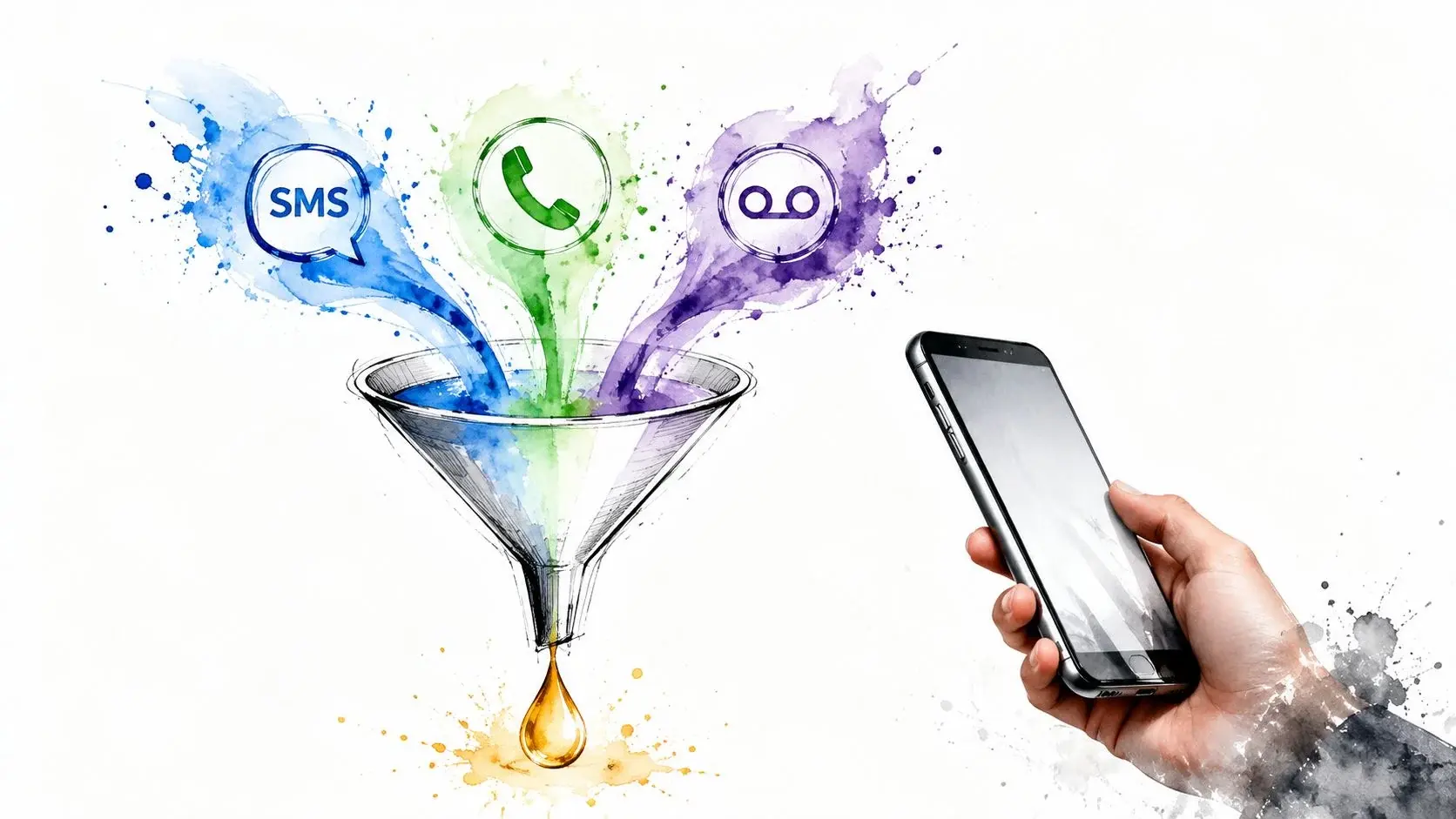
A drip campaign gives your follow-up a dependable structure. Instead of asking a salesperson to remember every lead, you define the journey, identify the trigger, and automate the next message across SMS, voice, email, or ringless voicemail.
Start with the customer journey on paper. A webinar organizer might send an invitation, confirmation, preparation note, and event-day reminder. A healthcare provider might confirm an appointment, answer preparation questions, and follow up afterward. A karate studio can automate weekly class reminders, attendance follow-ups, and notices about special sessions.
The mistake is treating every channel as interchangeable. Use SMS when the recipient needs to act quickly. Use email for details they may want to revisit. Use a ringless voicemail drop for an important announcement that benefits from a calm, spoken explanation.
Build the sequence before choosing the automation
Write the intended outcome for each step, then add a condition for what happens next. If a lead replies, stop the automated path and route the conversation to a person. If there's no response, send a useful follow-up rather than repeating the original pitch.
- Map the journey: Define the first contact, education stage, decision point, and handoff.
- Personalize responsibly: Use merge fields for names, appointments, companies, or event details, but verify that your source data is accurate.
- Protect trust: Include clear opt-out instructions and monitor engagement, replies, conversions, and unsubscribes.
A practical starting point is Broadcast's guide to drip campaign best practices, and these drip marketing examples for SMS and voice show finished sequences. Build one journey first, review the results, and only then add more branches.
2. Ringless Voicemail Drop Technology
Ringless voicemail is a distinct nurture tactic, not just another version of SMS. It delivers a pre-recorded message to a voicemail inbox without making the phone ring, which can give a prospect space to listen when convenient. That makes it useful when tone and context matter more than speed.
A healthcare practice might use a concise message to remind a patient about preparation instructions. An event organizer could send a spoken reminder about a webinar or conference. A karate studio might announce a schedule change or special event. A sales representative could leave a personalized message for a high-value prospect who hasn't replied to email or text.
The format works best when the recording sounds intentional. A rambling script, weak audio, or vague next step makes the channel feel automated in the wrong way.
Treat consent as part of the workflow
The FCC ruled in November 2022 that ringless voicemail sent to wireless phones is a call using an artificial or prerecorded voice under the TCPA, and therefore requires consumer consent before delivery. The ruling also rejected the argument that a message avoids robocall rules just because the phone doesn't ring. Review the FCC ruling on ringless voicemail (FCC 22-85) and our ringless voicemail compliance guide before launching a campaign.
Keep the recording focused, identify the sender, provide a callback number, and state one clear action. Maintain consent records and DNC controls. Combining ringless voicemail with a permission-based SMS follow-up can work well, but it doesn't remove the need for compliance.
For implementation details, consult Broadcast's explanation of ringless voicemail marketing.
3. Behavioral Trigger-Based Messaging
Fixed schedules are useful, but behavior often tells you more than elapsed time. A form submission, pricing-page visit, abandoned cart, appointment booking, or trial-class request can trigger a message while the lead's interest is still clear.
An ecommerce business might send an SMS after an abandoned cart, then route a ringless voicemail follow-up only if the customer remains inactive. A healthcare practice can send confirmation immediately after booking. An event platform can begin its reminder path as soon as registration is complete. A sales team can alert a representative when a prospect views pricing or returns to a product page.
The trigger should explain the message. “Thanks for requesting a trial class” is useful because it reflects the lead's action. “Just checking in” gives the recipient no reason to engage.
Design conditional paths, not message piles
List meaningful actions in your CRM and assign one response to each. Then add suppression rules. Someone who replies to an SMS shouldn't receive the next automated nudge. A lead who books a meeting should leave the promotional sequence and enter the appointment workflow.
- Use urgency carefully: Send time-sensitive actions by SMS, while reserving ringless voicemail for explanation or emphasis.
- Cap frequency: Count contacts across channels, not separately by channel.
- Test the delay: A message sent immediately may be helpful after a form submission, but intrusive after a casual page visit.
- Preserve context: Reference the form, appointment, event, or product action that caused the trigger.
Behavioral automation should make the next step feel obvious. It shouldn't expose every data point your tracking system has collected.
Speed matters most for new inquiries. Our guide to building an automated lead follow-up system covers the first minutes after a form, a missed call or a keyword reply.
4. Segmentation and Personalized Messaging
A lead database becomes useful when it reflects meaningful differences between people. Segmentation can use behavior, interests, customer status, business fit, service need, or buying stage. Personalization then changes the message, offer, channel, or timing for that group.
A karate studio might separate parents seeking children's classes from adults asking about fitness training. A veterinary practice might distinguish new-patient inquiries from existing clients due for preventive care. The same appointment reminder reads differently for each group, as these appointment confirmation text examples show.
Healthcare providers may need different reminders for pediatric, specialty, or recurring-care patients. Event organizers can separate first-time registrants, past attendees, and people who started registration without completing it. A sales team might segment by company size, industry, and deal stage before choosing voice or SMS outreach.
Start with segments your team can act on
Don't create a dozen groups that nobody manages. Begin with a few segments tied to a decision, such as “needs education,” “ready for a conversation,” “appointment booked,” or “inactive customer.” Broadcast's customer segmentation examples can help translate those distinctions into campaign logic.
- Check data quality: An incorrect phone number or outdated status creates a bad experience.
- Use dynamic rules: Move contacts when their behavior or lifecycle stage changes.
- Personalize with restraint: A first name and relevant service detail can help. Excessive personal references can feel invasive.
- Measure by segment: Compare replies, booked appointments, conversions, and opt-outs across groups.
The best segment is one that changes what you do next.
5. SMS With Text-to-Join Keywords and Opt-In Workflows
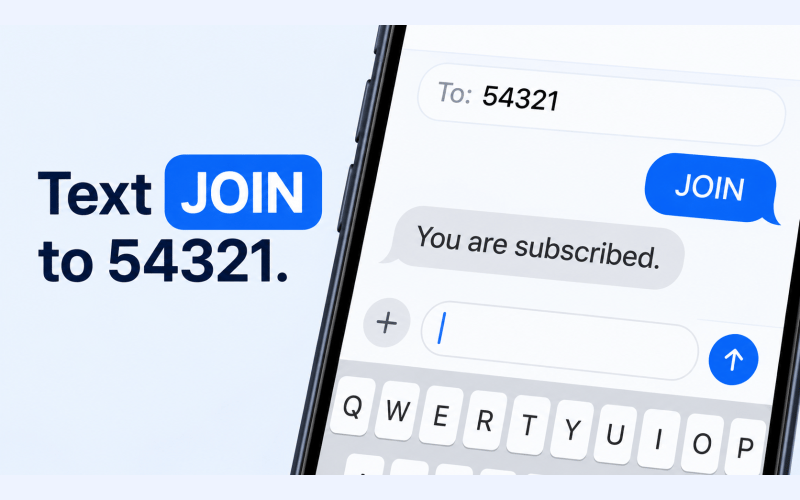
Permission should begin before the first nurture message. Text-to-join keywords give prospects a simple way to request updates, offers, reminders, or event information. The keyword also records the context of the opt-in, which helps you avoid putting every contact into one generic list.
An event organizer can promote “TEXT EVENT” on a registration page or printed flyer. A karate studio can invite prospects to text “TRIAL” for a class offer. A healthcare provider might use a keyword for appointment information, while an ecommerce brand can create a separate keyword for promotional updates.
The welcome workflow matters as much as the keyword. Confirm the subscription, provide the promised value, explain what the recipient can expect, and make opting out easy. A keyword that collects a number but sends no immediate confirmation wastes the strongest moment of intent.
Make the opt-in specific
Use a memorable keyword tied to one purpose. Track the source, such as a social post, event sign, landing page, or in-store promotion, so you can connect acquisition activity to later engagement.
- State the purpose: Explain what messages the person is joining.
- Confirm the subscription: Send a clear welcome message with opt-out instructions.
- Deliver the promise: Provide the class offer, event detail, appointment path, or discount that motivated the opt-in.
- Route the contact: Add the subscriber to a relevant segment and nurture path instead of a universal broadcast list.
SMS works best when people know why they're receiving it. Consent isn't a checkbox at the edge of the campaign. It's the first useful interaction.
The rules back this up. Under FCC rules, automated marketing texts to a cell phone need the person's prior express written consent (47 CFR 64.1200(a)(2)), and a reply such as STOP revokes it. Carrier guidance in the CTIA Messaging Principles and Best Practices adds a confirmation message, clear opt-out instructions and support for STOP, END, CANCEL, UNSUBSCRIBE and QUIT. Our guide to express written consent covers the wording.
6. Appointment Reminders and Follow-Up Sequences
Appointment nurturing has a practical objective: help the person attend, prepare, reschedule, or take the next step. The workflow should continue after the appointment, because a completed visit isn't always the end of the relationship.
A healthcare provider can send an initial SMS with the appointment details, a ringless voicemail with preparation guidance, and a final SMS reminder. A salon, spa, dental practice, fitness studio, or professional service firm can use the same structure with different content. A mental health practice may need discreet wording that avoids exposing sensitive details on a shared phone.
Build around the appointment state
The first message should include the information people need to act, such as time, location, provider, parking guidance, and a rescheduling option. Ask for confirmation when appropriate. A response can identify people who need help before they become no-shows.
After the visit, send a feedback request or next-step recommendation. If the appointment is missed, trigger a recovery path that offers rescheduling rather than treating the contact as lost.
Practical rule: Every appointment message should answer one question, “What does this person need to do next?”
Healthcare organizations must also review privacy and HIPAA requirements before including appointment details in SMS or voicemail. HHS says providers may leave reminders but should limit the information disclosed, for example leaving only the provider's name, number and what is needed to confirm the appointment. Use the least sensitive wording that still helps the recipient recognize the appointment, and confirm that the communication workflow is configured for the organization's compliance needs.
7. Voice Broadcasting With Live and Machine Detection
Voice broadcasting becomes useful when a message needs reach, urgency, or a path to a live person. The system can distinguish between a live answer and voicemail, then play an appropriate recording or route the call to a representative.
A healthcare practice might offer a press-1 option for rescheduling. An educational institution can communicate a school closure. An organization handling emergency information may need a clear, direct announcement. A compliant collections operation may use voice outreach under the rules that apply to its audience and message.
This channel carries more interruption risk than email. A recording that sounds like a generic sales pitch can damage trust quickly, especially when the recipient doesn't recognize the caller.
Make every recording accountable
Identify the sender and provide a callback number: FCC rules require every prerecorded message to name the business at the start and give its phone number (47 CFR 64.1200(b)), and prerecorded marketing messages also need an automated press-a-key or voice opt-out. Keep the script concise, state the purpose early, and give a clear opt-out path. If you use live transfers, route qualified responses to people who can handle the conversation.
Before each campaign, check DNC data and document the compliance controls. Marketing calls are limited to 8 a.m. to 9 p.m. in the recipient's local time (47 CFR 64.1200(c)(1)). Maintain accurate records of consent, suppression requests, caller ID configuration, recording approval, and transfer behavior.
- Use live detection: Offer a conversation only when a trained person is available.
- Use machine detection: Leave a voicemail that works without a live explanation.
- Review complaints: A rise in complaints or opt-outs signals a problem with targeting, timing, or message relevance.
- Separate use cases: An emergency notice, appointment reminder, and sales promotion shouldn't share the same script or cadence.
Voice broadcasting can scale outreach, but it still needs editorial judgment.
8. Lead Scoring and Priority-Based Nurturing
Not every lead deserves the same intensity or the same handoff. Lead scoring combines fit and behavior to help your team decide which contacts need a sales response, which should continue in nurture, and which should be suppressed or reviewed.
A B2B software company might score company fit, industry, product-page visits, and demo requests. A real estate agent could prioritize repeated property-viewing activity and direct replies. An event organizer might distinguish someone who only registered from someone who engages with event information and clicks the registration path.
Build a model salespeople will use
Start with a small number of signals. Separate fit, such as company type or service need, from engagement, such as replies, clicks, bookings, or meaningful form submissions. Add negative signals for inactivity, unsubscribing, or a clear mismatch.
Set operational thresholds. One threshold can create a sales task. Another can move a lead into a deeper nurture path. A high-priority lead may receive coordinated SMS, ringless voicemail, and voice outreach, while a lower-priority contact receives educational email and occasional reminders.
Review the model against actual outcomes rather than assuming the score is correct. If salespeople ignore alerts because too many contacts qualify, lower the noise. If strong opportunities remain in automated nurture, improve the fit or intent signals.
Score decay also matters. An old interaction shouldn't keep a dormant lead at the top of the queue forever. The model should reflect current intent, not merely historical activity.
9. Cross-Channel and Content-Based Lead Nurturing
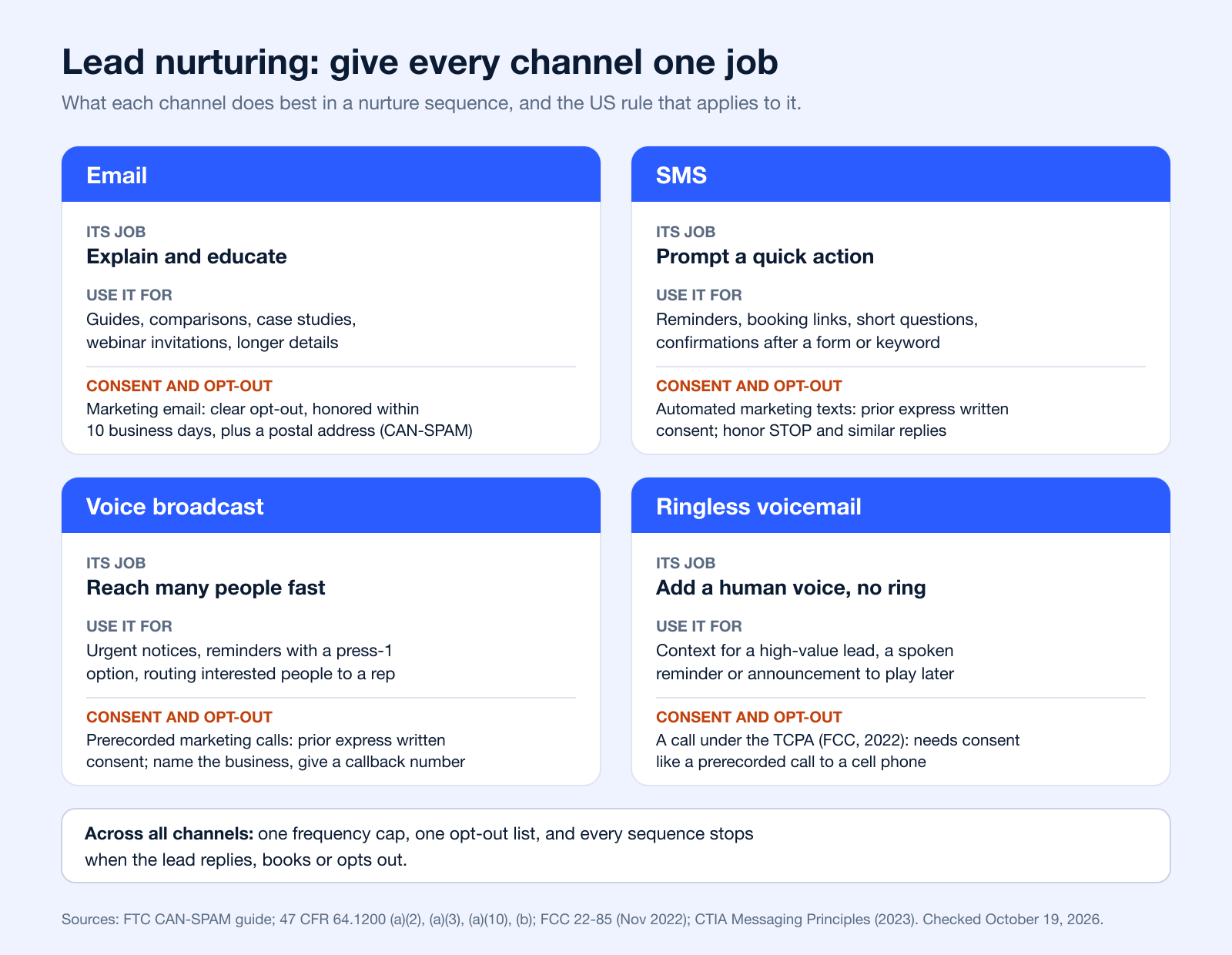
Cross-channel nurturing works when each medium contributes something different. Email can carry a detailed guide, comparison, or webinar invitation. SMS can deliver a timely reminder or meeting link. Ringless voicemail can explain an important detail or reinforce a high-value next step.
A B2B software company might begin with educational content about workflow problems, then introduce product-specific material after the lead engages. An accounting firm can share practical tax-planning guidance before asking for a consultation. A sales training company can offer a short educational series before inviting prospects to a webinar. A healthcare system can provide general patient education before presenting a service pathway.
The sequence should progress from understanding to evaluation to action. Don't send a pricing request to someone who hasn't clarified the problem, and don't keep sending introductory content to a lead who is asking implementation questions.
Coordinate the message, not just the calendar
Create a content map for each stage. Use articles, videos, infographics, webinars, podcasts, guides, and case studies where they help the lead decide what to do next. Keep the value proposition visible without turning every educational touchpoint into a sales pitch.
A reasonable operational safeguard is to set a cross-channel frequency cap, such as a maximum of 2 to 3 contacts per week as a starting point to test. Treat that as a starting control, not a universal law; no study sets one right number. A booked appointment, urgent service update, and educational follow-up have different urgency and permission contexts.
Track progression, not just opens. Measure content engagement, replies, booked meetings, lead-to-opportunity movement, opt-outs, and channel contribution. The strongest channel is the one that helps the journey progress without creating avoidable friction.
For the automation side, our guide to marketing automation workflows shows how to wire triggers, waits and branches across tools.
10. Dynamic Retargeting and Win-Back Campaigns
Dormant leads need a different message from new leads. A win-back campaign acknowledges the previous relationship, offers a relevant reason to return, and gives the contact a simple way to respond. Dynamic retargeting can use prior behavior, service history, product interest, or lifecycle status to decide what to send.
A fitness studio might reach out to a lapsed member with a reactivation option. A karate studio can invite a student who stopped attending to a trial class or schedule review. A healthcare practice may remind a patient about overdue preventive care in a privacy-conscious way. A software company can contact a former customer with a relevant feature update rather than sending the same offer used for new prospects.
Ask why the relationship went quiet
Segment inactive contacts by the reason for inactivity when that information exists. Someone who had a scheduling problem needs a different path from someone who found the service irrelevant. If the reason is unknown, ask for feedback before pushing an offer.
A useful sequence might begin with an email that references the prior relationship, followed by an SMS with a direct response option, then a ringless voicemail for contacts who have permission and may benefit from a spoken explanation. Offer a clear value, such as a new feature, helpful content, service update, or limited reactivation incentive.
Remove or suppress contacts who don't engage after a defined recovery path. Keeping every inactive record in every campaign increases noise and makes reporting less trustworthy. Win-back is successful when it recovers a real relationship, not when it inflates the size of a contact list.
Check consent before you restart any channel: anyone who opted out stays out, and our guide to reactivation campaigns has message examples for dormant lists.
10-Point Lead Nurturing Best Practices Comparison
| Item | Implementation Complexity | Resource Requirements | Expected Outcomes | Ideal Use Cases | Key Advantages |
|---|---|---|---|---|---|
| Automated Multi-Channel Drip Campaigns | Medium–High: strategy, sequence design and testing | Marketing automation platform, multi-channel content, analytics | Consistent engagement; improved conversion; scalable nurture | E‑commerce follow-ups, event sequences, ongoing lead nurturing | Automated multi-channel sequencing, personalization, detailed analytics |
| Ringless Voicemail Drop Technology | Low–Medium: provider integration and compliance setup | Ringless voicemail provider, quality audio assets, compliance checks | Non-intrusive delivery; room for a spoken explanation; callbacks from interested leads | Appointment reminders, high‑value prospect outreach, announcements | Delivery to voicemail without a ring, human tone; needs consent like a prerecorded call (FCC 22-85) |
| Behavioral Trigger-Based Messaging | High: real‑time integrations and event tracking | CRM/website/e‑commerce integration, webhook/Zapier, logic rules | Timely, contextually relevant responses while interest is fresh | Cart abandonment, pricing page visits, form submissions | Real‑time relevance, precise attribution, improved conversion timing |
| Segmentation and Personalized Messaging | Medium: data modeling and segment maintenance | Clean contact data, segmentation tools, dynamic content/templates | More relevant messages for each group | Role‑based campaigns, industry/vertical targeting, lifecycle messaging | Targeted content; fewer irrelevant messages that lead to opt-outs |
| SMS with Text-to-Join Keywords and Opt-In Workflows | Low–Medium: keyword setup and promotional workflow | SMS platform, shortcode/longcode, promotion channels, compliance logs | Subscribers who asked for the messages; permission-based lists | Event signups, local promotions, list building from ads/print | Permission-based lists, clear opt-in evidence tied to a source |
| Appointment Reminders and Follow-Up Sequences | Low–Medium: calendar integration and timing rules | Booking/calendar integration, multi-channel templates, automation | Fewer missed appointments as the goal; better post‑visit follow‑up | Healthcare, salons, fitness classes, professional appointments | Automates confirmations and rescheduling; aims to lower no‑shows |
| Voice Broadcasting with Live and Machine Detection | Medium–High: compliance, routing and detection tuning | Voice broadcast platform, call lists, agents for live transfers, compliance | Rapid large‑scale reach; live transfers connect interested people to a person | Political outreach, emergency alerts, mass notifications, collections | Scales outbound calls, live answer routing, consistent messaging |
| Lead Scoring and Priority-Based Nurturing | Medium–High: scoring model design and alignment with sales | Historical data, CRM integration, analytics tools, review process | Focused sales effort on the leads most likely to buy | B2B SaaS, high‑touch sales, teams prioritizing limited resources | Objective prioritization, better sales efficiency, data‑driven focus |
| Cross-Channel and Content-Based Lead Nurturing | High: orchestration across channels and content production | Unified channel platform, extensive content library, analytics | Broader engagement; educated prospects; stronger mid‑funnel movement | Long sales cycles, product education, multi‑stage buyer journeys | Channel coordination, content credibility, fallback options if one channel fails |
| Dynamic Retargeting and Win-Back Campaigns | Medium: inactivity detection and personalized creative | Historical engagement data, segmentation, multi‑channel creatives | Reactivation of contacts who already know you | E‑commerce lapsed customers, churned subscribers, dormant leads | Uses past history; personalized reactivation; cleaner lists |
A Sample Lead Nurturing Sequence Across Email, SMS and Voice
The most common question behind this post is how to combine email automation with other channels. Here is one way to do it for a new inquiry, such as a quote request, a class sign-up or a course application. The timings are starting points to test, not benchmarks, and every step assumes the lead gave consent for that channel.
| Step | When | Channel | What it does | Moves on when |
|---|---|---|---|---|
| 1 | Right away | SMS | Confirms the request and offers one next step, such as a booking link | The lead books or replies: stop and hand off |
| 2 | Same day | Sends the details: what happens next, pricing basics, a short guide | The lead clicks or replies: alert a rep | |
| 3 | Day 2 | Call or ringless voicemail | A short spoken message with the business name, the reason and a callback number | The lead calls back: route to a person |
| 4 | Day 4 | Answers the most common objection or shares a customer story | No action: continue | |
| 5 | Day 7 | SMS | A simple yes or no question, such as "Still interested in a quote?" | A "no" or STOP ends the sequence on all channels |
| 6 | Day 14 | A last helpful resource and an easy way to come back later | No action: move to a monthly education list |
Two rules make this work. First, every reply, booking or opt-out ends the remaining steps on every channel. Second, one frequency cap covers the whole sequence, so a lead never gets an email, a text and a call on the same day because they sit on three lists.
- Online education or course providers: start with the application or info request, use SMS for deadlines and email for program details, and add a call before the enrollment deadline.
- Healthcare patient acquisition: keep messages free of health details, confirm consultations by SMS and follow HHS guidance for voicemail.
- Event registrations left unfinished: one reminder by email with the registration link, one by SMS closer to the deadline, then stop.
Consent and Opt-Out Rules by Channel
Each channel in a nurture sequence has its own rules in the US. This table summarizes the federal ones as of October 19, 2026.
| Channel | Consent before marketing messages | Opt-out | Source |
|---|---|---|---|
| Not required by federal law; the law makes no exception for B2B email | Clear opt-out in every marketing email, honored within 10 business days; include a postal address | FTC CAN-SPAM guide | |
| SMS (automated marketing) | Prior express written consent | STOP and similar replies revoke consent; honor within 10 business days at most | 47 CFR 64.1200(a)(2), (a)(10); CTIA |
| Prerecorded voice to cell phones | Prior express written consent for marketing calls | Name the business, give a phone number and an automated opt-out | 47 CFR 64.1200(a)(2), (b) |
| Prerecorded voice to home phones | Prior express written consent for telemarketing (some exemptions) | Same identification and opt-out rules; calls only 8 a.m. to 9 p.m. local time | 47 CFR 64.1200(a)(3), (b), (c) |
| Ringless voicemail to cell phones | Consent required: it is a call under the TCPA | Same as prerecorded calls | FCC 22-85 (Nov 2022) |
The FCC revised parts of its consent revocation rules on September 30, 2026 (FCC 26-67), so check the current text before you change your opt-out handling. State laws can add stricter rules.
Turn the Ten Practices Into One Working System
Don't launch all ten practices at once. Start by documenting how each contact entered your database, what permission they gave, which channels they accepted, and what suppression or opt-out rules apply. Store the source and context of the lead, whether it came from a form, text-to-join keyword, appointment request, event registration, referral, or direct conversation.
Next, create a few useful segments. Separate new inquiries from active opportunities, booked appointments from missed appointments, current customers from dormant contacts, and high-fit leads from contacts that need more qualification. Keep the definitions visible to marketing, sales, customer success, and operations. A segment only helps when everyone routes and reports on it consistently.
Choose one workflow with an obvious business outcome. For a healthcare provider, that might be appointment confirmation and follow-up. For an event organizer, it might be registration through attendance. For a karate studio, it could be trial-class inquiry through attendance and membership conversation. For a service business, it might be form submission through a completed consultation.
Build the workflow around triggers and conditions. Send an immediate confirmation where appropriate, wait for a response or meaningful action, then choose the next channel based on the result. Add ringless voicemail when a concise audio message improves context, not merely because another channel is available. If the message is urgent and short, SMS may be better. If the message needs explanation, voice may earn its place.
Then connect scoring and reporting. A useful score should help sales decide who needs attention, while reporting should show whether nurture moves contacts toward opportunities, appointments, attendance, purchases, renewals, or reactivation. Email opens can provide directional feedback, but they shouldn't be the only measure of success.
Track performance at two levels:
- Channel level: Review delivery, replies, clicks, listens where available, opt-outs, complaints, and conversion actions.
- Journey level: Review lead-to-opportunity movement, appointment completion, event attendance, sales acceptance, revenue outcomes, and inactive-contact recovery.
- Operational level: Review handoff speed, duplicate messages, failed data fields, suppression errors, and unresolved sales tasks.
Frequency controls should apply across the entire journey. A contact shouldn't receive a promotional SMS, a voice broadcast, and a ringless voicemail because three teams manage separate lists. Maintain DNC records, consent evidence, opt-out processing, and healthcare privacy controls as part of campaign operations, not as an afterthought.
Speed is the clearest benchmark for why structure matters. In a study published in Harvard Business Review, researchers audited 2,241 US companies with a web test lead: only 37% responded within an hour, 23% never responded, and the average response time among those that did was 42 hours. In a separate analysis of 1.25 million leads, firms that tried to contact a lead within an hour were nearly seven times as likely to qualify it as firms that waited even one more hour (Oldroyd, McElheran and Elkington, HBR, 2011). The study is from 2011, but it supports fast, structured follow-up; it doesn't justify sending more messages without a plan.
When a nurture program underperforms, the practical response is to repair workflow ownership, data quality, qualification rules, handoffs, and downstream reporting before adding another campaign.
Broadcast can fit this operating model for SMBs that need SMS, voice broadcasting, ringless voicemail, drip timing, merge fields, analytics, integrations, and healthcare-oriented communications. Its workflows can connect with tools such as HubSpot, ActiveCampaign, Keap, and Zapier, allowing nurture actions to remain connected to existing lead and customer records.
Start small, document what happens, measure the next step, and expand only when the first workflow is reliable. That approach produces better lead nurturing than adding channels just to increase the number of touchpoints.
Broadcast brings SMS, voice broadcasting, ringless voicemail, text-to-join keywords, drip campaigns, scheduling, merge fields, analytics, and integrations into one outbound workflow. Use it to build permission-based nurture sequences for leads, appointments, events, studios, healthcare communications, and service follow-up, then visit Broadcast to see how it can fit your current process.
Lead Nurturing FAQ
What is lead nurturing?
Lead nurturing is the follow-up that helps an interested person move toward a decision: useful information, timely reminders and a clear next step, sent on the channels they agreed to, until they buy, book, opt out or go quiet.
How do I use email automation to nurture leads from different channels?
Tag each lead with its source (form, keyword, event, call), send an automated email that matches that source, and let email carry the details while SMS and voice handle reminders and quick questions. The sample sequence above shows one version.
How do you nurture leads by SMS?
Get consent first, confirm the opt-in, and keep texts short: a reminder, a link or a yes or no question. Space them out, stop when the lead replies, and honor STOP right away. Our guide to follow-up texts after no response has wording you can adapt.
What nurturing workflow turns more leads into booked calls?
A fast first response with a booking link, a reminder by a second channel if there is no reply, a rep task as soon as the lead engages, and stop rules once a call is booked. The HBR study above found that contacting leads within an hour made qualification far more likely.
How do you nurture abandoned registrations?
Trigger a reminder from the unfinished registration, link straight back to the form, answer the likely question (price, schedule, requirements), and stop after one or two reminders or when the person completes it.
How do you nurture leads without harassing them?
Use one frequency cap across all channels, send only what the lead asked for, make every message useful on its own, and make opting out easy. A reply, booking or opt-out should end the sequence.
Can you use voicemail for lead nurturing?
Yes, for context a text cannot carry, such as a spoken explanation or a personal note to a high-value lead. Ringless voicemail and prerecorded calls need consent like other automated calls (FCC 22-85), must name the business and give a callback number.