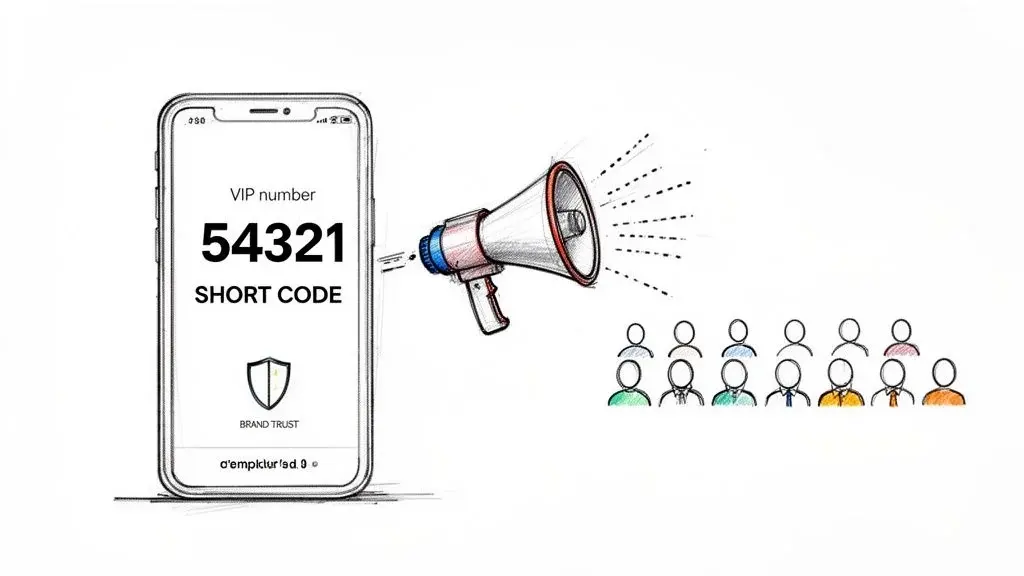
An SMS short code is a special 5-6 digit phone number built specifically for high-volume text messaging. Think of it as a VIP number for your business: it's short, incredibly easy to remember, and engineered for mass communication.
Short codes are leased, not bought, through the US Short Code Registry, which the Common Short Code Administration runs under CTIA (US Short Code Registry). This guide covers what they are, what they cost, and when a toll-free or 10DLC number is the better fit. Facts and prices were checked on October 19, 2026.
What Are Short Codes and Why Do They Matter?
Imagine if your business mailing address wasn't a long, complicated street name but a simple, iconic one like "123 Main St." Customers would remember it instantly. That's exactly what a short code does for your text message campaigns; it's a custom, high-traffic address that makes connecting with your audience effortless.
These specialized numbers are the engine behind professional Application-to-Person (A2P) messaging. They let businesses send thousands of texts at once through a channel carriers have reviewed and approved, a critical advantage for time-sensitive promotions, alerts, and customer service updates.
Establishing Trust and Credibility
When a customer gets a text from a 5-digit number, it signals that it's from an established business. Unlike standard 10-digit phone numbers, every short code program is reviewed and approved by the carriers before it goes live, which builds trust and means less carrier filtering than unregistered numbers. Approval does not guarantee delivery, though: the content still has to follow the approved program (CTIA Short Code Monitoring Handbook).
Since they first appeared, short codes for SMS have become a staple of business communication, and texting itself is everywhere: Americans exchanged nearly 2.2 trillion SMS and MMS messages in 2024 (CTIA). You will often see "98% open rates" quoted for SMS; that figure comes from vendor roundups rather than a published study, and standard SMS has no open tracking, so treat it as marketing shorthand.
The Foundation of Scalable SMS Marketing
At its core, a short code is a tool for scale. It’s built from the ground up to handle a massive volume of messages, making it the perfect choice for:
- Marketing Blasts: Sending a promotional offer to your entire contact list at the same time.
- Urgent Alerts: Notifying customers about emergencies, account updates, or appointment reminders.
- Interactive Campaigns: Running polls, contests, and keyword-based subscription services.
Short codes bring a unique combination of speed, reliability, and brand recognition to your communication strategy. Let's break down exactly how these benefits translate into tangible business results.
How Short Codes Create Business Impact
| Benefit | Impact on Your Business | Example Use Case |
|---|---|---|
| High Throughput | Starts at 100 messages per second and can scale to thousands (AWS). | A retail store sends a flash sale announcement to 50,000 customers instantly. |
| Brand Recognition | A short, memorable number makes your brand easier to recall and engage with. | A restaurant uses "Text PIZZA to 55555" on billboards to drive orders. |
| Carrier-Approved | Each program is reviewed by carriers before launch, so messages see less filtering than unregistered numbers. | A bank sends critical fraud alerts that customers see and act on immediately. |
| Increased Engagement | The professional look and feel of a short code encourages higher open and response rates. | A nonprofit runs a text-to-donate campaign, making it simple for supporters to give. |
These advantages make short codes a powerful asset for any business serious about connecting with its audience through text.
A short code isn't just a number; it's a direct line to your audience that’s built for speed, reliability, and brand recognition. It gives your most important communications a fast, carrier-approved route.
These powerful numbers come in two flavors, dedicated and shared, though shared short codes are no longer allowed for commercial traffic on the major US carriers (more on that below). Understanding the difference is the first step toward building more effective outreach strategies that drive real results.
What Is an SMS Code? Keywords, Numbers, and Verification Codes
The easiest way to understand what is sms code is to split it into three parts. The same phrase gets used for three different things, and they serve different jobs.
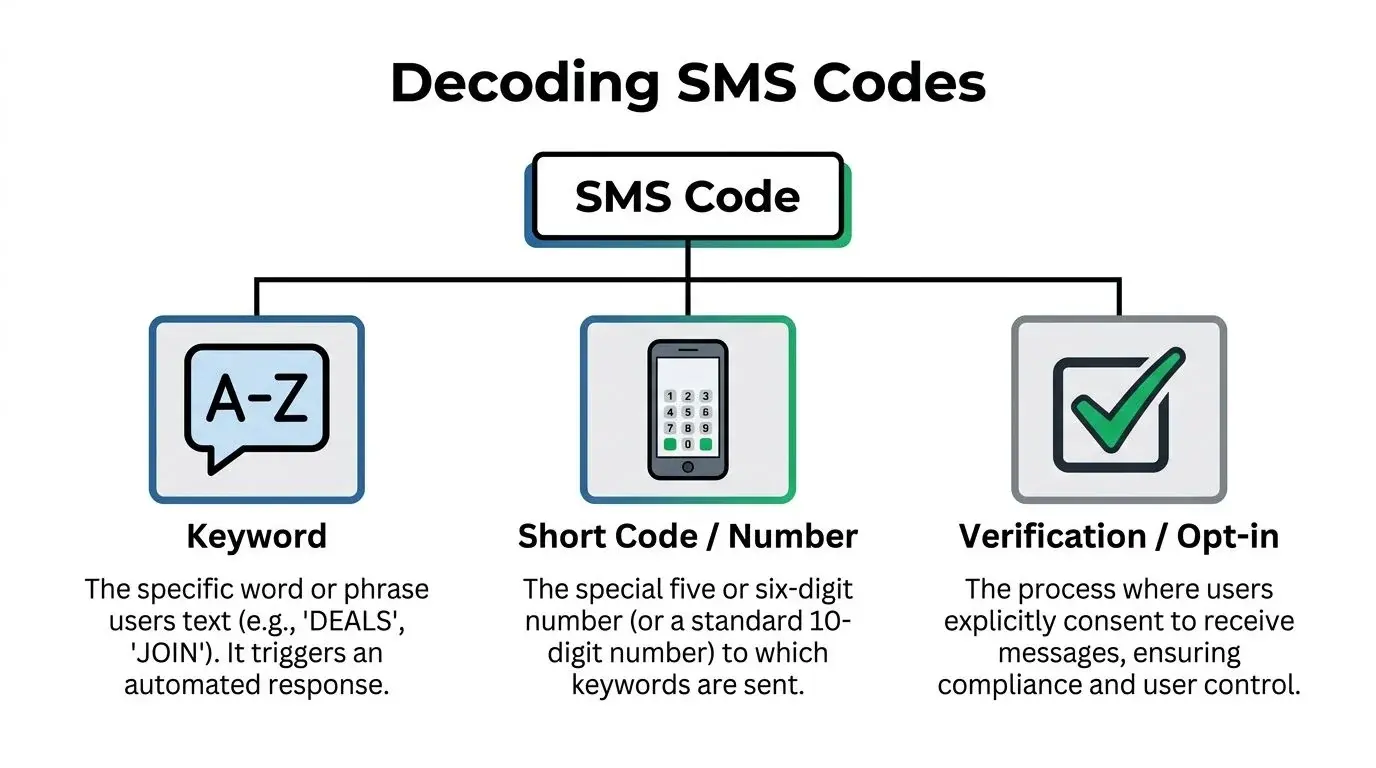
The keyword
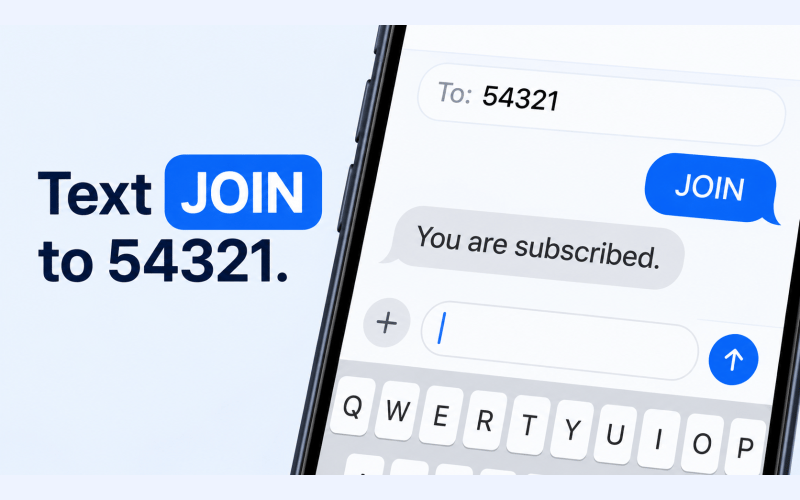
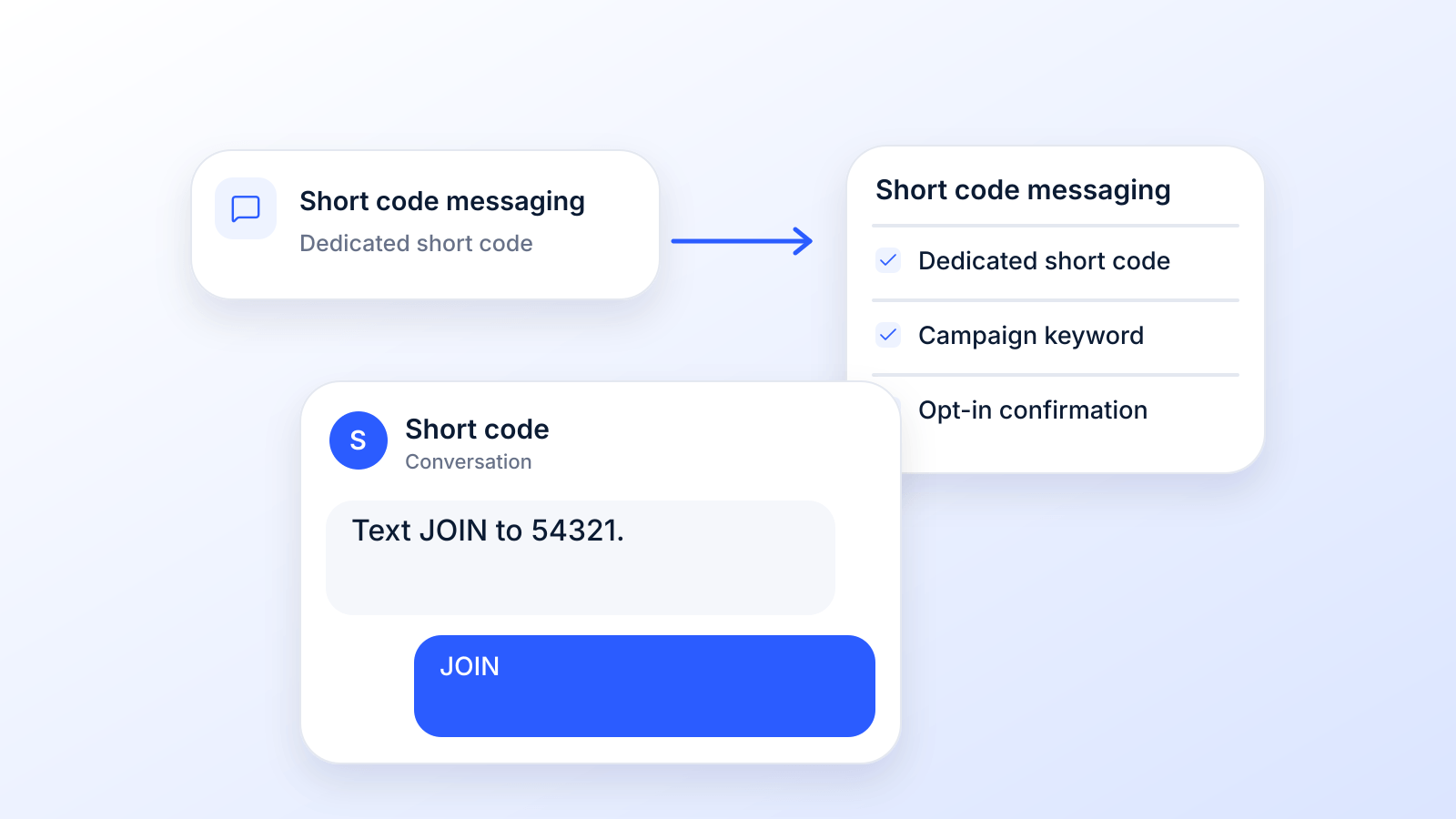
The keyword is the word someone texts in. It serves as a door opener.
Examples include:
- JOIN
- DEALS
- KARATE
- VIP
- APPT
When a customer texts that word, the system knows what action to take. It might send a coupon, add the contact to a segment, trigger a reminder flow, or ask for confirmation.
A good keyword is short, easy to spell, and tied to the offer. “JOIN” works for general list growth. “KARATE” works better on a flyer for a free class. “CHECKIN” works for events. “REMIND” fits service businesses.
For keyword ideas and how keyword campaigns are set up, see our guide to keyword text messaging.
The number
The number is where the text goes. This is often the first part that comes to mind.
It can be:
- a short code, usually 5-6 digits
- a standard business texting number, often called a 10DLC long code
- a toll-free number
Short codes are built for business messaging at scale. According to AWS’s guide to SMS short codes, short codes start at 100 messages per second and can scale to thousands per second, which is why they’re preferred for large campaigns. Toll-free numbers start at 3 messages per second and 10DLC numbers at 3 to 180, depending on the brand and use case (Twilio).
The number is the address. The keyword is the instruction.
The verification code
The third meaning is the verification code, also called an OTP or one-time passcode.
This is the text a customer gets to confirm an action, such as:
- signing in
- confirming ownership of a phone number
- completing a double opt-in
- validating a secure request
In a marketing workflow, verification-style messages often support consent. Someone texts your keyword, then receives a follow-up asking them to confirm they want messages. That extra step protects both the business and the subscriber.
The cleanest SMS programs treat consent as part of the customer experience, not a legal box to check later.
How the three pieces work together
Here’s the simple model:
| Part | What it is | Example | Job |
|---|---|---|---|
| Keyword | The word texted by the customer | JOIN | Triggers the workflow |
| Number | The destination number | 12345 | Receives the text |
| Verification | The confirmation message or code | YES or one-time code | Confirms permission or identity |
When people ask what is sms code, they’re often referring to one of these parts. In real campaigns, you usually use all three together.
Your Step-by-Step Guide to Getting a Short Code
Getting your hands on a dedicated short code isn't like just buying a phone number off the shelf. Think of it more like commissioning a custom piece of equipment for your business. It’s a carefully managed process that involves you, your messaging provider (like us here at Broadcast), the U.S. Short Code Registry, and every major mobile carrier. Knowing the roadmap upfront is the key to setting the right expectations.
The journey starts after you decide between a random number and a more memorable vanity code. From there, we’ll work with you to put together a detailed application and campaign brief. This document is everything: it spells out exactly how you plan to use the short code, covering your opt-in methods, sample messages, and how you'll handle customer support.
For the full checklist (program brief, call-to-action mockups, HELP and STOP messages, terms and privacy policy), see our guide to short code registration.
This flowchart breaks down that initial choice, helping you weigh your budget, campaign size, and branding goals.
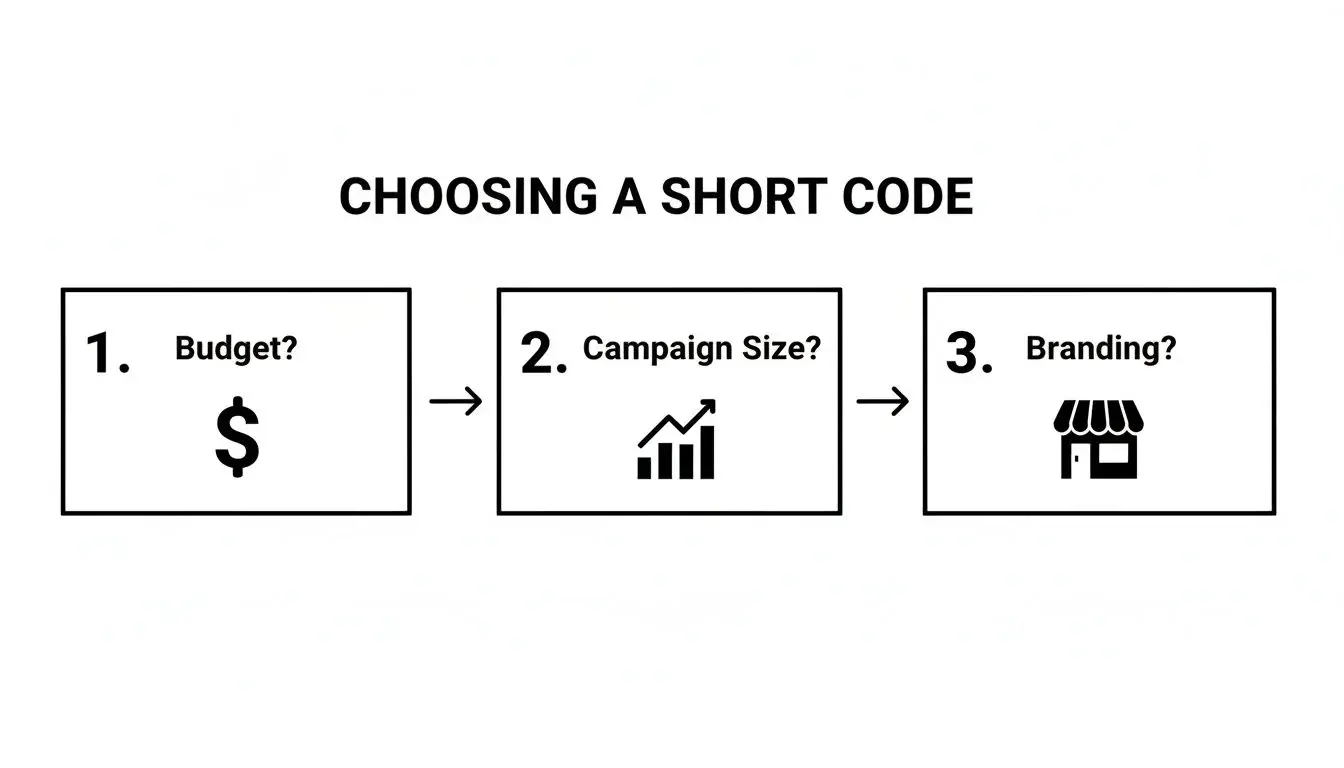
It’s a simple way to prioritize what truly matters, whether that’s keeping costs low, preparing to reach a massive audience, or cementing your brand identity in a few memorable digits.
Navigating the Approval Timeline
Once your application is in, the waiting game begins. This is the provisioning phase, where each mobile carrier (think Verizon, AT&T, and T-Mobile) individually reviews and green-lights your campaign. They comb through every detail to make sure you’re playing by the rules and providing a good experience for their customers.
Plan for about 8 to 12 weeks from the day you pay for the code to the day it goes live, with carrier review taking about 6 to 10 of those weeks (Twilio). There is no guaranteed time, because each carrier reviews and tests the program on its own network (AWS).
This is why you have to plan ahead. If you’ve got a big product launch or a holiday campaign on the calendar, you need to start the short code process months in advance. The last thing you want is for your number to still be stuck in approvals when you need it most.
Breaking Down the Costs
The investment for a dedicated short code really comes down to two things: leasing fees and setup costs. You don’t actually own the number; you lease it from the Short Code Registry.
- Random Short Code Lease: The registry charges $500 per month. For that, you get a randomly assigned 5 or 6-digit number.
- Vanity Short Code Lease: If you want a specific, easy-to-remember number (like 25252), the registry price is $1,000 per month, and provider prices can be higher (Twilio lists $1,500 a month).
The registry leases codes for 3, 6 or 12 months, and payment for the full term is due within 60 days of the order; fees are not refunded if carriers reject the program (Short Codes 101). Providers that lease the code for you may bill differently: Twilio, for example, bills quarterly and adds a one-time setup fee (Twilio SMS pricing).
This investment reflects how central texting has become: Americans exchanged nearly 2.2 trillion SMS and MMS messages in 2024 (CTIA). Short codes are the high-throughput lane of that traffic, which is why carriers treat them as a premium product (AWS). It’s a serious investment for serious marketing efforts, so budget for the lease, provider fees and per-message costs together.
Real-World Short Code Strategies That Win
Theory is great, but what really matters is what works in the trenches. The true power of SMS short codes comes to life when you see how businesses use them to solve real-world problems. These little numbers become the engine for campaigns that boost sales, cut down on operational headaches, and forge stronger connections with customers.
Companies from massive retailers to your local dentist are using short codes to slice through the marketing noise. Instead of sending an email and just hoping it gets opened, they send a text that's seen almost instantly. It's a direct line for getting time-sensitive info in front of people right when they need it.
Driving Action With Proven Use Cases
So, what does this actually look like day-to-day? The beauty of short codes is their flexibility. Businesses in just about any industry can use them to hit specific, measurable goals.
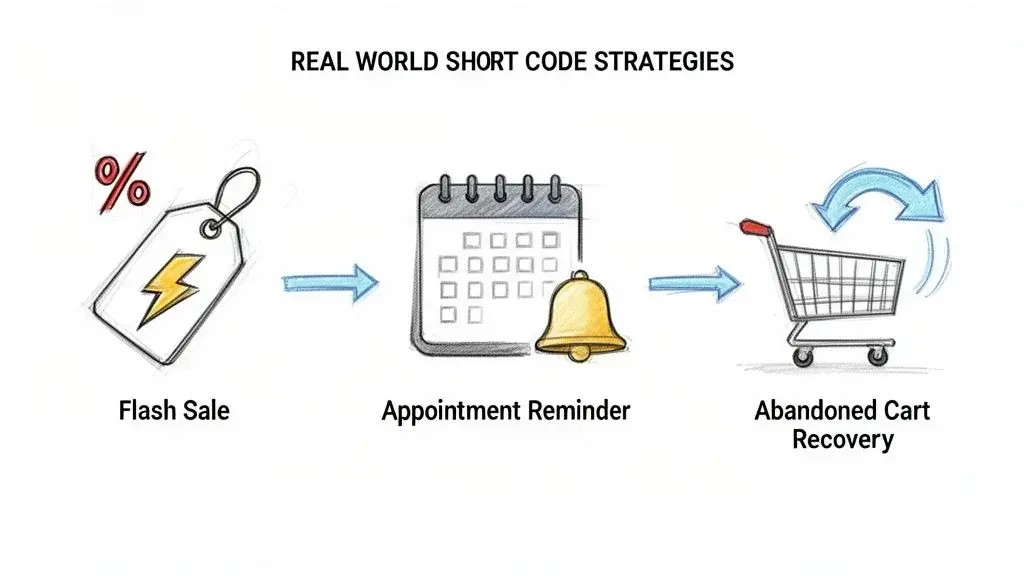
Here are a few winning strategies we see all the time:
- Retail Flash Sales: An online store texts its VIP list: "FLASH SALE! Get 40% off for the next 3 hours. Text SAVE to 55555 for your code." It creates instant urgency and sends a flood of traffic to their site.
- Appointment Reminders: A hair salon sends a quick text 24 hours before a client's appointment to cut down on no-shows. One simple alert can protect a lot of booked revenue.
- Abandoned Cart Recovery: Someone leaves a few items in their online cart. An hour later, a text pops up: "Forget something? Your items are waiting. Click here to complete your order." That gentle nudge is often all it takes to recover a sale that would have otherwise been lost.
Creating Multi-Channel Marketing Sequences
As powerful as short codes are on their own, they become absolute game-changers when you layer them with other communication channels. Think about a sequence where a customer gets a text, and if they don't respond, a ringless voicemail lands in their inbox the next day. This creates a follow-up system that's persistent without being annoying. This technique, sometimes called a voicemail drop, ensures your message is heard without disrupting your contact's day.
One rule to know: the FCC treats ringless voicemail to cell phones as a call made with a prerecorded voice, so it needs the same prior consent as other robocalls (FCC 22-85, November 2022).
By combining SMS with tools like ringless voicemail, you build a dynamic communication strategy that engages customers at multiple touchpoints, significantly increasing the likelihood of a response.
The best short code strategies are often powered by smart business tools working together in the background. When your texting platform and your CRM share the same contact record, opt-ins, replies and purchases can trigger the next message automatically, so you get the most out of every text you send. When your tools are in sync, a simple text message becomes a serious engine for growth.
For more ideas on building out your strategy, check out our guide on SMS marketing best practices for some extra insights.
Short Codes vs. 10DLC and Toll-Free Numbers
While SMS short codes are the heavyweight champs of high-volume texting, they aren't the only players in the game. To get the most out of business texting, you need to understand the whole landscape. Choosing between a short code, a 10DLC number, or a Toll-Free number really boils down to your specific needs for speed, volume, cost, and the kind of brand identity you want to project.
Think of it like picking a vehicle for a job. A short code is your Formula 1 race car: it’s built for incredible speed and massive audiences, but it comes with a premium price tag and takes longer to get on the track. It's the go-to for those huge national marketing campaigns where brand recognition and high throughput are absolutely non-negotiable.
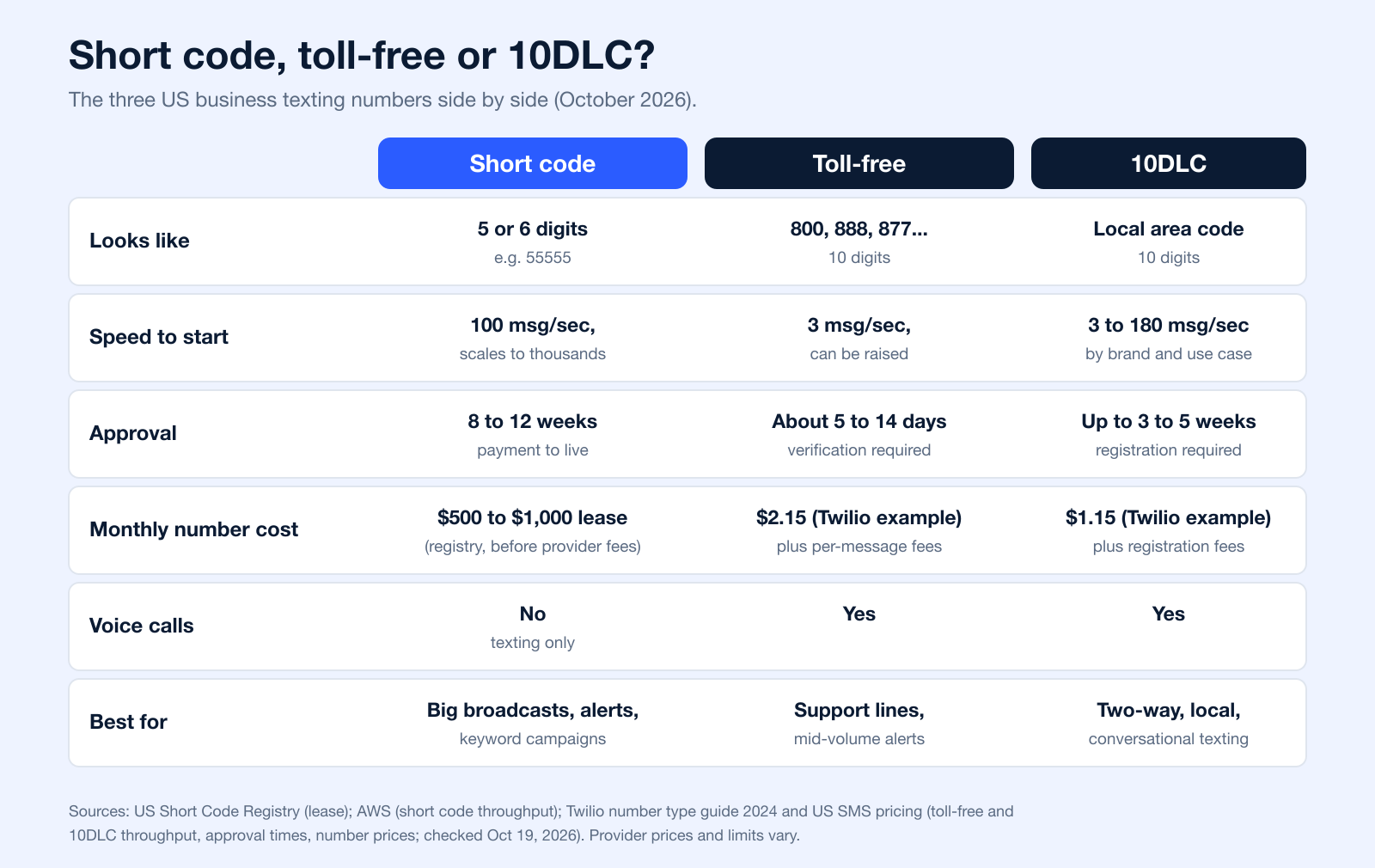
| If you need... | Use | Why | Source |
|---|---|---|---|
| National campaigns, keyword sign-ups on ads and TV, big alert bursts | Short code | Starts at 100 messages per second and scales; memorable 5 or 6 digits | AWS |
| To launch within weeks, support plus some marketing, one number for calls and texts | Toll-free | About 5 to 14 days to verify; voice-capable; starts at 3 messages per second | Twilio |
| Two-way conversations from a local number | 10DLC | 3 to 180 messages per second by brand and use case; voice-capable | Twilio |
| The lowest monthly number cost | 10DLC or toll-free | Twilio lists $1.15 and $2.15 a month vs $500 to $1,000 for a short code lease | Twilio pricing; Registry |
| To text people in more than one country | A separate number per country | A short code only reaches phones in its own country | AWS |
Throughput and approval times are one provider's published figures (Twilio, 2024; AWS, 2025); prices checked October 19, 2026. Other providers differ.
10DLC: The Conversational Workhorse
10-Digit Long Codes (10DLC) are essentially standard local phone numbers that have been registered for business messaging through the carriers' 10DLC system. They are the perfect tool for more conversational, lower-volume interactions that need a personal touch.
Because a 10DLC number looks just like a regular phone number, it feels more personal and less corporate. This makes it ideal for things like appointment reminders, one-on-one customer service chats, and targeted follow-ups. Their biggest advantage? They’re cheap: Twilio lists a local number at $1.15 a month plus registration fees (Twilio pricing). Setup is not instant, though: brand and campaign registration is required (unregistered traffic has been blocked since February 1, 2025, per Bandwidth) and vetting can take up to 3 to 5 weeks (Twilio). See our 10DLC compliance guide for the steps. While they can't match a short code's raw sending power, 10DLC numbers are a reliable and affordable starting point for any business focused on building relationships, not just broadcasting messages.
Toll-Free Numbers: The Versatile Middle Ground
Toll-Free numbers, like the familiar 800-series numbers, strike a fantastic balance between the power of short codes and the simplicity of 10DLC. Throughput starts at 3 messages per second and can be raised for qualifying senders to levels that rival short codes (Twilio), and they carry an immediate sense of trust and legitimacy that customers instantly recognize. Before a toll-free number can text US and Canadian phones it must pass toll-free verification, which takes about 5 to 14 days (Twilio).
Plus, they support both texting and voice calls, making them a versatile, all-in-one contact solution. For businesses that need to send more messages than 10DLC can handle but aren’t quite ready for the investment of a dedicated short code, Toll-Free texting is an excellent middle-of-the-road option that blends reliability with brand credibility.
How to Find Out Who Owns a Short Code
People search for specific codes ("who owns short code 22395?", "what is 34804?") and for lists of short codes. There is no official public directory that shows who leases a given US code: the US Short Code Registry lets businesses search for and lease available codes, and leases run 3, 6 or 12 months, so a code can change hands (Short Codes 101). Third-party "short code lists" can be out of date.
The reliable ways to identify a sender:
- Read the message. A short code program has to identify the organization in its call-to-action and first message (CTIA 5.1.1).
- Reply HELP. Short code programs must answer HELP with the program name and how to contact them, and should answer even if you never subscribed (CTIA Handbook).
- Check the brand's SMS terms. Legitimate programs publish terms that name the short code, the message frequency and how to opt out.
- Report spam. Forward unwanted texts to 7726 (SPAM) or report them at ReportFraud.ftc.gov (FTC).
For the receiver side in more detail (texting a short code, why replies fail, unblocking short codes), see how to text a 5-digit number.
Common Questions About SMS Short Codes
Even with the best strategy, you're bound to have a few questions when you're ready to pull the trigger on a new messaging solution. Getting straight answers helps you take those final steps with confidence. Let’s tackle the most common questions we hear from businesses about using short codes.
What's the Real Cost of an SMS Short Code?
When you get a dedicated short code, you're looking at two main costs: a one-time setup fee and a recurring lease. For a random, non-custom 5-6 digit number, the registry lease is $500 per month (US Short Code Registry).
Want something more memorable? A "vanity" short code that’s easy to recall and ties into your brand (think texting "SALE" to 24242) will cost you more: the registry lease is $1,000 per month. The lease goes to the registry; your messaging provider adds its own setup, platform and per-message fees (Twilio, for example, lists $1,000 to $1,500 a month for the lease plus a setup fee and per-message carrier fees: Twilio SMS pricing).
How Long Does the Short Code Approval Process Take?
Getting a short code isn't something you can do overnight, so you definitely need to plan ahead. Once you submit your application and a detailed campaign brief explaining exactly how you'll use it, you should budget for about 8 to 12 weeks from payment to live, 6 to 10 of them for carrier review (Twilio).
During this time, every major mobile carrier reviews your application and provisions the code for their network. The timeline really depends on how clear your application is and the complexity of your campaign. Bottom line: start the process well before you need it for any big marketing push.
That 8 to 12-week window is a typical provider estimate, not a guarantee: AWS notes there is no service level agreement for short code approval. It gives carriers the time they need for thorough compliance checks and technical testing to make sure everything works smoothly for their customers.
Can I Use One Short Code for Multiple Countries?
Nope. SMS short codes are strictly country-specific: a short code can only reach recipients in the country where it is based (AWS). A short code approved for the United States won't work in Canada, the UK, or anywhere else; Canada, for example, runs its own registry through the CWTA (CTIA 5.5.4). Every country has its own set of rules, carrier networks, and approval hoops to jump through.
If you’re planning to run SMS campaigns internationally, you’ll have to apply for and lease a separate short code for each country you want to reach. It’s the only way to stay compliant with local laws and carrier rules, ensuring your messages actually get delivered.
What are short codes for text messaging?
They are 5 or 6-digit numbers that businesses lease to send and receive texts at high volume, such as alerts, reminders and keyword sign-ups ("Text JOIN to 55555"). In the US they are leased through the Common Short Code Administration, governed by CTIA (CTIA 5.5.4).
Who owns a specific short code, like 22395 or 34804?
No official public lookup shows who leases a given code, and codes can change hands when leases end. Read the brand name in the message, reply HELP for the program name and contact details, or check the brand's SMS terms. More in How to Find Out Who Owns a Short Code.
How can I find SMS short codes?
If you are a business, search for available codes and lease one at the US Short Code Registry (directly or through your messaging provider); the steps are in our short code registration guide. If you are a consumer looking for a sender, use the brand's SMS terms or a HELP reply rather than third-party lists.
Can a short code receive phone calls?
No. Short codes are for SMS and MMS only and are not voice-enabled; toll-free and 10DLC numbers can handle both calls and texts (Twilio).
Ready to build powerful, multi-channel outreach campaigns with SMS, ringless voicemail, and voice broadcasts? Broadcast provides the tools and compliance features you need to connect with your audience at scale. Start your free trial today and see the difference for yourself!