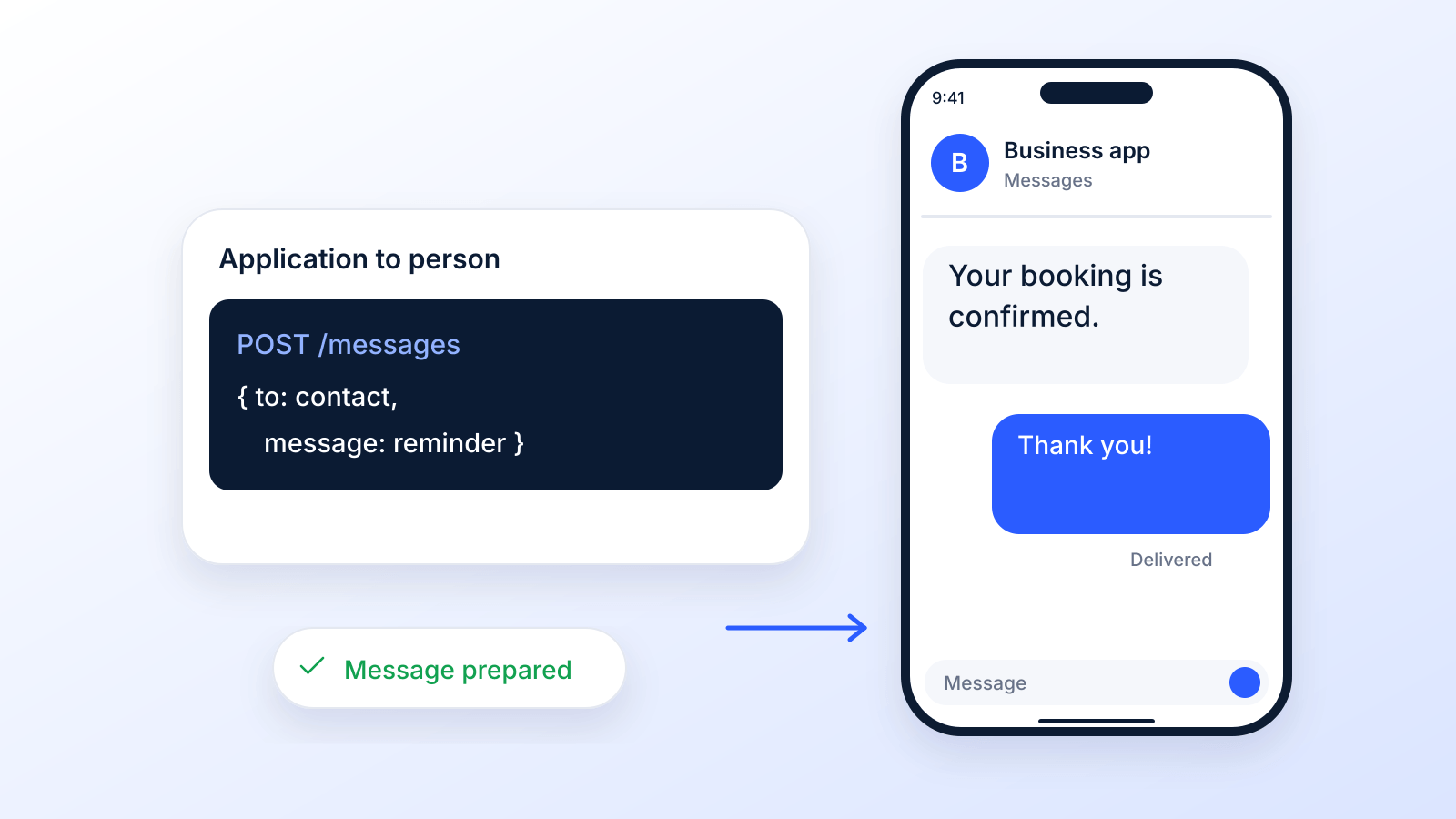
Let's cut through the jargon. At its core, A2P (Application-to-Person) messaging is a text sent by a business or organization to a real person, usually from software that sends it automatically. It's the magic behind the flight status updates, appointment reminders, and flash sale alerts that pop up on your phone every day.
The wireless industry's own rulebook, CTIA's Messaging Principles and Best Practices (May 2023), now calls these "Non-Consumer" (A2P) and "Consumer" (P2P) messaging, and notes that some carriers still use the older A2P and P2P labels. Facts and rules in this guide were checked on October 19, 2026.
Your Guide to A2P Messaging
Think of A2P as a one-way announcement from a business to its audience. A concert promoter texting thousands of ticket holders about a last-minute time change? That's a perfect example of A2P in action.
It's a system built from the ground up for scale and reliability. This is completely different from the casual, back-and-forth texts you exchange with a friend, which is known as P2P (Person-to-Person). The distinction might seem small, but it's crucial: mobile carriers treat these two types of messages very, very differently.
A2P vs P2P Messaging at a Glance
To really see the difference, let's break it down side-by-side. While both use SMS, their purpose, technology, and rules are worlds apart.
| Feature | A2P (Application-to-Person) | P2P (Person-to-Person) |
|---|---|---|
| Primary Use | Automated, one-to-many communication (alerts, marketing), plus customer service conversations | Conversational, one-to-one communication (friends, family) |
| Sender | A business, organization or anyone acting for one, whether a platform or a person sends the text | An individual texting from their own phone |
| Volume | High-volume, mass messaging | Low-volume, individual messages (CTIA: rarely more than a few hundred a day) |
| Phone Numbers | Short codes, toll-free numbers, 10DLC | Standard 10-digit mobile numbers |
| Carrier Approval | Requires carrier registration and vetting | No special registration required |
| Speed | From 3 messages per second (10DLC, toll-free) to 100 or more (short codes), per Twilio | About 15 to 60 messages per minute; rarely more than one per second (CTIA) |
Sources: CTIA Messaging Principles, sections 3.3, 4.1 and 4.2 (May 2023); Twilio number type guide (2024). Checked October 19, 2026.
Understanding this table is the first step to getting A2P right. P2P is for personal chats, while A2P is the professional tool for business communication. One detail trips people up: a sales rep texting customers one by one from a business line is still A2P, because CTIA classifies messages by who sends them, not by how they are typed (CTIA 4.1.1).
This method has become the backbone of modern customer engagement, allowing businesses to connect instantly and reliably with massive audiences. It's a powerful tool not just for standard SMS but also for related technologies like ringless voicemail, where a pre-recorded message lands directly in someone's voicemail box without their phone ever ringing.
The importance of A2P messaging isn't just anecdotal. Texting as a whole keeps growing: Americans exchanged nearly 2.2 trillion SMS and MMS messages in 2024, according to the CTIA 2025 Annual Survey, and a large share of the texts people receive every day come from businesses.
To tap into this power, companies use specialized platforms that handle all the tricky parts of sending messages at scale. These systems are designed to manage everything from compliance to deliverability, making sure your communications actually reach the people they're meant for.
When you set it up right, a solid SMS text messaging platform can automate your outreach, make your team more efficient, and drive real results. This guide will walk you through everything you need to know to get started.
How an A2P Message Travels from App to Phone
Ever wonder what actually happens after you hit 'send' on a mass text campaign? An A2P message doesn't just poof into existence on someone's phone. It takes a lightning-fast, highly specialized journey through an infrastructure built for speed and reliability.
This system is completely different from the simple path your personal texts take. Think of it like a dedicated postal service for businesses. When you send a message, you're not just dropping it in a regular mailbox. You're handing it off to a high-volume sorting facility designed to process thousands of messages a minute.
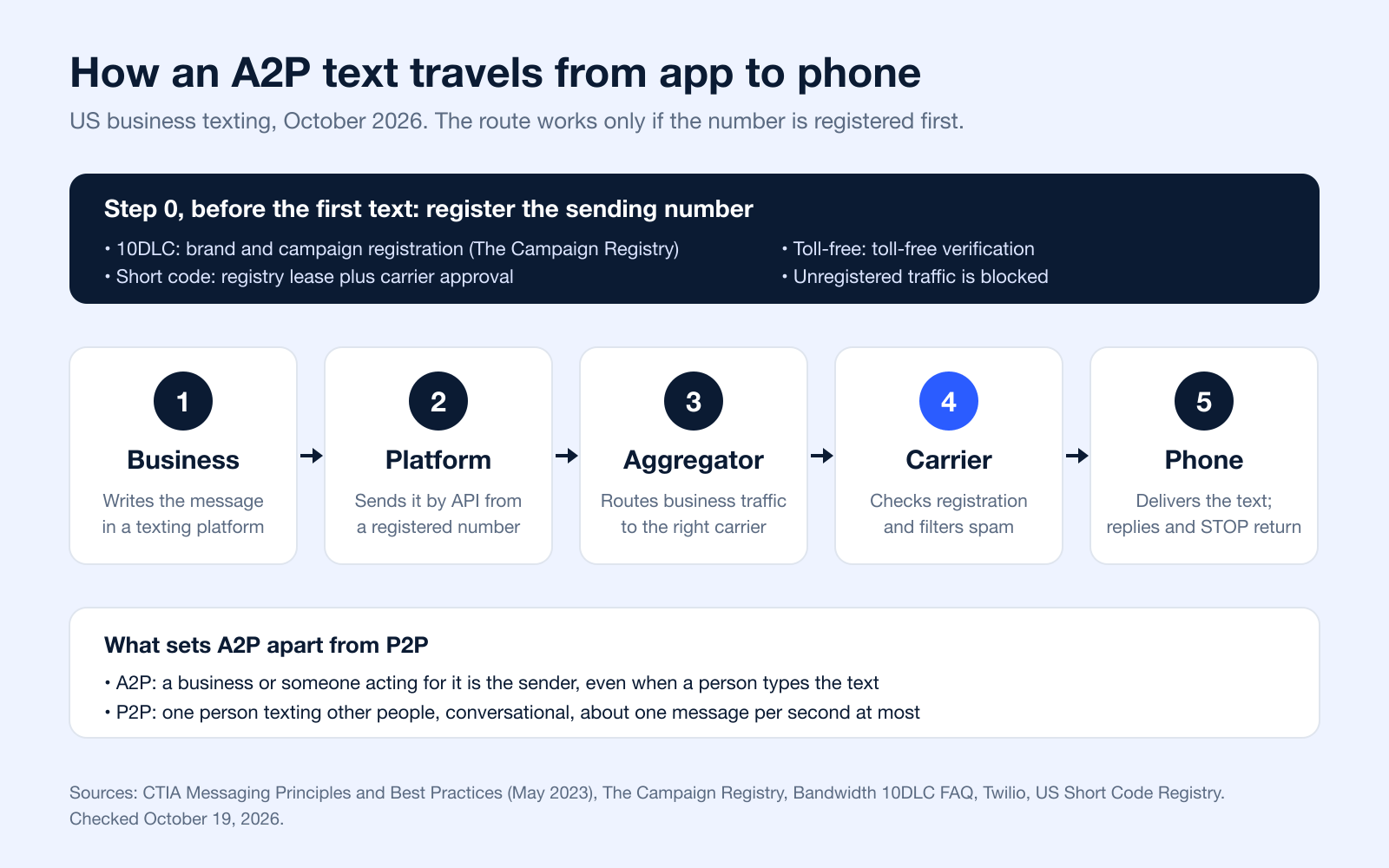
The journey starts the moment a business uses a platform to send a message. This kicks off an API call: basically a technical request that bundles up the message and shoots it off to the next stop.
The Role of Aggregators and Carriers
From the platform, the message zips over to a messaging aggregator. These companies are the main traffic controllers of the A2P world. They have direct pipelines into mobile carriers and their entire job is to sort and route massive volumes of texts from thousands of businesses.
The aggregator then passes the message to the right mobile carrier network, like T-Mobile, Verizon, or AT&T. The carrier checks that the traffic comes from a registered sender, runs its spam filters, and then delivers it straight to the recipient's device. This whole dance usually happens in seconds, which is how you get near-instant communication on a huge scale. Replies travel back the same way: CTIA counts messages sent "by or to" a business as A2P (CTIA 4.2), so a customer's reply or STOP is part of the same program.
The image below really nails the fundamental difference between the two communication paths.

As you can see, A2P is all about one-to-many broadcasting, while P2P is built for those classic one-to-one chats.
Choosing Your A2P Number Type
Businesses can't just use a personal cell number for A2P messaging. You have to use specific, carrier-approved numbers, and picking the right one is a crucial first step.
- Short Codes: These are the memorable 5 or 6-digit numbers (like 555-55) you see for high-volume marketing and alerts. They offer the fastest sending speeds, starting at 100 messages per second, but they're also the priciest option: the US registry lease alone is $500 to $1,000 a month (US Short Code Registry).
- Toll-Free Numbers: Your standard 1-800 numbers can be text-enabled for A2P. They're a trusted option for things like customer service updates and notifications, but they must pass toll-free verification before they can text US and Canadian phones (Twilio).
- 10DLC (10-Digit Long Code): This is a standard 10-digit local number that’s been officially registered with carriers for business use through The Campaign Registry. It has quickly become the go-to for most businesses, striking a great balance between cost, trust, and sending speed.
| Number type | Looks like | Starting speed | What you must do before texting | Typical approval | Source |
|---|---|---|---|---|---|
| 10DLC | A local 10-digit number | 3 to 180 messages per second, by brand trust score | Register the brand and each campaign with The Campaign Registry through your provider | Up to 3 to 5 weeks with vetting | Twilio; TCR |
| Toll-free | 800, 888, 877 and similar | 3 messages per second, can be raised for qualifying senders | Complete toll-free verification | About 5 to 14 days | Twilio; Twilio docs |
| Short code | 5 or 6 digits | 100 messages per second and up | Lease the code from the US Short Code Registry and pass carrier review | 6 to 10 weeks of carrier review | Twilio; Registry |
| Personal phone number | Your own mobile number | About one message per second at most | Not allowed for business messaging programs | Not applicable | CTIA |
Throughput and approval times are one provider's published figures (Twilio, 2024); other providers differ. Checked October 19, 2026. For a deeper look at short codes, see our guide to SMS short codes.
Key Takeaway: The entire A2P system (from the API call to the aggregator and carrier network) is purpose-built to handle business traffic securely and efficiently. This specialized route is what separates legitimate business communication from spam.
Getting this right is the key to making sure your messages actually land in the inbox. When businesses use an approved number type and a compliant platform, they give their messages the best chance of high deliverability. If texts are failing anyway, our guide to why text messages are not being delivered walks through the common causes.
Understanding what gets a message delivered is a topic all its own, which is why we've put together a guide on how to improve your A2P SMS deliverability. It’s essential for making sure your important communications, from marketing promos to ringless voicemail notifications, connect with your audience every time.
The Rules of the Road: A2P Compliance and Registration
If you want to get into A2P messaging, you have to play by the rules. Mobile carriers have put strict requirements in place for a good reason: to protect all of us from the flood of spam texts and build a communication channel people can actually trust. For any business, understanding these compliance rules isn't just a good idea; it's the single most important factor in actually getting your messages delivered.
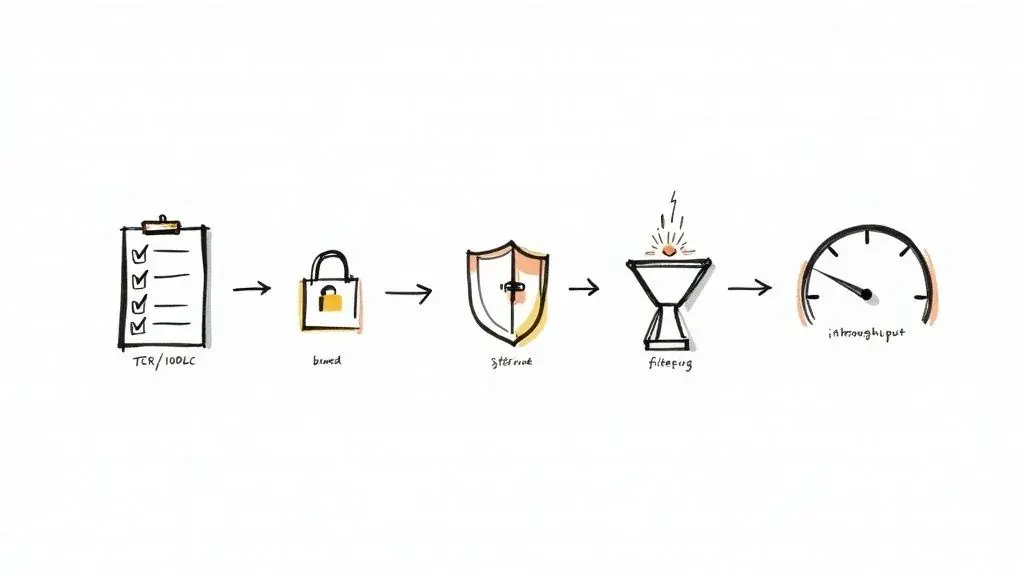
It wasn't always this organized. In the past, some businesses would try to game the system by using unregistered numbers for their mass messaging. This pushed carriers to create a formal registration system to tell the good guys from the bad guys. Now, when a customer gets a text from a registered business, carriers know who sent it and what kind of program it belongs to.
The Campaign Registry and 10DLC
At the center of 10DLC compliance in the United States, you'll find The Campaign Registry (TCR). TCR runs the central registry where brands and campaigns are verified before they can send A2P messages on standard 10-digit long code (10DLC) numbers. Most businesses do not register with TCR directly: their messaging provider (a "Campaign Service Provider") registers the brand and campaigns for them (The Campaign Registry). Toll-free numbers and short codes have their own separate approval processes.
Think of it as getting a business license for your text messaging.
The process is pretty straightforward and breaks down into two main steps:
- Brand Registration: First, you register your business itself. You’ll provide basic details like your legal company name, address, and tax ID (EIN). This is how you prove to carriers that you're a real, legitimate organization. Individuals without an EIN can use a separate Sole Proprietor registration with lower limits (Twilio).
- Campaign Registration: After your brand is approved, you register each specific "campaign," which is just a way of describing the type of messages you plan to send. You'll explain the campaign's purpose (like marketing promotions or appointment reminders) and even provide a few sample messages.
This simple process builds a ton of trust with the carriers. When their systems see a message coming from a registered brand and a well-defined campaign, they are far less likely to mistake it for spam. Getting registered is the bedrock of any solid A2P strategy.
For the full registration checklist (use cases, sample messages, opt-in proof, fees), see our 10DLC compliance guide.
Throughput, Filtering, and Why Registration Matters
Following the rules has a direct, immediate impact on how well your messaging performs. There are two key concepts you need to get familiar with: throughput and filtering.
- Throughput is simply the speed at which you can send messages, usually measured in messages per second (MPS). Registered 10DLC campaigns get between 3 and 180 MPS depending on the brand's trust score (Twilio). Unregistered traffic is no longer just slowed down: it is blocked. Twilio has blocked unregistered 10DLC traffic since September 1, 2023 (Twilio), and "as of February 1, 2025, unregistered outbound traffic is being blocked in the industry" (Bandwidth).
- Filtering is what carriers use to automatically block spam. Even registered traffic is filtered, so content and consent still matter, but registration gives your messages a known, vetted sender, which lowers the chance of being blocked. On toll-free numbers, Twilio blocks messages from numbers that were never submitted for verification since November 8, 2023, and from numbers still pending or restricted since January 31, 2024 (Twilio changelog; error 30032).
By completing the registration process, you are essentially telling carriers, "We are a legitimate business sending messages that our customers want." This unlocks higher sending speeds and gives your communications a much better chance of reliably reaching your audience.
At the end of the day, compliance isn't about jumping through hoops to avoid penalties; it’s about making your messaging work. Platforms and services are also held to these same strict standards, so it's always smart to review a provider's policies. You can get a deeper sense of what this looks like by reading Broadcast's comprehensive anti-spam policy to see how a compliant framework protects both businesses and their customers. By embracing registration, you make sure all your A2P efforts succeed.
Registration is the carriers' side. The law has its own rules: the FCC says "Commercial texts require written consent" (FCC consumer guide), and replies such as STOP, QUIT, END, REVOKE, OPT OUT, CANCEL or UNSUBSCRIBE revoke consent and must be honored within a reasonable time, no more than 10 business days (47 CFR 64.1200(a)(10)). For the full list, see our SMS compliance checklist.
Putting A2P Messaging to Work in Your Business
Alright, we’ve covered the technical side of things. Now let’s get to the fun part: seeing how A2P messaging actually helps businesses make more money and keep customers happy. This isn't just some background tech; it's a powerful tool that companies, from local shops to massive enterprises, use every single day.
The real magic of A2P is its direct line to your customer's pocket. It delivers important, timely info straight to the one device they never ignore: their phone.
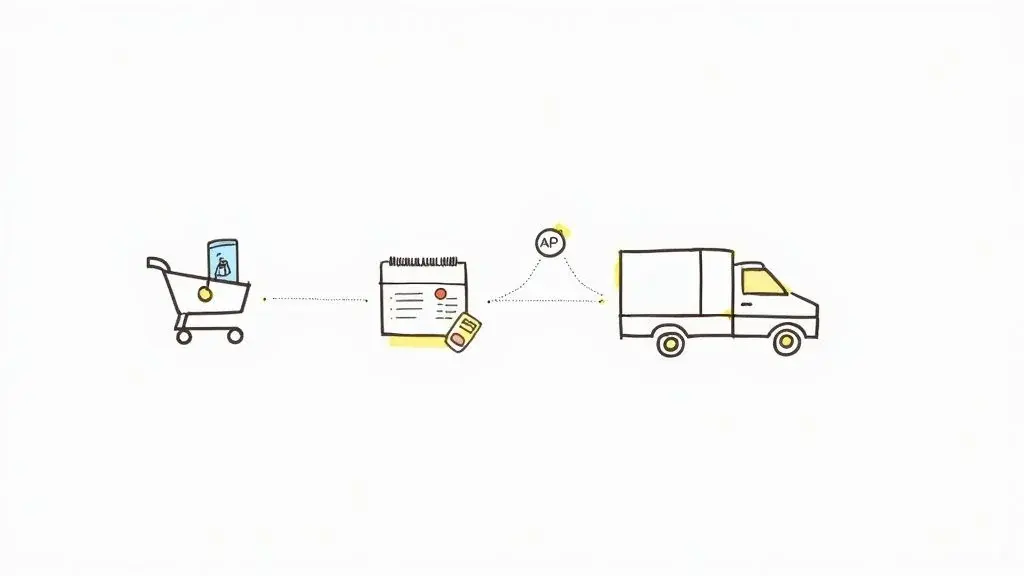
Think about it. This lets you slice right through the noise of a jam-packed email inbox or a chaotic social media feed. Your most critical messages get seen. In fact, A2P is the engine behind many of the essential business automations companies can't live without, from order updates to login codes.
Common A2P Use Cases Across Industries
The ways businesses use A2P are incredibly varied. Retailers send flash sale alerts and reminders about abandoned shopping carts (to subscribers who opted in). Healthcare providers automatically send appointment confirmations, which helps cut down on no-shows. The impact shows up in every industry.
Here are just a few real-world examples of A2P in action:
- Retail and Ecommerce: Sending out promo codes, order confirmations, and shipping updates. It keeps customers in the loop and hungry for their next purchase.
- Healthcare: Delivering appointment reminders, alerts for prescription refills, and notifications for lab results securely and on time.
- Service Businesses: Firing off package delivery notifications, appointment reminders for home visits, and follow-up texts asking for a quick review.
- Financial Services: Issuing instant fraud alerts, one-time passwords for secure logins, and gentle nudges about upcoming payments.
CTIA's own examples of A2P traffic match this list: messages from a business to many customers, customer service conversations, and "service alerts or notifications (e.g., fraud, airline)" from senders such as financial service providers, schools and medical practices (CTIA 4.2). Banks and retailers are among the heaviest users, because fraud alerts, login codes, order updates and promotions all run on A2P.
Combining A2P SMS with Ringless Voicemail
One of the smartest strategies we see is pairing A2P SMS with other channels. Imagine a customer gets a text about an important payment due soon. A couple of days later, you could follow up with a non-intrusive ringless voicemail that gives them a bit more detail or a friendly reminder, all without their phone ever actually ringing. This type of communication is often called a voicemail drop.
One rule to know: the FCC treats ringless voicemail to cell phones as a call made with a prerecorded voice, so it needs the same prior consent as other robocalls (FCC 22-85, November 2022). More in our guide to ringless voicemail compliance.
This multi-channel approach makes your communication strategy far more robust. You can layer your messages, using the instant hit of an SMS for urgent stuff and the personal feel of a voice message for more detailed follow-ups.
By combining tools like SMS and ringless voicemail, businesses can create a cohesive communication experience that respects the customer's time while ensuring the message is received.
This approach lets you connect with your audience on their own terms, which naturally boosts response rates and builds a much stronger relationship. At the end of the day, A2P is the engine that drives these kinds of automated, multi-step campaigns, making them scalable and incredibly effective for any business.
Choosing the Right A2P Messaging Platform
Okay, you get what A2P is and how the magic happens behind the scenes. The next logical question is: which platform do you trust to handle it for you? This is a bigger decision than it seems.
Not all messaging platforms are built the same. Far from it. The partner you choose will make or break your SMS campaigns, directly impacting whether your messages get delivered, if you stay on the right side of carrier rules, and what kind of return you see for your efforts.
It's tempting to get wooed by flashy features and slick sales demos, but success comes from focusing on the fundamentals. You're looking for a true partner, someone who handles the messy technical stuff so you can get back to what you do best: talking to your customers.
What to Look For in an A2P Provider
When you start comparing options, it's easy to get lost in feature lists that are a mile long. Let's cut through that noise. A handful of core elements really separate the great platforms from the merely good ones. Think of these as the non-negotiables.
Here's what should be at the top of your checklist:
- A Rock-Solid API & Clear Docs: If you have developers, this is everything. A stable, well-documented API means they can get up and running fast without wasting days troubleshooting.
- An Interface Anyone Can Use: Your marketing team shouldn't need to be coders to send a text blast. A clean, intuitive platform lets you quickly set up everything from simple SMS alerts to more complex sequences that include ringless voicemail.
- Pricing That Makes Sense: No one likes surprise fees. Look for a straightforward pricing model. For example, some platforms only bill for successful ringless voicemail drops. That’s a fair approach because you’re only paying for what actually works.
The Two Things You Absolutely Can't Compromise On
Beyond the tech specs, two "hidden" factors will determine your long-term success: the platform's dedication to compliance and the quality of their support. Get these wrong, and you're in for a world of hurt.
Here's a little inside baseball: A provider's relationships with the mobile carriers are their secret weapon. A platform with deep carrier connections can get deliverability problems sorted out way faster and go to bat for you when issues pop up. That's the difference between a message sent and a message received.
This is why you have to find a platform that takes compliance seriously. That means giving you the tools to manage opt-outs automatically and helping you through the entire 10DLC registration process (and toll-free verification, if you text from a toll-free number). A provider who helps you navigate the red tape is worth their weight in gold.
And finally, test their support before you commit. Send them a question. See how quickly they respond and how helpful they are. When you're in a pinch, having a responsive, knowledgeable human to help you is priceless. It shows they're actually invested in your success.
A2P is a Global Game
Don't think of A2P messaging as just some local trend; it’s the global standard for how businesses talk to people, and it has exploded across every continent. While the idea is the same everywhere, how it's used and how fast it's growing can look wildly different from one place to another.
The Asia-Pacific region is usually described as the largest A2P market by volume, driven by rapid digital growth, a boom in mobile banking, and very high smartphone ownership in countries like China and India. Market-research firms publish share estimates for each region, but they vary by firm and method, so treat any single figure with care.
But while Asia-Pacific brings the volume, North America brings a different kind of value. It's a mature market, heavily focused on playing by the rules: carrier registration for 10DLC, toll-free verification and short code audits make the US one of the most regulated A2P markets. And texting keeps growing there, with nearly 2.2 trillion SMS and MMS messages exchanged in 2024 (CTIA).
New Players are Entering the Field
It's not just about the established leaders, either. We're seeing huge growth in Africa and the Middle East as their digital infrastructure comes online, turning A2P into a truly global tool, not just something for developed nations.
Here's one of the most interesting shifts: small and medium-sized businesses (SMBs) now use A2P as routinely as large brands. Registration options such as Low-Volume Standard and Sole Proprietor 10DLC brands exist precisely for smaller senders (Twilio). It shows that powerful communication tools, which used to be locked away for huge corporations, are now open for businesses of all sizes.
This worldwide adoption is a strong signal that building an A2P strategy is a smart, long-term move. Whether you're sending out a marketing text blast, a critical alert, or a gentle follow-up with a ringless voicemail, you’re using a channel that people trust and understand no matter where they are. It's a reliable bet for any business looking to connect.
Got Questions About A2P? We've Got Answers.
Even after you get the basics down, a few questions always pop up when businesses start thinking about actually using A2P messaging. Let’s clear the air and tackle some of the most common ones so you can move forward with confidence.
Is A2P Messaging Considered Spam?
Absolutely not. Legitimate A2P messaging is consent-based communication, not spam. The entire framework is built around one core idea: customers must give you permission to text them. CTIA expects businesses to get consent before messaging (CTIA 5.1), and the FCC requires written consent for commercial texts (FCC).
Think of it this way: the whole 10DLC registration process was created specifically to weed out spammers and verify legitimate businesses. Spam is junk mail you never asked for. A2P is a regulated channel for sending messages your customers actually want. That’s what makes it so powerful.
What Is 10DLC and Why Does It Matter for A2P?
10DLC is short for "10-Digit Long Code." In simple terms, it’s a standard, local-looking phone number that has been registered for business messaging through The Campaign Registry. It was created to give businesses a reliable and affordable way to send texts at a higher volume than a personal phone ever could. "A2P 10DLC" simply means application-to-person messaging sent from one of these numbers.
Getting your brand and campaigns registered for 10DLC is non-negotiable in the US now: unregistered 10DLC traffic is blocked (Bandwidth). This process is how you prove to carriers that you're a legitimate sender. In return, you get higher sending speeds and a lower chance of your texts being flagged as spam.
Can I Use My Personal Phone for A2P?
Please don't. Using your personal cell for mass business texting goes against carrier policies. CTIA's guidelines say that a person texting on behalf of a business counts as a business (Non-Consumer) sender, and that typical personal use is about one message per second at most, to a limited number of recipients (CTIA 3.3 and 4.1.1). Carriers watch for A2P-style traffic coming from regular P2P (person-to-person) numbers.
If you try it, your messages are likely to be filtered and your number can be blocked. For any kind of reliable business texting, use a dedicated A2P platform with a registered number, like a 10DLC or a verified toll-free number.
What is an A2P phone number?
It is a number a business is allowed to send A2P texts from. In the US there are three kinds: a 10DLC local number registered with The Campaign Registry, a toll-free number that passed toll-free verification, and a 5 or 6-digit short code leased from the US Short Code Registry. See the number types table above.
What is P2P texting?
P2P (person-to-person) texting is an individual texting other people from their own phone: conversational, low volume, and usually answered. CTIA describes typical personal use as about 15 to 60 messages per minute at most, roughly one reply for every message sent, and messages to a limited number of people (CTIA 4.1.1). Some vendors sell "P2P texting" tools where staff send each text by hand; when a business sends them, carriers still treat that traffic as A2P.
What are the key differences between P2P and A2P SMS?
Who sends the message is the deciding factor: a person texting for themselves is P2P, a business or anyone acting for one is A2P. From that follow the other differences: A2P runs from registered numbers (10DLC, toll-free or short code), needs consent from recipients, and can send much faster, from 3 to 100 or more messages per second. See the comparison table at the top.
Can A2P numbers receive replies?
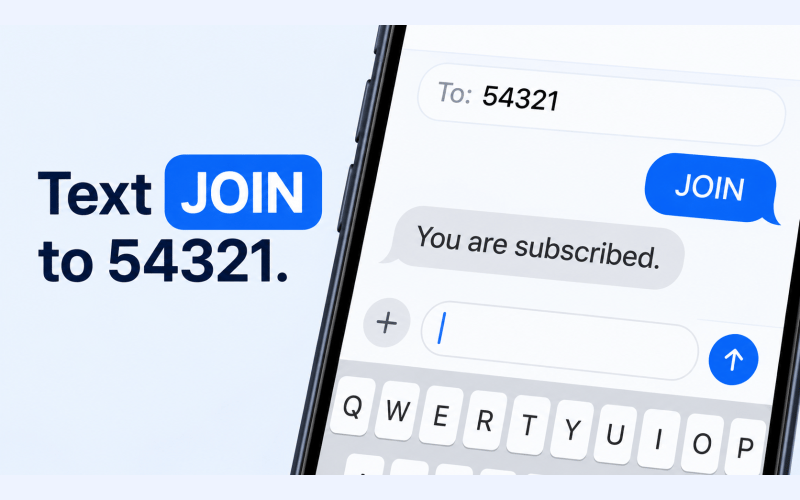
Yes. 10DLC and toll-free numbers support two-way texting, and short codes receive keyword replies such as JOIN, HELP and STOP. CTIA counts messages sent to a business as A2P too (CTIA 4.2), so replies follow the same program rules, and opt-out replies must be honored.
Ready to start sending messages your customers actually want to receive? With Broadcast, you can easily manage SMS campaigns, send ringless voicemail drops, and automate your outreach while staying fully compliant. See how Broadcast can help you connect with your audience today.