SMS marketing works for small businesses when the message is timely, permission-based, and useful. In practice, that usually means appointment reminders, limited-time offers, review requests, order updates, and service notifications, not constant promotions. The channel is where customers already are: Americans exchanged nearly 2.2 trillion SMS and MMS messages in 2024, according to CTIA’s 2025 Annual Survey. The catch is just as important: texting is a poor fit for long educational content, broad unsolicited outreach, or anything you cannot justify interrupting someone with. In the US, marketing texts also come with rules (consent, quiet hours, opt-outs, number registration), summarized in the rules section below.
How We Evaluated SMS Marketing for Small Businesses
We approached this guide like a buyer’s checklist, not a generic channel overview. The criteria we prioritized were the ones that usually determine whether SMS becomes a useful operating tool or an expensive headache for a small team: compliance requirements, setup complexity, automation depth, local-business fit, pricing transparency, and how well a platform supports two-way conversations.
In our view, the fastest way to waste money on SMS is to buy for headline features instead of day-to-day use. A restaurant, salon, dental office, or home-services company usually needs dependable reminders, simple automations, clear opt-in records, and easy replies long before it needs advanced enterprise segmentation. We also treated any tactic that depends on unsolicited promotional texting as a poor choice, because legal risk and list quality problems quickly outweigh the upside.
We also weighted transparency heavily. If a tool makes it hard to estimate monthly spend, hides automation behind expensive tiers, or lacks clear unsubscribe and consent controls, that matters. For small businesses, the best setup is usually the one staff can run consistently without extra technical overhead.
Why SMS Is Your Secret Weapon for Growth
SMS marketing is the practice of sending consent-based text messages to customers for promotions, reminders, updates, and follow-up communication. For a small business, it tends to work best when the message is short, relevant, and tied to a clear moment: a booking tomorrow, a flash sale today, a review request after service, or a delivery update that cannot wait for email.
It is not a universal replacement for email or social media. If you need room for storytelling, product education, or richer visuals, email usually does that better. If you do not have explicit permission to text someone, SMS is the wrong channel entirely. I’d rather see a business send fewer texts with obvious value than treat the inbox like a discount megaphone.
Quick Proof: Why Small Businesses Still Use SMS in 2026
The reason is reach and timing, not magic numbers. Americans exchanged nearly 2.2 trillion SMS and MMS messages in 2024 (CTIA), and a text shows up on the lock screen the moment it arrives. Be careful with the open-rate figures (often quoted as 90% or more) that circulate in vendor roundups: we could not trace them to a primary study, and most SMS platforms report delivery, clicks and replies rather than opens. Measure your own results instead (see how to measure campaign effectiveness).
For a local business, that speed matters more than vanity metrics. A reminder that cuts no-shows, a same-day promo that fills empty tables, or a service update that prevents missed appointments is often worth more than a large but passive email list.
Is SMS Marketing Worth It?
Usually yes, if you use it for high-intent moments. A salon can reduce no-shows with reminder and confirmation texts. A dental office can fill cancellations from a waitlist. A retailer can move slow inventory with a weekend-only offer. A home-services company can text technician arrival windows and review requests after the job. Those are practical use cases with a direct operational payoff.
What makes SMS worth it is not just open rate; it is the combination of speed, visibility, and action. The businesses that get the best results usually keep lists clean, set expectations clearly, and avoid over-messaging.
SMS Marketing vs Email Marketing At a Glance
So, how does texting stack up against the old standby, email? Here’s a quick look at why SMS is such a powerful tool for small business communication.
| Metric | SMS Marketing | Email Marketing |
|---|---|---|
| What you can measure | Delivery, clicks, replies, opt-outs (no standard open tracking) | Opens (pixel based, approximate), clicks, unsubscribes |
| How it arrives | On the lock screen, as a notification | In the inbox, next to other mail |
| Click-through rate | Set your own baseline from your first campaigns | Set your own baseline from your first campaigns |
| Customer Preference | Preferred for urgent updates | Preferred for longer content |
| Required Effort | Minimal: 160 standard characters per segment, 70 with an emoji (Twilio) | High (design, copy, etc.) |
Email still has its place for newsletters and longer-form content. SMS wins when the message is short and the timing matters. For a fuller comparison, see SMS vs email marketing.
Building Your Subscriber List the Right Way
Before a single text goes out, you need a list. But not just any list: you need a community of engaged people who have willingly raised their hands and said, "Yes, I want to hear from you." This is the bedrock of successful SMS marketing, and it’s built on two simple things: trust and value.
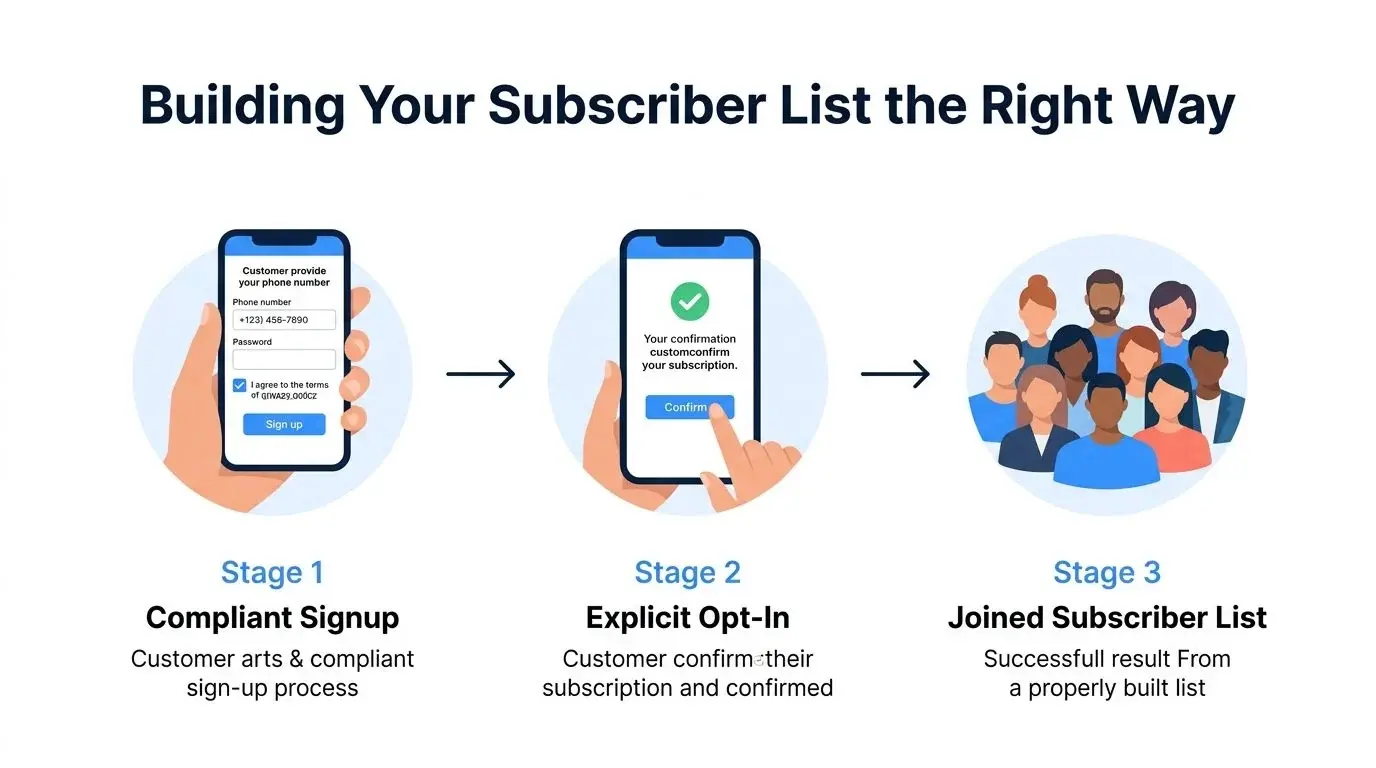
Getting that trust starts with respecting the law. Under the Telephone Consumer Protection Act (TCPA), a text is a "call" (Campbell-Ewald v. Gomez, 2016), and marketing texts sent with an autodialer generally need "prior express written consent": a signed agreement (an online checkbox or keyword reply with an electronic signature counts) that names the phone number and says consent is not a condition of purchase (47 CFR 64.1200(a)(2) and (f)(9)). Carriers expect the same for any promotional message (CTIA Messaging Principles 5.1).
This permission, called an "opt-in," protects your business and guarantees you’re only talking to people who are interested. An unsolicited text feels like a stranger barging into someone's living room. A text someone asked for feels like a welcome guest.
Earning the Opt-In with Value
Beyond the legal checkboxes, the secret to growing your list is offering undeniable value. People guard their phone numbers closely, so give them a clear, compelling reason to share theirs with you.
So, what does a valuable offer look like? It's anything that makes a customer's life easier, saves them some cash, or gives them a taste of the VIP life.
- Exclusive Discounts: "Text DEALS to 555-1234 for 15% off your next purchase!"
- VIP Access: "Join our Text Club for early access to new arrivals and members-only sales."
- Helpful Content: "Sign up for weekly tips from our head chef, delivered right to your phone."
The trick is to make the benefit crystal clear. You aren't just asking for a number; you're offering a tangible reward in return. This value-first mindset shifts the opt-in from a dry transaction to the beginning of a real relationship. For a deeper dive, check out our guide on 5 ways to grow your SMS marketing list starting today.
Crafting Compliant and Compelling Calls to Action
Your opt-in language has to be clear and direct. You set expectations and build that first layer of trust. A fully compliant call to action (CTA) needs a few key pieces.
Key Takeaway: Always clearly state what users are signing up for, how often they can expect messages, that message and data rates may apply, and how to opt out (e.g., "Reply STOP to cancel"). CTIA also lists your business name, a help contact and a link to your privacy policy (section 5.1.1).
Let's see how this works in the wild:
- In-Store Signage: "Text PIZZA to 555-1234 to join our VIP Slice Club! Get a free slice on your next visit. Recurring msgs. Msg & data rates may apply. Reply STOP to cancel."
- Website Pop-Up: "Get 10% Off Your Order! Enter your number to receive exclusive offers and updates. By signing up, you agree to receive recurring automated marketing messages. Msg & data rates may apply. Reply STOP to end. View Terms & Privacy."
- Social Media Post: "Want first dibs on our next flash sale? Text FLASH to 555-1234 to get on the list! We'll send you alerts before anyone else. Msg frequency varies. Msg & data rates may apply. Reply STOP to unsubscribe."
Keep proof of every opt-in: CTIA recommends storing the timestamp, the sign-up method, the exact wording the person agreed to, the campaign, and the phone number (section 5.1.2), and never using rented, bought or shared lists (5.1.4). If a customer ever disputes a text, that record is your answer.
Sticking to best practices will build a high-quality list, not of phone numbers but of loyal fans who are excited to hear from you.
SMS Marketing Rules for Small Businesses (US, 2026)
Most small-business texting problems come from a handful of rules. This table summarizes the federal rules and carrier requirements as of October 2026. It is general information, not legal advice; state laws can add requirements.
| Rule | What it means for you | Source |
|---|---|---|
| Consent | Marketing texts sent with an autodialer generally need prior express written consent; consent cannot be a condition of purchase | 47 CFR 64.1200(a)(2), (f)(9) |
| Texts are calls | TCPA rules for calls apply to text messages | Campbell-Ewald v. Gomez (2016) |
| Quiet hours | No marketing texts before 8 a.m. or after 9 p.m., recipient’s local time; some states are stricter | 47 CFR 64.1200(c)(1) |
| Opt-out | Honor STOP, QUIT, END, REVOKE, OPT OUT, CANCEL or UNSUBSCRIBE within 10 business days; one confirmation text is allowed | 47 CFR 64.1200(a)(10), (a)(12) |
| Number registration | 10DLC brands and campaigns must be registered; unregistered traffic has been blocked since February 1, 2025. Toll-free numbers need verification | The Campaign Registry, Bandwidth, Twilio |
| Disclosures and records | Program name, frequency, fees, HELP and STOP in the sign-up and confirmation; keep consent records; no bought lists | CTIA Messaging Principles 5.1 |
| Penalties | $500 per violation, up to three times that if willful or knowing | 47 U.S.C. 227(b)(3) |
What changed recently
- February 1, 2025: carriers began blocking unregistered 10DLC traffic (Bandwidth).
- September 30, 2026: the FCC adopted new rules on revoking consent (by category, and through a designated method) and asked whether to shorten the time to honor opt-outs (FCC 26-67). Check the effective date before relying on the old timelines.
For the full checklist, see our TCPA compliance guide and 10DLC compliance.
Crafting Text Messages That Connect and Convert
A great text message shouldn’t feel like an ad. It should feel like a helpful tip from a friend. That’s the secret to SMS marketing for small business, delivering something valuable that feels personal, not pushy. The whole idea is to craft messages so spot-on and timely that your customers are happy to get them.
It all boils down to understanding what makes SMS unique. One standard text segment holds 160 characters (70 if you add an emoji), and longer texts are split and usually billed per segment (Twilio), so every single word has to pull its weight. There's zero room for corporate fluff or vague promises. Your message has to be clear, short, and compelling enough to make someone act right now, whether that’s clicking a link, stopping by your store, or texting back a keyword.
That directness is a huge advantage. A well-written text cuts straight through the noise and drops a little piece of value into your customer's hands exactly when they can use it. It changes your marketing from a generic broadcast into a personal invitation.
The Anatomy of a High-Converting Text Message
To get real results consistently, every text you send needs three key ingredients. Think of these as the fundamental building blocks for any campaign, whether you're announcing a flash sale or just sending a simple appointment reminder. Nail these, and your messages will always be clear, actionable, and focused on the customer.
- A Clear and Compelling Offer: Always lead with the "why." What's in it for them? It could be a discount, an exclusive first look, or just a helpful heads-up.
- Concise and Personal Language: Write like a person, not a robot. A friendly tone goes a long way, and using the customer's name when you can makes a huge difference.
- A Strong Call-to-Action (CTA): Tell them exactly what you want them to do next. Vague instructions get ignored, so be direct: "Show this text," "Click here to shop," or "Reply YES."
| Element | Purpose | Example |
|---|---|---|
| The Offer | Grabs attention and provides immediate value. | "VIP Early Access: Get 25% off our new collection!" |
| The Language | Builds connection and makes the message feel personal. | "Hey Sarah, your favorite items are back in stock." |
| The CTA | Drives a specific, desired action from the customer. | "Shop the sale now before it ends tonight: [link]" |
Proven Message Templates for Any Goal
Theory is great, but seeing it in action is better. Let’s walk through a few practical, real-world examples you can tweak for your own business. Pay attention to how each one is short, valuable, and has a crystal-clear next step.
For a Neighborhood Cafe:
"Good morning, Alex! Brighten up your Monday with a FREE pastry with any coffee purchase. Show this text to redeem. Valid today only!"
For a Local Hair Salon:
"Hi Jamie, you have an appointment with Chloe tomorrow at 2 PM. Please reply YES to confirm or call us at 555-1234 to reschedule. See you soon!"
For an Online Boutique:
"FLASH SALE ALERT! ✨ Get 30% OFF everything for the next 3 hours only. Don't miss out! Shop now: [short link]"
Pro Tip: Always include your business name. Your subscribers opted in, but they probably didn't save your number. Adding your name instantly clears up any confusion about who’s texting them.
These examples just work. They respect the customer's time, deliver a clear benefit without wasting words, and make it easy for someone to understand the value and take action. To really dig in and polish your approach, check out these detailed SMS marketing best practices.
By keeping your messages concise, personal, and actionable, you’ll do more than just drive sales; you’ll strengthen relationships. Every text is a chance to prove your worth and build the kind of loyalty that keeps people coming back.
How Much Does SMS Marketing Cost for a Small Business?
Small-business SMS costs usually come from four buckets: platform fee, per-message charges, phone number fees, and add-ons such as automation, integrations, or advanced reporting. The exact mix varies by provider, but most plans fall into one of two models.
The first is monthly subscription pricing. You pay a fixed fee for access to the platform, then either get a message allowance or still pay usage on top. This can make sense if you send messages every month and need automations, team access, or integrations.
The second is pay-as-you-go pricing. You pay mainly for what you send. This is often a cleaner starting point for very small lists, seasonal campaigns, or businesses testing SMS before committing to a full workflow.
In my view, the right question is not just “What does one text cost?” but “What does one useful workflow cost?” A reminder system that cuts missed appointments can justify itself quickly. A bulk promo plan with no segmentation often looks cheap until unsubscribes climb.
Common Pricing Variables to Check
- Monthly base fee: Often charged for platform access or included message credits.
- Per-message rate: Usually billed per outbound text segment; longer messages can count as multiple segments.
- Inbound or two-way texting fees: Some tools include replies, others treat them separately.
- Contact or seat limits: Useful to check if you have multiple staff members or a growing list.
- Automation access: Some plans reserve journeys, triggers, or API access for higher tiers.
- Compliance support: Opt-in forms, consent logs, and unsubscribe handling are not optional extras in practice.
A Simple Budgeting Rule for Small Businesses
Start with one high-value use case and estimate backward. If you are a salon with 600 opted-in contacts, sending reminders plus two promotional messages per month will cost differently than a retailer sending weekly campaigns to 5,000 contacts. For many small businesses, a good early budget is one that covers reminders, one welcome flow, and one or two monthly campaigns before expanding into more advanced automations.
A common rule of thumb for smaller businesses is to start with a few marketing texts per month (two to four is often suggested), make opt-out simple, and save SMS for high-value moments such as reminders and exclusive offers. Whatever frequency you choose, say it at sign-up: CTIA expects the confirmation text to disclose that messages are recurring and how often they arrive (section 5.1.2.1). Also budget for number registration (10DLC or toll-free verification), which carriers now require before you send (see 10DLC compliance).
Using SMS and Voice for a Seamless Experience
For most small businesses, the more urgent decision is not whether to add more channels; it is whether the SMS tool you choose matches your budget, staffing, and customer journey. A good platform should make it easy to collect consent, send two-way texts, automate reminders and follow-ups, and connect to the systems you already use. If it cannot do those basics cleanly, extra features will not save it.
I’d prioritize operational fit over feature count. A local service business often gets more value from reliable reminders and reply handling than from advanced campaign design. A retailer may care more about segmentation, offers, and POS integrations. The best choice depends on what you send, how often you send it, and who needs to manage it.
| Channel | Best For | Example Use Case |
|---|---|---|
| SMS Text Message | Immediate, concise, and actionable information. | Sending a flash sale link or a quick order confirmation. |
| Ringless Voicemail | Adding a personal, human touch in a non-intrusive way. | Leaving a thank you message or a special invitation. |
| Automated Voice Call | Urgent, high-priority notifications that require attention. | Communicating a last-minute event cancellation or a critical alert. |
Voice channels follow the same consent rules as texts: the FCC ruled in 2022 that ringless voicemail is a call under the TCPA, and it usually does not ring the phone, though it sometimes can (FCC 22-85). Prerecorded marketing messages need prior express written consent.
What to Compare Before You Choose an SMS Tool
| Criteria | What to Look For | Why It Matters for Small Businesses |
|---|---|---|
| Pricing model | Monthly plan, pay-as-you-go, or hybrid | Predictable spend matters when volume changes month to month |
| Contact limits | Included subscriber count or overage fees | Cheap entry plans can get expensive as your list grows |
| Automation access | Welcome flows, reminders, follow-ups, triggers | Automation is where small teams save the most time |
| Two-way texting | Shared inbox, routing, reply management | Replies matter for bookings, confirmations, and service updates |
| Integrations | CRM, booking app, POS, ecommerce, forms | Reduces manual work and missed follow-ups |
| Compliance support | Consent records, STOP handling, quiet hours | Protects deliverability and reduces legal risk |
| Local-business fit | Scheduling, staff alerts, location-level messaging | Useful if you run appointments, routes, or multiple locations |
Monthly Fee vs Pay-As-You-Go
A fixed monthly plan is often better if you send predictable reminders, post-purchase texts, and recurring campaigns. It gives you a stable cost base and usually unlocks more automation. Pay-as-you-go can be smarter for businesses with irregular volume, such as seasonal retailers, event companies, or shops just testing SMS adoption.
The tradeoff is that low entry pricing sometimes excludes the features smaller teams need most. I’d check whether automation, integrations, or two-way texting sit behind higher tiers before comparing headline monthly fees.
Feature Fit by Business Type
- Restaurants and cafes: Waitlist alerts, daily specials, order updates, loyalty offers.
- Salons and spas: Booking confirmations, reminders, fill-last-minute-slot campaigns, rebooking nudges.
- Dental and medical offices: Appointment reminders, paperwork prompts, recall campaigns, waitlist fills.
- Home services: Estimate scheduling, technician ETA updates, review requests, seasonal maintenance prompts.
- Retail: Flash sales, back-in-stock alerts, VIP drops, abandoned cart follow-up.
A Compliance-First Note on Outbound Outreach Costs
If a small business is evaluating outbound messaging costs, the first step is to separate consent-based marketing from prohibited unsolicited promotional texting. Texting existing opted-in customers about offers, reminders, or updates is one thing. Sending promotional texts to people who never gave permission is a legal and deliverability problem, not just a pricing question.
What counts as outreach depends on the context, but for promotional SMS, consent is the baseline. That is why compliance features matter when comparing costs: opt-in capture, consent records, automatic unsubscribe processing, and message controls are part of the actual total cost of ownership. A tool that seems cheap but leaves compliance work manual can become expensive quickly.
If you are connecting SMS with lead generation or outbound sales workflows, keep that layer separate from promotional texting and make sure the system supports documented consent and contact controls. Our TCPA compliance guide covers what counts as consent and what the penalties are.
How to Automate Your SMS Marketing
Automation is where SMS becomes manageable for a small team. Instead of hand-sending every text, you connect messages to customer actions: someone books, buys, joins, confirms, cancels, or goes quiet, and the right message goes out automatically. That is how local businesses stay responsive without living inside an inbox all day.
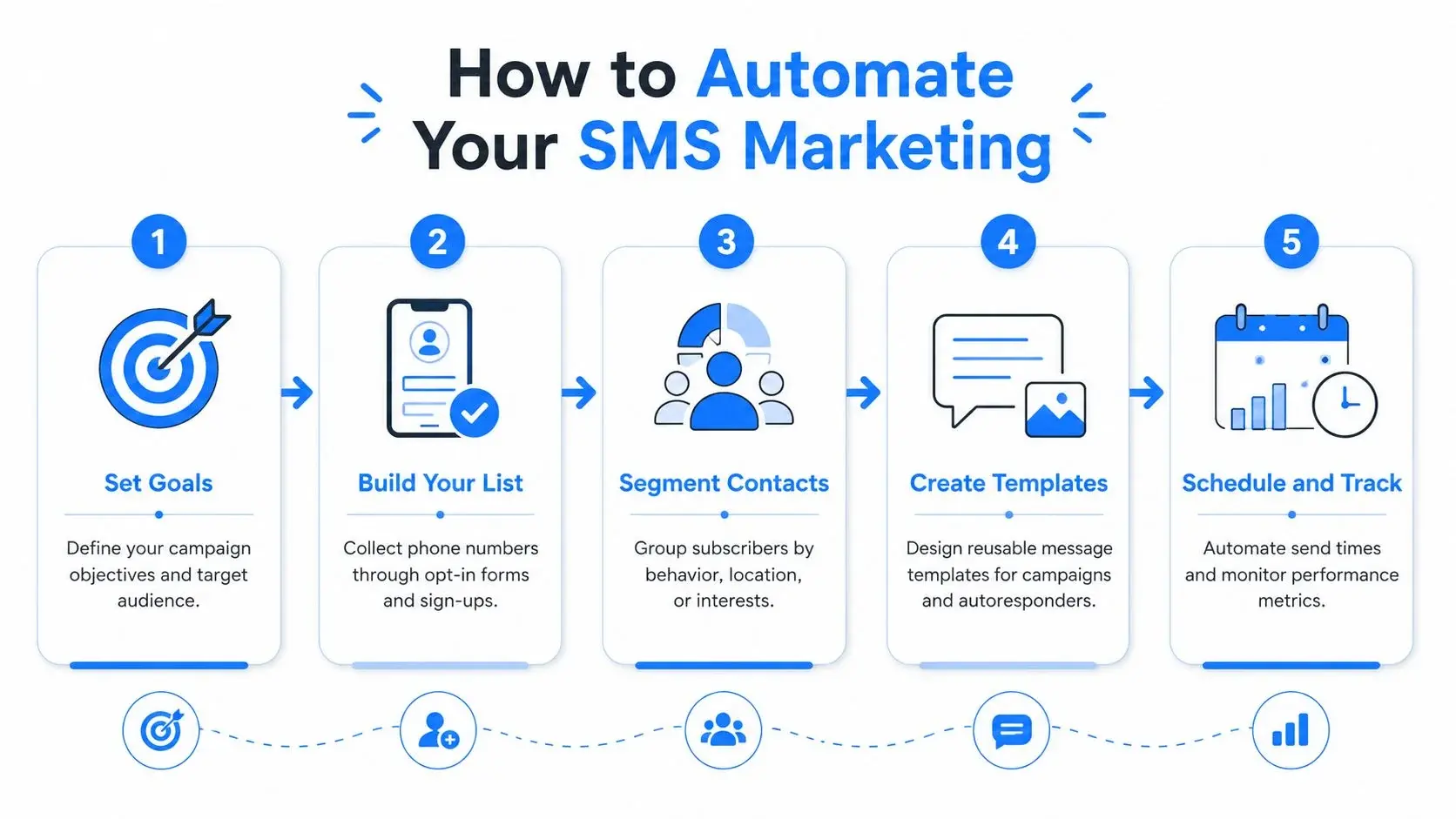
The most effective automations are usually simple. In most cases, I would automate reminders, welcome texts, review requests, and follow-ups before building elaborate promotional sequences. Those flows deliver operational value fast and are easier for staff to maintain.
Start With This Basic SMS Automation Sequence
A practical starting sequence looks like this:
- Opt-in: Customer joins through a web form, checkout box, in-store keyword, or booking form.
- Welcome text: Sent immediately, confirms what they signed up for, includes any promised offer, and reminds them how to opt out.
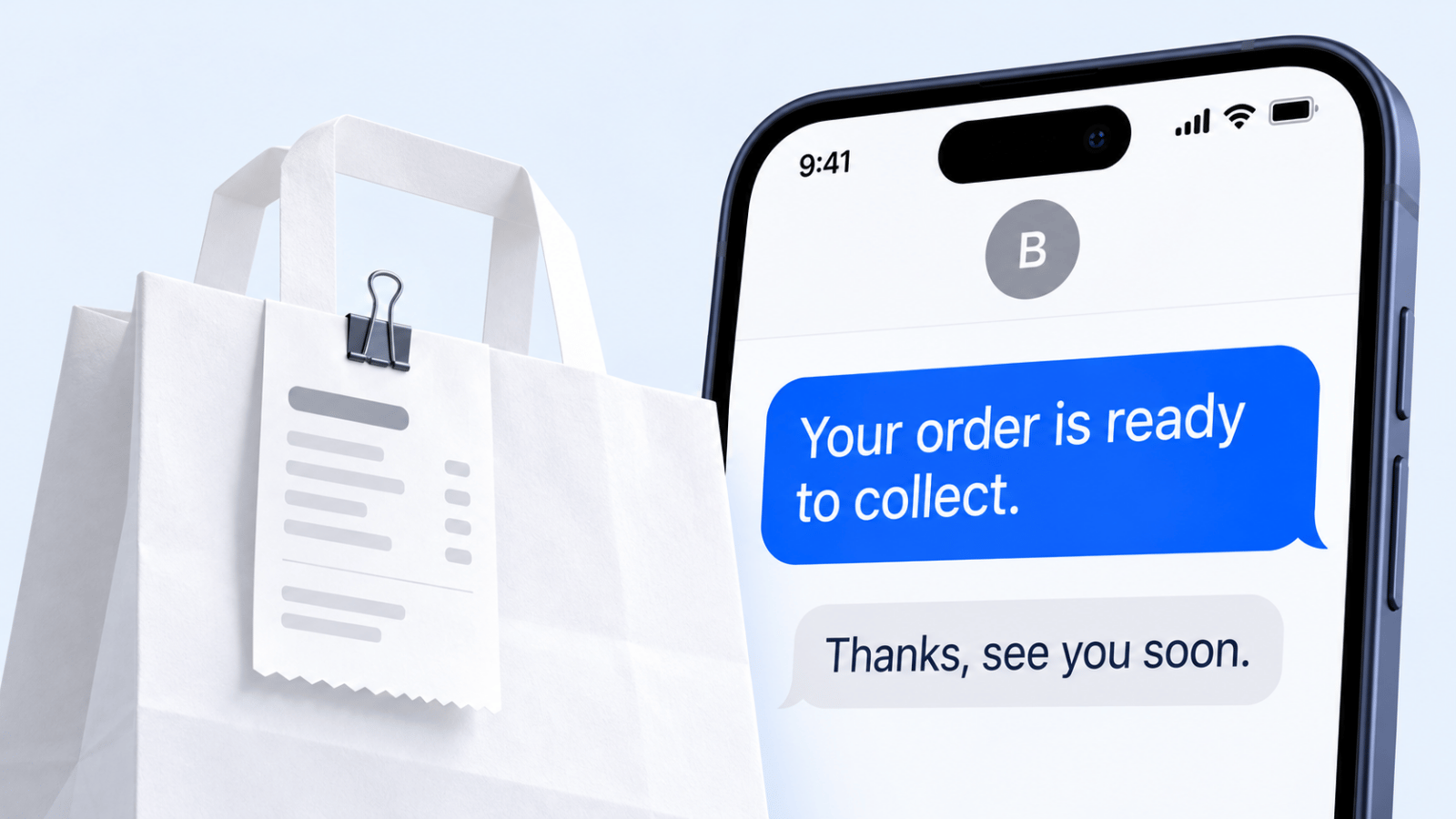
- Primary reminder or update: Triggered by the business event that matters most, such as an appointment tomorrow or an order shipping.
- Follow-up text: Sent after the appointment, delivery, or purchase to request feedback, offer help, or prompt the next action.
- Re-engagement or loyalty prompt: Sent later only if the customer has not booked, bought, or replied within a defined window.
That sequence is enough to cover a large share of small-business SMS use without overwhelming customers.
| Workflow Type | Purpose | Example Trigger |
|---|---|---|
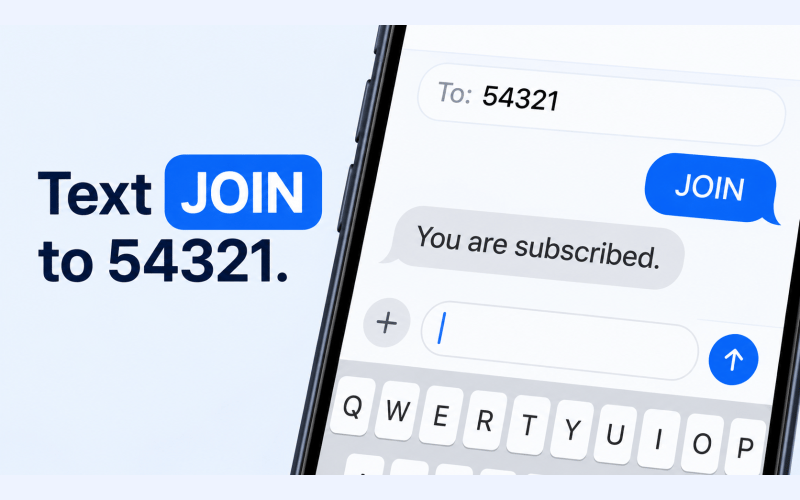
| Welcome Series | To greet new subscribers, set expectations, and deliver an initial offer. | A customer texts your keyword (e.g., "JOIN") to your number. |
| Abandoned Cart | To recover potentially lost sales by reminding customers about items left in their cart. | A customer adds items to their online cart but doesn't complete the purchase. |
| Birthday/Anniversary | To build loyalty and create a moment of delight with a personalized offer. | A customer's birthday or the anniversary of their first purchase. |
| Appointment Reminders | To reduce no-shows and ensure customers arrive on time and prepared. | An appointment is scheduled for a future date (e.g., 24 hours before). |
| Post-Purchase Follow-Up | To request a review, offer support, or suggest a related product. | An order is marked as "fulfilled" or "delivered" in your system. |
Automation Workflows by Business Type
Restaurant
- Trigger: Reservation created or online order placed
- Timing: Immediate confirmation, reminder 2–4 hours before reservation, follow-up next day
- Message type: Confirmation, reminder, bounce-back offer
- Goal: Reduce no-shows and increase repeat visits
A restaurant can also automate waitlist openings or same-day specials when inventory is perishable and timing matters.
Salon or Spa
- Trigger: Appointment booked, no future appointment on file after visit
- Timing: Instant confirmation, 24-hour reminder, rebooking prompt 2–4 weeks later
- Message type: Confirmation, reminder, rebooking offer
- Goal: Cut no-shows and improve retention
This is one of the clearest automation wins because the revenue link is easy to see.
Dental Office
- Trigger: Appointment scheduled, cancellation slot opens, hygiene recall due
- Timing: Confirmation at booking, reminder 48 and 24 hours before, recall prompt at due date
- Message type: Reminder, paperwork prompt, waitlist fill text
- Goal: Keep chairs filled and improve recall compliance
Home Services
- Trigger: Estimate requested, technician dispatched, job completed
- Timing: Instant lead acknowledgment, ETA text on dispatch, review request after completion
- Message type: Confirmation, arrival window, follow-up
- Goal: Improve response time, reduce missed visits, generate reviews
For home services, SMS often works best when paired with exact arrival communication instead of generic promotions.
Retail
- Trigger: VIP signup, abandoned cart, purchase completed, product back in stock
- Timing: Immediate welcome, cart reminder within hours, post-purchase follow-up after delivery
- Message type: Offer, reminder, product alert
- Goal: Recover revenue and increase repeat purchases
Which Events Should You Automate First?
If you are starting from scratch, automate the events that are both frequent and time-sensitive:
- New subscriber welcome
- Appointment or booking confirmation
- Reminder before service or visit
- Post-purchase or post-service review request
- Re-engagement for inactive customers
Those five cover most local-business use cases and are easier to measure than broad promotional blasts.
Frequency Caps and Quiet Hours
Automation still needs restraint. A good baseline is to avoid stacking multiple promotional texts in a short window, suppress messages during overnight hours based on the customer’s time zone, and cap recurring marketing texts unless there is a clear reason to send more. Quiet-hour controls are especially important for local businesses with evening or early-morning activity.
Quiet hours are also a legal rule. Federal rules ban telephone solicitations, which include marketing texts, before 8 a.m. or after 9 p.m. in the recipient’s local time (47 CFR 64.1200(c)(1)). Some states are stricter: Florida, for example, limits commercial solicitation calls to 8 a.m. to 8 p.m. and three per day on the same subject (Fla. Stat. 501.616). Set your platform’s quiet hours to the strictest rule that applies to your list.
The compliance and customer-experience side are closely connected here. Sending fewer, more relevant texts usually protects deliverability and keeps unsubscribe rates lower.
Connecting Your Tools for Seamless Automation
The best automations happen when your SMS platform connects to your booking system, CRM, ecommerce platform, or POS. A salon might trigger reminders from its scheduler. A home-services company might fire ETA texts from dispatch software. A retailer may sync purchase and inventory events from its ecommerce platform or POS. When those systems are connected, staff do not have to re-enter data or remember to send every follow-up manually.
That is also why integration depth matters when choosing a tool. If the booking app can only send a basic confirmation but not a review request or cancellation-fill text, you may outgrow it quickly. Our recommendation is to map the customer journey first, then check whether your SMS tool can trigger from the events you already track. You can dive deeper into setup in our guide on how to send automated texts.
Measuring Your Success and Improving ROI
So, you’ve launched your first SMS campaign. That's a huge step. But how do you know if it’s working? To avoid just throwing money away, you need to track a few key numbers. These aren’t just for fancy reports; they reveal what’s connecting with your audience and what’s falling flat.
Think of it like a chef tasting a sauce while it simmers. You don't wait until the dish is on the customer's table to find out it needs more salt. You taste, tweak, and adjust as you go. Your SMS metrics are your taste tests, helping you perfect the recipe and prove that your marketing is actually making a difference.
Good data turns guesswork into a repeatable strategy, making sure every text you send is a smart investment in your business.
Key Metrics Every Small Business Should Track
- Delivery Rate: This is the percentage of texts that made it to your subscribers’ phones. It should stay high and stable; a sudden drop usually points to bad numbers, an unregistered sending number, or carrier filtering (see why text messages are not delivered).
- Click-Through Rate (CTR): This tells you how many people clicked the link in your message. A solid CTR means your offer was juicy enough and your message was compelling enough to get a reaction.
- Conversion Rate: This is the big one. It's the percentage of people who did the thing you wanted them to do after clicking, like buying a product, signing up, or filling out a form.
- Unsubscribe Rate: This tracks how many people opted out after getting your text. A few unsubscribes are perfectly normal, but if you see a sudden jump, it’s a red flag that you might be sending too often or your offers aren't hitting the mark.
To get the full picture, it's super helpful to understand how to measure marketing effectiveness across all your channels, not just SMS. This helps you see how everything fits together.
Turning Insights into Action with A/B Testing
Just looking at the numbers isn't enough. The magic happens when you use that data to make your next campaign even better. The easiest way to do that is with A/B testing (sometimes called split testing).
The idea is simple: Create two versions of a message (Version A and Version B) that have one small difference. Send each version to a small slice of your list. Whichever one performs better gets sent to everyone else.
It takes the guesswork out of the equation and lets your customers' actions tell you exactly what they want. You can test just about anything:
- The Offer: 20% Off vs. Free Shipping
- The Call-to-Action: "Shop Now" vs. "Get the Deal"
- Send Time: 10 AM Tuesday vs. 3 PM Thursday
- Message Tone: Fun and casual vs. Straight and urgent
By constantly testing and tweaking, you turn your SMS marketing into a well-oiled machine that gets better and more profitable with every send.
Frequently Asked Questions About SMS Marketing
How Much Does SMS Marketing Cost for a Small Business?
Most small businesses will see SMS pricing structured as a monthly platform fee, per-message charges, or a mix of both. You may also pay for a phone number, extra users, advanced automations, or higher contact limits. The practical way to budget is by use case: reminders and follow-ups usually justify spend faster than broad promotional campaigns because they directly reduce no-shows, recover sales, or drive repeat bookings.
Is SMS Marketing Legal for Small Businesses?
Yes, when it is consent-based and handled correctly. Promotional SMS generally requires prior express written consent, clear disclosure about what the subscriber is signing up for, and an easy opt-out path such as replying STOP. Unsolicited promotional texting is where businesses get into trouble. If you cannot document consent, do not send the campaign. The baseline rules are in 47 CFR 64.1200, which many businesses review with counsel or compliance teams.
Can I Text My Existing Customer Phone Numbers?
Not for marketing unless they specifically agreed to receive marketing texts. A phone number collected for checkout, scheduling, or customer service does not automatically equal SMS marketing consent. Transactional and service texts can be treated differently from promotional texts, but the safest small-business practice is to capture explicit permission and keep records.
Is SMS Marketing Worth It?
It usually is when the message solves an immediate business problem or customer need. Reminders reduce missed appointments, flash sales move same-day inventory, post-service review requests generate social proof, and service updates improve customer experience. The return tends to be strongest when texts are targeted and limited rather than constant.
Does SMS Marketing Still Work?
Yes. Texting remains one of the most used channels in the US: Americans exchanged nearly 2.2 trillion SMS and MMS messages in 2024 (CTIA). That reach is why businesses keep investing in it. I would not use it as an excuse to text more often; I would use it as a reason to reserve SMS for the moments that matter most.
What Is the Difference Between a Short Code and Long Code?
A short code is a 5 or 6 digit number leased through the Common Short Code Administration and designed for higher-volume messaging, while a long code is a standard 10-digit number that often feels more conversational. For many small businesses, a regular business texting number is the better operational fit because customers can reply naturally and staff can manage two-way conversations more easily. Either way, it has to be registered or approved before you send: 10DLC registration for long codes, toll-free verification for toll-free numbers.
Is SMS Marketing Illegal?
No. Texting customers who opted in is legal. What is illegal is sending marketing texts without the required consent, outside 8 a.m. to 9 p.m. local time, or ignoring opt-outs. Each violation can cost $500, and up to three times that if willful (47 U.S.C. 227(b)(3)). This is general information, not legal advice.
What Do Small Businesses Use for Text Message Marketing?
A business texting platform on a registered number (10DLC long code, toll-free, or short code) that handles opt-ins, STOP replies, scheduling, automations and two-way replies. A personal phone does not scale and is not registered for business traffic. See our comparison of SMS marketing platforms and what SMS marketing on Broadcast includes.
What Is the Best SMS Marketing Platform for Businesses?
The one that fits what you send. Use the criteria table above (pricing model, contact limits, automation, two-way texting, integrations, compliance support) and test it with one workflow before you commit.
Is There a Free SMS Marketing Service?
Free phone apps work for a small group of people you know, but marketing texts at scale need a registered business number, and carriers charge per message, so business platforms are paid (some offer trials). Our guide to free group texting options compares what is truly free.
How Do I Collect Phone Numbers for SMS Marketing?
Ask in the places customers already are: a keyword on in-store signs, a checkbox at online checkout, a website form, or your booking form. Each sign-up should say what they will get, how often, that rates may apply and how to opt out (CTIA 5.1.1). Never buy or import lists. More ideas in 5 ways to grow your SMS list.
Ready to see how simple and effective SMS and voice marketing can be? Broadcast gives you all the tools you need to automate your outreach, build stronger customer relationships, and grow your business. Start your free trial today and discover the power of direct communication.