If your team is only comparing TextMagic alternatives on SMS price and basic blast features, you're probably looking too narrowly. The bigger question is whether TextMagic still fits the way your outreach works now. Maybe you need tighter CRM sync, better team workflows, stronger compliance, or a channel mix that includes voice and ringless voicemail instead of text alone.
TextMagic is still a capable platform. In 2026 it covers SMS, MMS in North America, email campaigns, WhatsApp and social inboxes, and one-to-one calls, but its site lists no voice broadcasting or ringless voicemail (Textmagic pricing, checked October 19, 2026). Many businesses outgrow that mix when reminders, lead follow-up, reactivation, and appointment outreach start living across multiple channels. A text works for one contact. A voicemail drop works better for another. A voice broadcast can move a campaign faster than a long SMS sequence.
That shift matters most for smaller teams, which want practical, low-friction tools rather than heavy custom infrastructure. If that sounds like your business, the best replacement usually isn't the platform with the most features on paper. It's the one that matches how your team communicates.
Conventional lists also miss an important gap. Many focus on SMS marketing blasts and sales follow-up. Textline's own list of TextMagic alternatives (September 2025), for example, adds healthcare messaging tools but does not cover ringless voicemail, even though the combination of texting, voice and voicemail drops is relevant for healthcare, education, and service businesses.
Every price and trial below was checked on the vendor's own page (checked October 19, 2026). Jump to TextMagic in 2026, the comparison table, how to switch or the FAQ.
TextMagic in 2026: What It Offers and What It Costs
Before comparing alternatives, it helps to know exactly what you would be leaving. These are TextMagic's published US terms (checked October 19, 2026):
| Item | TextMagic terms | Source |
|---|---|---|
| Outbound SMS | $0.049 per SMS (160 plain text characters), pay as you go | Textmagic pricing |
| Inbound SMS | Free | Textmagic pricing |
| Dedicated number | $10 per number per month, first month free | Textmagic pricing |
| 10DLC campaign | $10 per campaign per month, first month free (initial registration free) | Textmagic pricing |
| Credit | Never expires; free test balance on sign-up; monthly subscription plans with discounted SMS rates in the US, Canada, Australia and the UK | Textmagic pricing |
| Other channels | MMS (North America only), email ($0.006 per email, first 10,000 free), WhatsApp, Facebook and Instagram messaging | Textmagic pricing |
| Voice | Outbound calls $0.041 per minute, inbound $0.023 per minute, call forwarding $0.041 per minute | Textmagic pricing, call forwarding |
| Voice broadcast and ringless voicemail | Not listed on TextMagic's feature or pricing pages | Textmagic pricing |
So the usual reasons to look elsewhere are not "TextMagic only does SMS". They are a per-message price you may beat on a credit plan or an API, the lack of voice broadcasting and ringless voicemail, a CRM-first or shared-inbox workflow, or a preference for a flat monthly plan. The comparison table below shows how each alternative handles those points.
1. Broadcast
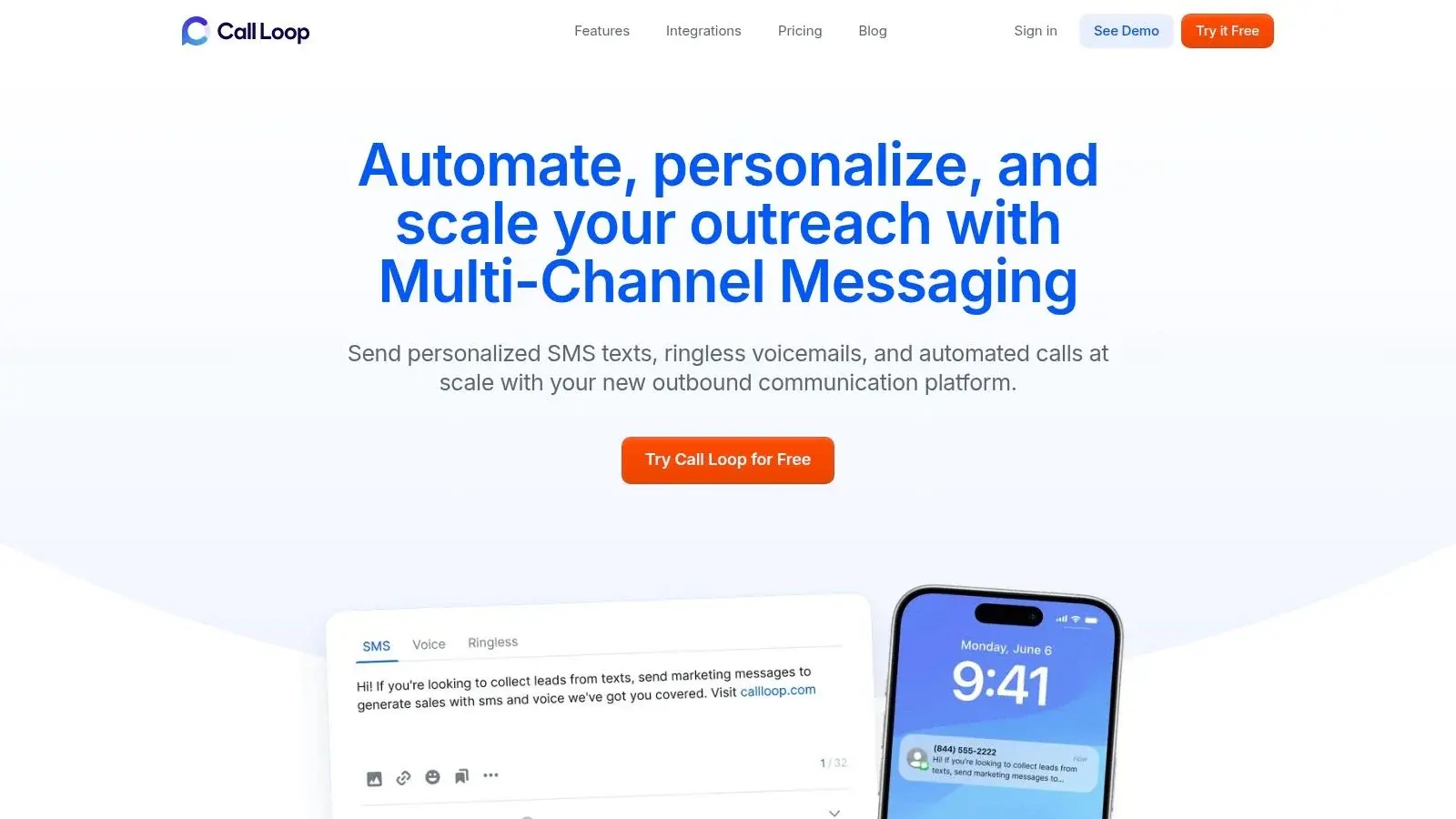
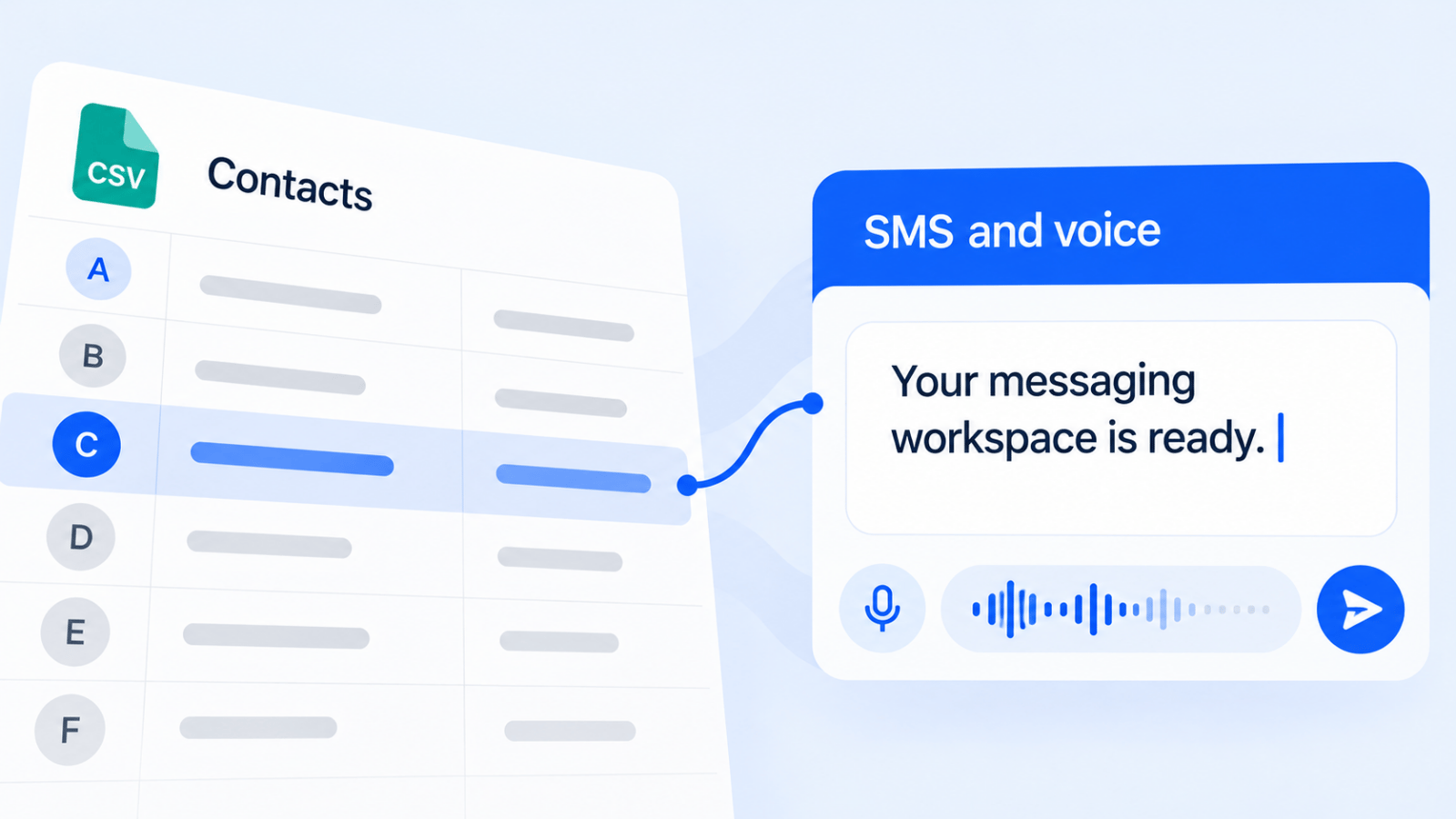
Broadcast is first on this list for teams that are done stitching together separate tools for texting, voice, and voicemail. It's built for outbound communication across SMS/MMS, voice broadcasting, and ringless voicemail, so you can run one campaign strategy instead of juggling disconnected channels.
That matters because former TextMagic users usually don't leave just for another texting app. They leave because they want a more robust SMS, voice, and ringless voicemail platform, plus two-way texting and deeper integrations. Broadcast fits that need well, especially for healthcare teams, agencies, service businesses, and sales workflows where follow-up rarely happens in one channel only.
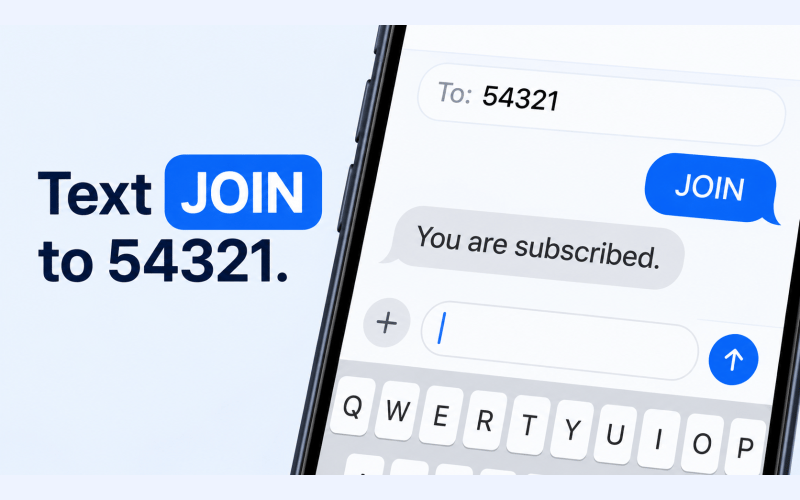
Broadcast also serves over 45,000 users and combines mass texting with voice broadcasting and ringless voicemail, along with text-to-join keywords, live call transfers from SMS, and double opt-in compliance for toll-free numbers (Broadcast on Capterra).
Where Broadcast stands out
The biggest advantage is orchestration. You can start with SMS, follow with a ringless voicemail drop, and route hot responses into a live call workflow. That's much closer to how real outbound teams operate than the typical “send blast, wait for replies” model.
Ringless voicemail is the feature most comparison posts underplay. Instead of ringing the phone, the platform leaves the recorded message on the carrier's voicemail server, so the contact sees a new voicemail without hearing a ring. The FCC's 2022 ruling quotes one provider's software as creating "a landline to landline session directly to the telephone company's voicemail server" (FCC 22-85, para. 3; see how ringless voicemail works).
Practical rule: Use ringless voicemail when the message benefits from tone, urgency, or reassurance. Appointment reminders, renewals, and local service follow-up often land better as audio than as another text block.
For teams that care about message format, concise voicemail wins. A strong business ringless voicemail message is typically best kept between 20 and 30 seconds, which forces you to tighten the offer and CTA (recommended ringless voicemail length).
Trade-offs
Broadcast is not the lightest option on this list. If all you want is occasional bulk SMS, it may feel broader than necessary. But if your team needs coordinated outreach, that extra depth is exactly the point.
A few practical strengths and limitations:
- Best fit: Teams that need SMS, voice, and ringless voicemail in one outbound workflow.
- Operational upside: Deep integrations and automation make it easier to build repeatable campaigns instead of one-off sends.
- Learning curve: Multi-channel tools take more setup discipline than SMS-only platforms.
If you're building campaigns seriously, it helps to pair platform choice with channel discipline. Broadcast's own guide to SMS marketing best practices is worth reading before you migrate, because better tooling won't fix weak list hygiene or sloppy timing. Healthcare teams can also compare HIPAA-compliant texting platforms, and the ringless voicemail page explains how voicemail drops work in Broadcast.
2. Salesmsg
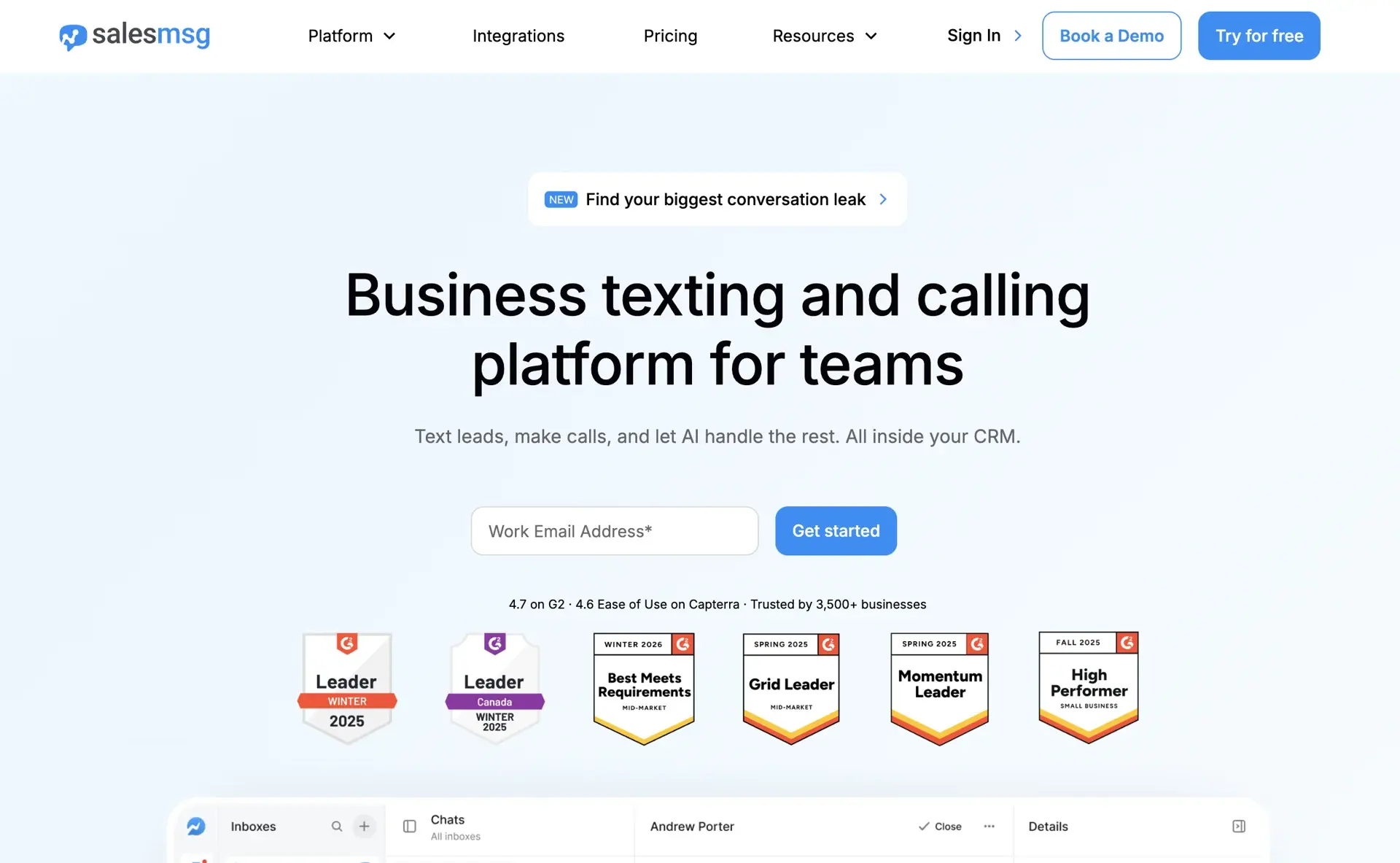
Need texting to sit inside your CRM instead of living in a separate marketing tool? Salesmsg is one of the cleaner options for that job.
It fits teams that run lead follow-up through HubSpot SMS, ActiveCampaign, or Keap and need reps to text from the same workflow they already use for calls, deals, and tasks. The product is built around two-way conversations, shared inbox handling, scheduled campaigns, drip sequences, keyword automation, call forwarding, and voicemail drops. That mix makes it more useful for pipeline management than for pure list-based SMS blasting.
The practical appeal is speed to response. Reps can text from familiar systems, managers can monitor conversations without patching together multiple tools, and handoffs are easier when messages are tied to contact records instead of a standalone inbox.
Best use case
Salesmsg works well for sales and service teams where conversation ownership matters. If each lead, customer, or account has a clear rep attached, the platform gives that person a fast way to text, follow up, and keep the thread visible to the rest of the team.
A few reasons teams pick it:
- CRM-first workflow: Useful when texting needs to support pipeline activity, not run as a separate channel.
- Two-way communication: Better for demos, reminders, reactivation, and support follow-up than one-way promotional sends.
- Quick rollout: Teams already working inside supported CRMs usually need less process change to adopt it.
Where it falls short
Salesmsg starts to look narrower once your outreach strategy expands beyond text conversations. It lists calling, a power dialer and ringless voicemail inside broadcasts and multi-step campaigns, but not prerecorded voice broadcasts to a list (Salesmsg, checked October 19, 2026). Businesses that want to coordinate SMS, voice broadcasts, and ringless voicemail at scale will hit its limits faster. That is the trade-off versus broader outbound platforms such as Broadcast.
Cost can also become a planning issue. Salesmsg Basic is $25/month and Pro $277/month; the first seat is free and each additional seat costs $10/month, with credits per SMS (1), MMS (2) and calling minute (1), a 14-day free trial and a 30-day money-back guarantee (Salesmsg pricing, checked October 19, 2026). Seat costs are manageable for a small sales pod, but they deserve a closer look if you expect many reps, service agents, or location-based teams to be active in the platform at the same time.
Salesmsg is a strong fit for rep-led texting inside a CRM. It is a weaker fit for centrally managed, multi-channel outreach where SMS is only one part of the communication mix.
3. SimpleTexting
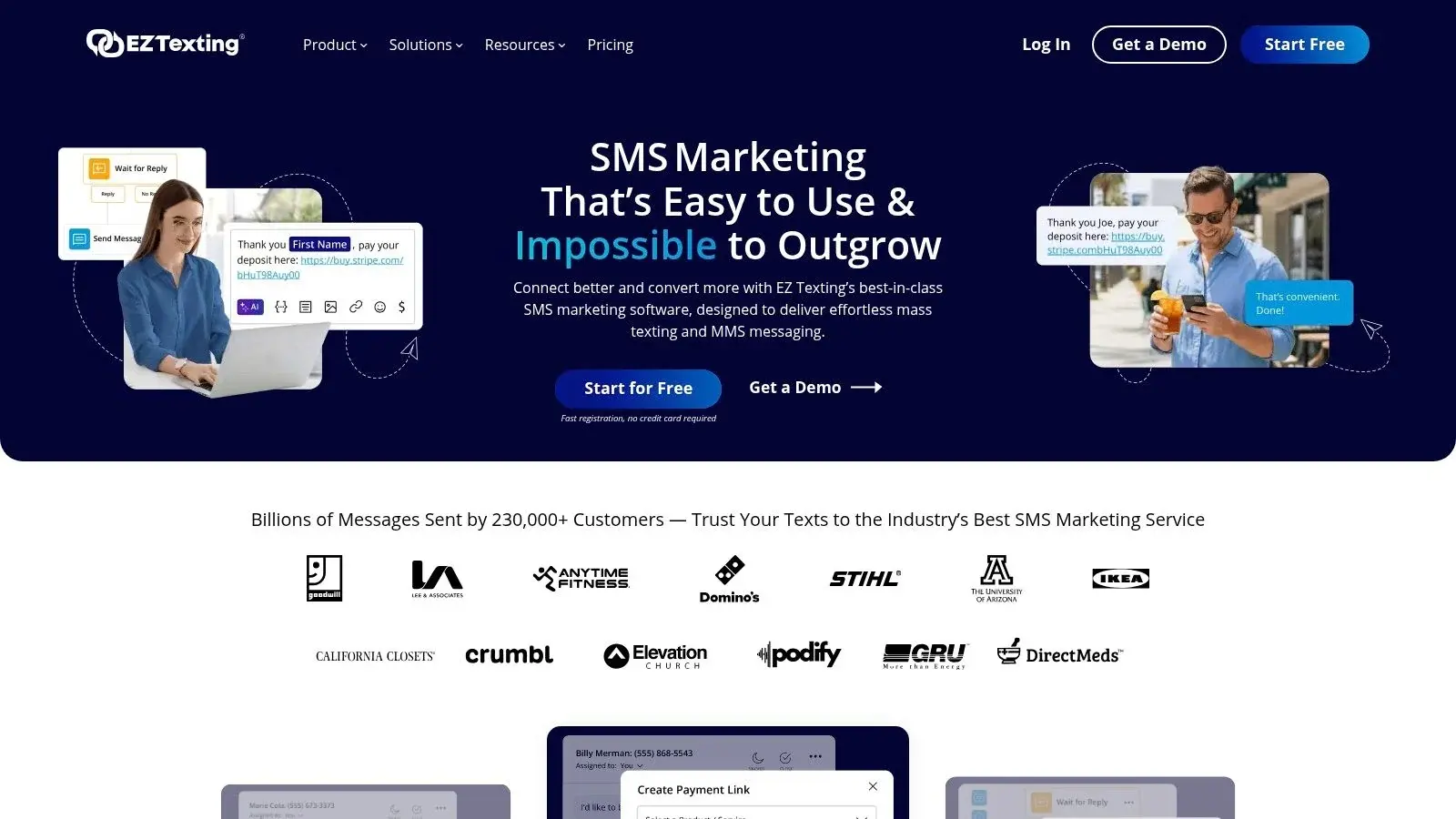
Need a TextMagic replacement that your team can start using this week, without handing the project to a developer?
SimpleTexting is a practical choice for that job. It focuses on SMS and MMS execution, keeps the interface clean, and gives marketing or operations teams enough automation to run campaigns, handle replies, and stay organized without much setup. For businesses that mainly need texting to work reliably, that simplicity has real value.
It is especially useful for teams running recurring outreach such as promotions, reminders, confirmations, and basic drip sequences. The platform covers the core workflow well: build lists, segment contacts, send campaigns, manage incoming messages, and keep everyday texting tasks in one place.
Where it fits best
SimpleTexting works well for businesses that treat messaging as a campaign channel first.
- Campaign management: Good for scheduled sends, list segmentation, and repeatable SMS marketing workflows.
- Reply handling: The shared inbox helps teams manage inbound responses after a blast or reminder campaign.
- Low setup burden: A better fit for non-technical teams that want to launch quickly and avoid API-heavy implementation.
That makes it a cleaner fit for marketing-led texting than for sales teams that need deep CRM ownership or outbound teams building a broader contact strategy across channels.
The trade-off
SimpleTexting gets narrower once SMS is only one part of your outreach mix. If your plan includes voice drops, voice broadcasting, or ringless voicemail alongside text, you will need other tools to cover those channels. That matters if you are comparing TextMagic alternatives based on how well they support a full communication stack, not just texting.
Pricing also deserves a closer look if you send a lot of MMS or longer messages. A picture message uses 3 credits, so credit usage can climb faster than expected in media-heavy campaigns. Plans start at $39/month billed yearly for 500 credits, extra credits cost 5.5 cents, carrier fees add about $0.0025 per US message, and local numbers carry a $4 one-time carrier registration (SimpleTexting pricing, checked October 19, 2026). If you are leaving SimpleTexting too, see our SimpleTexting alternatives.
SimpleTexting is a solid option for teams that want polished SMS marketing software with minimal setup. It is a weaker option for businesses that want to scale outreach across SMS, voice, and ringless voicemail from one system.
4. EZ Texting
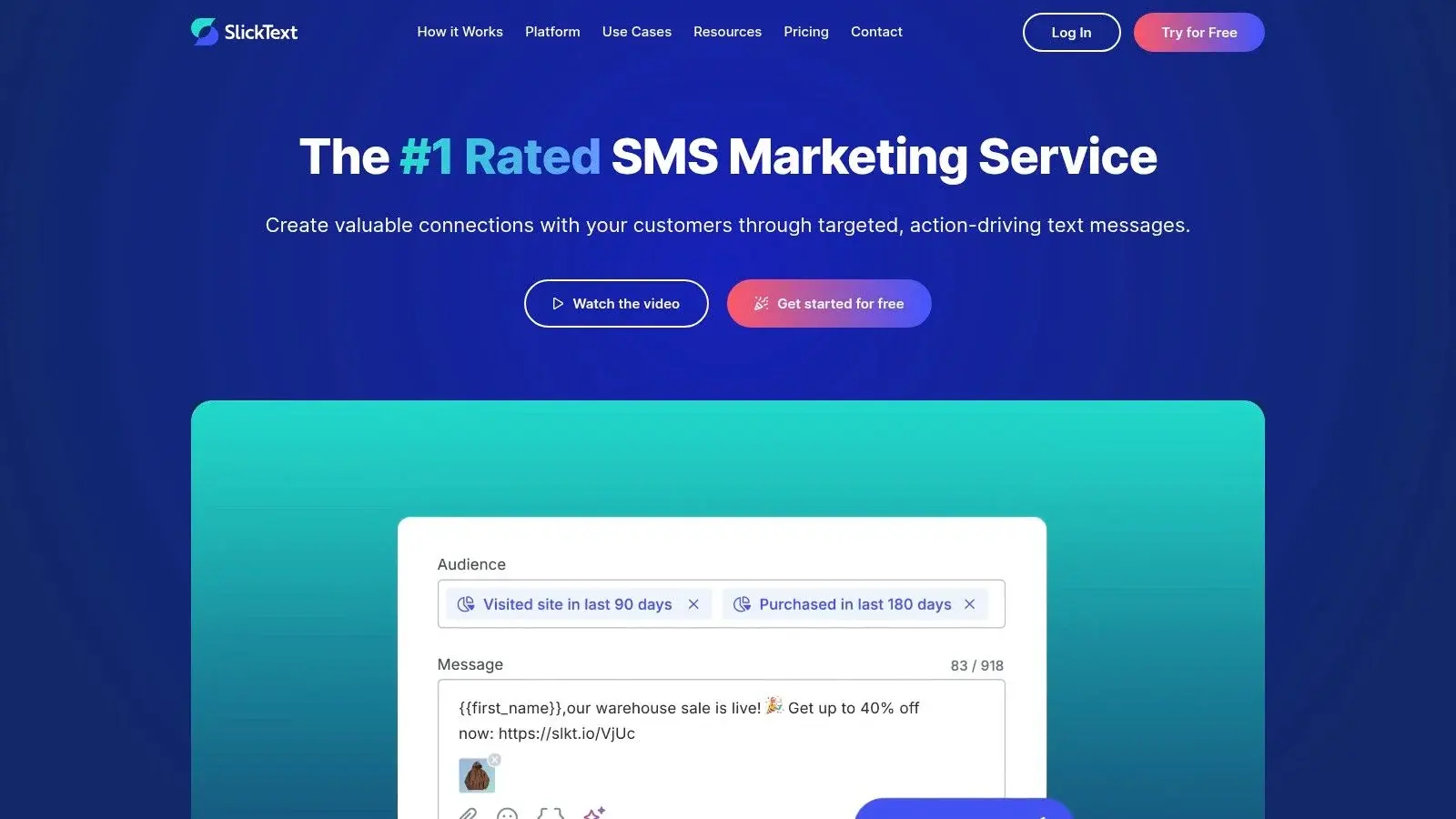
Need a TextMagic replacement that feels familiar without forcing your team into a full rebuild? EZ Texting fits that brief. It stays focused on the core jobs many SMB teams need to handle day to day: bulk texts, reminders, keywords, contact lists, templates, and simple integrations.
That familiarity is the main selling point. Teams can switch over without retraining everyone around a developer-first product or a more complex outbound stack.
Where EZ Texting makes sense
EZ Texting works best for businesses that still see texting as a standalone channel, or at least as the center of their outreach program. It gives you multiple sending options: Launch, Boost and Scale plans use a local 10DLC number, toll-free and text-enabled landline numbers are available, and a dedicated short code comes with the Enterprise plan (EZ Texting pricing, checked October 19, 2026). That matters if your current setup has outgrown a single basic number.
That flexibility helps with scale and compliance planning, especially for organizations sending appointment reminders, promotions, or recurring customer updates. You get more room to shape the sending setup around your use case without needing to build on top of an API.
- Best fit: SMB marketing teams, franchises, local service businesses, and organizations running recurring reminders or promotions
- Practical upside: Familiar interface, easier onboarding, and enough sender options to support higher-volume texting programs
- Limitation: Voice and ringless voicemail are not part of the core value proposition
The trade-off
EZ Texting is a stronger TextMagic alternative than a multi-channel outreach platform. That distinction matters.
If your goal is to add SMS and improve campaign execution, it can do the job well. If your goal is to coordinate SMS with voice calls, voice broadcasts, or ringless voicemail from one system, EZ Texting will leave gaps. In that case, you are not really replacing TextMagic with a broader communication stack. You are choosing a better organized texting platform.
Choose EZ Texting for ease of adoption and solid SMS operations. Choose something else if your growth plan depends on combining text, voice, and voicemail in one workflow.
5. SlickText

Need a TextMagic alternative that helps you grow an SMS list, not just send campaigns? SlickText earns consideration for ecommerce teams that care about subscriber capture, segmentation, and automated follow-up tied to online sales.
The product is built around SMS marketing execution. Pop-ups, web forms, keywords, drip campaigns, and Shopify-friendly workflows are the center of gravity. That makes SlickText a stronger choice for brands running promotions, abandoned cart nudges, and repeat-purchase campaigns than for businesses trying to coordinate texts with calls or voicemail drops.
Its pricing model is also easier to read than some usage-heavy platforms. Instead of piecing together core features across plan tiers and add-ons, you get a clearer packaged approach: Starter is $29/month for 500 credits, an MMS uses 3 credits per segment, carrier fees are extra, and there is a 14-day free trial with no credit card (SlickText pricing, checked October 19, 2026). That helps smaller teams forecast costs before volume rises. SlickText also has a Shopify integration.
Where SlickText adds value
SlickText works best when SMS is part of your revenue engine and list growth matters as much as message delivery.
- Subscriber capture tools: QR codes, forms, and pop-ups help turn site traffic and in-store traffic into opted-in contacts.
- Segmentation and automation: Useful for welcome flows, campaign targeting, and repeat customer messaging.
- Ecommerce alignment: Shopify support matters if texting is tied directly to store activity and promotional timing.
That focus is real, and it shapes the trade-off.
The trade-off
SlickText is an SMS marketing platform first. Businesses that need outbound calling, voice broadcasts, or ringless voicemail as part of the same outreach system will need another tool alongside it.
For ecommerce operators, that may be a reasonable compromise. For teams in healthcare, education, home services, or any appointment-driven model, it usually creates workflow sprawl. If your replacement for TextMagic needs to support a broader multi-channel outreach strategy, SlickText solves the texting piece well but stops short of a full communication stack.
6. Textedly
Need a TextMagic replacement that your team can start using this week, not after a long setup cycle? Textedly is one of the cleaner options for that job. It focuses on the basics that small businesses use: mass texts, reminders, keywords, MMS, and simple contact management.
That simplicity is the appeal.
Textedly fits teams that do not want to configure a heavier communications platform just to send campaigns and follow-up messages. If your main goal is to get SMS running quickly for promotions, appointment reminders, or list growth, it covers the core workflow without much friction.
Where Textedly works well
Textedly is a practical fit for businesses that want straightforward texting features and predictable day-to-day use.
- Bulk SMS and MMS: Useful for announcements, offers, and customer updates.
- Keywords and scheduled sends: Helpful for opt-ins, reminders, and recurring outreach.
- Autoresponders and basic segmentation: Enough for simple nurture flows and grouped messaging.
- Light reporting: Works for teams that need confirmation a campaign went out and generated replies.
The trade-off is depth. Textedly handles SMS well enough for smaller marketing and customer communication programs, but it does not give you much room to build beyond texting.
The trade-off
This matters if you are replacing TextMagic because you need more than another SMS tool. Textedly does not give you integrated voice broadcasting or ringless voicemail, so it falls short for businesses building a broader outreach system across channels.
That gap shows up fast in appointment-driven and sales-driven workflows. A home services company may want to text confirmations, call leads who stop responding, and use ringless voicemail for follow-up. A clinic may need reminders by text, outbound calls for schedule changes, and a backup outreach option when messages go unread. Textedly handles the first piece, not the full sequence.
For simple SMS campaigns, it is a solid option. For a multi-channel communication strategy, it is usually a partial replacement rather than a complete one.
7. ClickSend
Need more than basic texting, but not ready to build everything on raw APIs? ClickSend fits that middle tier well.
It gives you a usable web app for day-to-day sending and an API. Earlier versions of this guide said ClickSend also gave you voice, email, and fax. That changed: ClickSend now says it is "all-in on SMS", and voice, email, fax and post are no longer available to new customers (ClickSend pricing, checked October 19, 2026). For new accounts it is a text-first vendor with pay-as-you-go pricing.
That matters if your replacement criteria go beyond SMS pricing and contact lists. A business running lead follow-up or customer notifications often needs text for speed, voice for urgency, and another channel when replies stall. New ClickSend customers get SMS (plus MMS and RCS), so voice and ringless voicemail need another tool or a platform built around coordinated SMS, calling, and ringless voicemail sequences.
Why teams choose it
ClickSend makes sense for businesses that want flexibility and predictable control over how they send.
- Usage-based billing: A practical fit for teams with uneven monthly volume or seasonal campaigns.
- Pay-as-you-go pricing: US SMS from $0.0285 at the entry tier down to $0.0093 at volume, plus a $0.0041 carrier fee per SMS; top-ups from $20; replies are free (ClickSend price list, pricing).
- API and integration options: Better suited to operational workflows, custom apps, and system-triggered messaging than simple promotional blasts.
ClickSend belongs on the shortlist for businesses that have outgrown a single-channel SMS tool but still want a product team to handle the carrier and delivery infrastructure.
What to watch
The trade-off is user experience. ClickSend is more functional than guided, so marketing teams may find it less polished than tools built around campaign creation, templates, and list growth.
Its channel support also has limits for businesses that want one coordinated outreach engine. For new customers it is SMS, MMS and RCS, without voice or ringless voicemail. If that is the gap you are trying to solve after TextMagic, ClickSend is a pay-as-you-go texting vendor, not a full answer by itself.
8. Sinch Engage (formerly MessageMedia)
Sinch Engage, formerly MessageMedia, is a more mature business messaging platform with enterprise lineage (Sinch Engage). It covers SMS, MMS, RCS and WhatsApp, with integrations for HubSpot, Salesforce, Zoho CRM, ActiveCampaign, Shopify, BigCommerce, NetSuite, Epic and Microsoft Dynamics 365. Consider it if you want portal access and API flexibility from a provider that's comfortable handling alerts, notifications, and larger-scale business messaging.
It isn't the obvious pick for a tiny team sending occasional promos. But for organizations that want a sturdier platform with integration options and operational support around sender programs, it deserves attention.
Where it fits best
Sinch Engage works well for businesses that need:
- Portal plus API access: Useful when marketing and technical teams both need control.
- Template and integration options: Better for structured business use cases than ad hoc texting.
- Scalable messaging operations: More suitable for formal workflows than casual one-off blasts.
The practical downside
Pricing is now published, but it starts higher than most SMB tools: Basics is $99/month for 3,000 SMS, Conversations $249 for 10,000, Pro $799 for 40,000, Pro Plus $1,799 for 100,000 and Advanced $2,399 for 150,000, with custom pricing above that and a 14-day free trial with no credit card (Sinch Engage pricing, checked October 19, 2026).
It can also be more platform than necessary for low-volume senders. If your needs are simple, a more focused TextMagic alternative will usually feel easier to buy and easier to run.
9. Twilio Programmable Messaging (SMS/MMS)
Need a TextMagic alternative that can scale past basic texting?
Twilio belongs on the list because it gives you raw control. You can build SMS and MMS flows into your product, connect them to your CRM, and extend into voice through Twilio's broader platform. That makes it relevant for businesses planning a true multi-channel outreach stack, not just a simpler SMS dashboard.
The trade-off is straightforward. Twilio is a programmable messaging platform first. Your team has to design the workflows, handle compliance setup, manage sender infrastructure, and build the reporting experience your users need. If your goal is to launch campaigns fast with little technical help, this usually feels heavier than TextMagic.
Where Twilio fits best
Twilio is a strong option for teams that want to build communication into their own systems instead of working inside a packaged marketing app.
- Product and engineering teams: Good for custom messaging logic, event-triggered sends, and deep integrations.
- Businesses planning multi-channel outreach: Useful if SMS is only one part of the plan and voice also matters.
- Operations-heavy use cases: Better for transactional messaging, routing rules, and high-control workflows than simple promotional blasts.
The practical downside
Twilio can become expensive in real-world use even if the messaging rate looks attractive at first. The US base rate is $0.0083 per SMS segment (outbound MMS $0.022), then carrier fees are added per network (for example $0.0035 at AT&T and $0.0045 at T-Mobile for outbound SMS), failed messages cost $0.001 each, and 10DLC senders pay registration fees (Twilio US SMS pricing, checked October 19, 2026). Development time, compliance work, and ongoing maintenance add up on top. It is not a cheap TextMagic swap unless the business already has technical resources in place. The free trial is a sandbox: 100 SMS to up to 5 verified numbers for 30 days (Twilio trial).
It also does not solve ringless voicemail out of the box. If your outreach strategy depends on SMS, voice, and ringless voicemail working together, Twilio is often one layer of the stack rather than the whole answer.
Before investing in an API-led setup, it helps to check which numbers are mobile, landline or VoIP. Cleaner numbers reduce wasted sends and make custom messaging logic easier to run at scale.
10. Plivo
Plivo is another CPaaS-style alternative for teams that want to build rather than buy a finished marketing platform. It usually enters the conversation when a business likes the API flexibility of Twilio but wants to compare network performance, architecture, or cost structure.
What makes Plivo interesting is that it tries to bridge infrastructure and campaign tooling. You get APIs and SDKs, but Plivo also lists promotional SMS campaigns and a "no-code agent studio" to build automated messaging flows (Plivo SMS). New accounts get $10 in free credits with no credit card, and SMS starts at $0.0077 per message (Plivo pricing, checked October 19, 2026).
Best fit
Plivo is worth considering for:
- Engineering-led teams: Good when developers own communications workflows.
- Cost-aware builds: Often explored by teams comparing programmable messaging providers.
- Hybrid needs: Useful if you want APIs first, but not APIs only.
The trade-off
It's still not a turnkey TextMagic replacement for many marketing professionals. Non-technical teams usually won't enjoy managing an API-centric system unless another platform layer sits on top.
If your goal is to text customers tomorrow with minimal setup, choose something else. If your goal is to build messaging fully into your stack, Plivo belongs on the shortlist.
11. Telnyx Messaging
Telnyx is the most technical option on this list, but it deserves inclusion because it pushes further into carrier-grade control and programmable communications than most SMB buyers ever consider. If your company wants direct connectivity, usage-based economics, and more control over transport behavior, Telnyx is worth a serious look.
Telnyx also sells a programmable Voice API, so developers can build calling into the same outbound system. It does not list a ringless voicemail product (checked October 19, 2026), so voicemail drops would be your team's build, and the consent rules for prerecorded calls still apply. US messaging costs $0.004 per SMS part and $0.015 per MMS part, with carrier fees passed through without markup (Telnyx messaging pricing).
Why technical teams choose it
Telnyx makes sense when communications is part of your product or core operating workflow.
- API-first messaging: Built for teams that want control over provisioning, reporting, and automation.
- Programmable voice: Useful when SMS alone won't cover the full outreach strategy (no ringless voicemail product listed).
- Transparent pricing orientation: Better fit for buyers who compare usage and transport economics closely.
Why most SMBs won't
This is not a natural fit for a small sales or marketing team looking for a faster TextMagic replacement. You'll need to manage registration, compliance details, and workflow design yourself.
For developer-led organizations, that trade can be worth it. For everyone else, it usually isn't.
TextMagic Alternatives Compared: Pricing, Trials and Voice
Most TextMagic alternatives fall into four groups. Pick the group that matches how your team sends, then compare tools inside it.
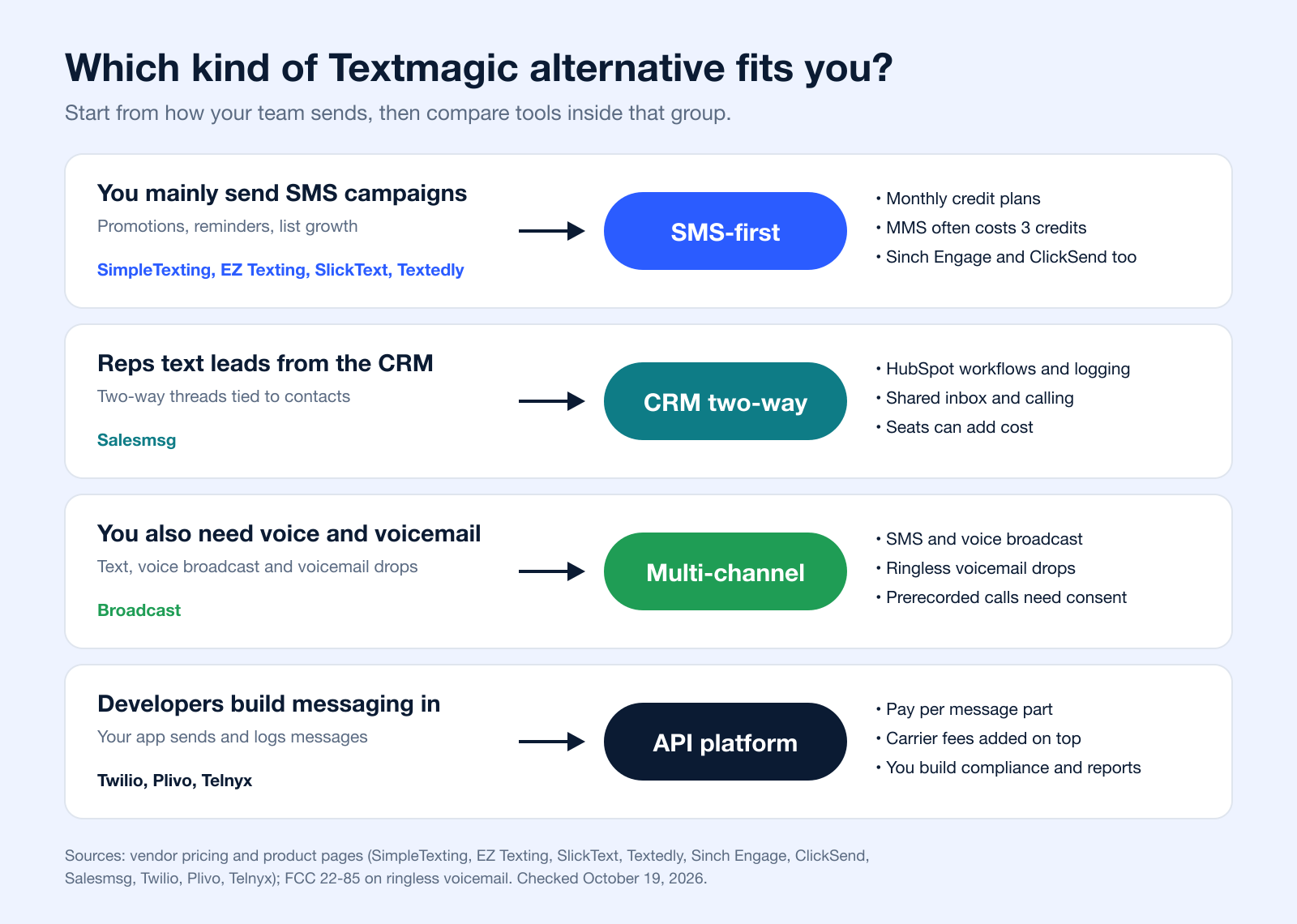
The table below lists each vendor's published entry price and trial (checked October 19, 2026). Prices change often, so confirm on the vendor's page before you sign up, and add number, registration and carrier fees to any per-message rate.
| Alternative | Type | Entry price | Free trial | Voice broadcast / ringless voicemail | Source |
|---|---|---|---|---|---|
| TextMagic (baseline) | Pay as you go | $0.049 per US SMS | Free test balance | One-to-one calls; no voice broadcast or RVM listed | Textmagic |
| 1. Broadcast | Multi-channel | See pricing page | See pricing page | SMS, voice broadcast and ringless voicemail | Broadcast pricing |
| 2. Salesmsg | CRM two-way | Basic $25/month; extra seats $10/month | 14 days | Calling, power dialer, ringless voicemail; no voice broadcast listed | Salesmsg |
| 3. SimpleTexting | SMS-first | $39/month billed yearly, 500 credits | 14 days, 50 messages | Not listed | SimpleTexting |
| 4. EZ Texting | SMS-first | Launch $25/month, 500 credits | 14 days, no credit card | Not listed | EZ Texting |
| 5. SlickText | SMS-first | Starter $29/month, 500 credits | 14 days, no credit card | Not listed | SlickText |
| 6. Textedly | SMS-first | Basic $29/month, 500 messages | 14 days, 50 messages | Not listed | Textedly |
| 7. ClickSend | Pay as you go | $0.0285 per US SMS + $0.0041 carrier fee | Free trial, no credit card | Voice no longer offered to new customers | ClickSend |
| 8. Sinch Engage | SMS, RCS, WhatsApp | Basics $99/month, 3,000 SMS | 14 days, no credit card | Not listed | Sinch Engage |
| 9. Twilio | API | $0.0083 per US SMS segment + carrier fees | 100 SMS to 5 verified numbers | Voice API; no RVM product | Twilio |
| 10. Plivo | API + no-code flows | From $0.0077 per SMS | $10 free credits | Voice API; no RVM product listed | Plivo |
| 11. Telnyx | API | $0.004 per US SMS part + carrier fee | Free sign-up (no credit stated) | Voice API; no RVM product listed | Telnyx |
For a wider field, see our guides to the best mass texting services and the best SMS marketing platforms.
TextMagic Alternatives: FAQ
What is the best TextMagic alternative for small businesses?
For SMS campaigns with a small team, a monthly credit plan is usually simplest: EZ Texting Launch ($25/month), SlickText Starter ($29/month), Textedly Basic ($29/month) and SimpleTexting ($39/month billed yearly) all start at 500 credits or messages and offer 14-day trials (EZ Texting, SlickText, Textedly, SimpleTexting). If reps text from a CRM, look at Salesmsg; if you also need voice broadcasting or ringless voicemail, a multi-channel platform like Broadcast.
Is TextMagic free?
No. TextMagic gives a free test balance when you sign up, then you pay as you go: $0.049 per US SMS, with inbound texts free. A dedicated number costs $10/month and a 10DLC campaign $10/month, each free for the first month (Textmagic pricing, checked October 19, 2026).
Does TextMagic offer voice broadcasting or ringless voicemail?
Not on its current pages. TextMagic lists one-to-one outbound and inbound calls and call forwarding, but no voice broadcast or ringless voicemail feature; its old voice broadcast URL now redirects to call forwarding (Textmagic pricing, call forwarding, checked October 19, 2026).
Which TextMagic alternatives integrate with a CRM?
Salesmsg triggers texts from HubSpot workflows and logs SMS and calls to the contact timeline (Salesmsg HubSpot), and also lists ActiveCampaign, Keap, Pipedrive and Salesforce (Salesmsg pricing). Sinch Engage lists HubSpot, Salesforce, Zoho CRM and Microsoft Dynamics 365 (Sinch Engage). API platforms such as Twilio connect to any CRM your developers integrate.
Do I need to register 10DLC again when I switch?
Plan for it. Anyone sending application-to-person texts over a US 10-digit number must register for A2P 10DLC (Twilio), brands and campaigns are registered through a provider in The Campaign Registry, and unregistered traffic has been blocked since February 1, 2025 (Bandwidth). Ask your new vendor how it handles your brand and campaign registration and how long approval takes. More in our 10DLC compliance guide.
Is ringless voicemail legal?
Yes, with consent. The FCC ruled in 2022 that ringless voicemail to wireless phones is a "call" made with a prerecorded voice under the TCPA, so it needs the recipient's consent, and written consent for marketing (FCC 22-85, 47 CFR 64.1200). This is general information, not legal advice.
Make Your Move: How to Switch from TextMagic
Ready to upgrade? Choosing a TextMagic alternative is really about choosing the communication model you want next. If your business still runs well on standard SMS campaigns, tools like SimpleTexting, Textedly, EZ Texting, and SlickText can do the job without much friction. If your team lives in the CRM and wants better one-to-one engagement, Salesmsg is a strong fit.
But a lot of businesses don't need just another texting platform. They need a better outreach system. That's where the decision gets more strategic. If you're handling reminders, lead nurturing, reactivation, follow-up, and service communication, SMS-only software can start to feel cramped fast. Voice broadcasting and ringless voicemail open up options that standard text campaigns can't replace, especially when tone, urgency, or response timing matters.
That gap is exactly why many comparison posts feel incomplete. They rank texting tools against other texting tools, but they don't ask whether your outreach should still be text-only. For healthcare, education, agencies, and service businesses, that's often the wrong frame. Compliance, channel mix, and workflow automation matter just as much as sending messages.
There's also a practical buying issue many small teams run into: billing models differ a lot in this category. Pay-as-you-go (TextMagic, ClickSend), monthly credits (EZ Texting, SlickText, Textedly, SimpleTexting) and per-seat costs (Salesmsg) can produce very different bills for the same send volume. That's why you should look past feature lists and pay close attention to how each vendor charges for send volume, users, numbers, registration and carrier fees.
Use this process to make the switch with less risk:
- Audit and shortlist: Review what TextMagic isn't doing anymore. If you need ringless voicemail, deeper CRM sync, or a more complete voice workflow, only shortlist platforms that cover those gaps.
- Export and test: Run free trials or pilot accounts with a small segment of your list. Test real workflows, not just the dashboard. Send a campaign, trigger an automation, and see how replies, opt-outs, and reporting behave.
- Announce and go live: Once you pick a platform, tell subscribers what to expect, import your full list carefully, confirm compliance settings, and launch the first campaign with the new workflow.
What to move before you cancel TextMagic
- Contacts with consent records: export each contact with when and how they opted in; marketing texts sent with an autodialer need prior express written consent (47 CFR 64.1200(a)(2)).
- Your opt-out list: import it as a suppression list first; a reply such as "stop," "quit," "end," "revoke," "opt out," "cancel," or "unsubscribe" revokes consent (47 CFR 64.1200(a)(10)).
- Sender registration: plan your 10DLC brand and campaign registration with the new provider before launch (The Campaign Registry, 10DLC compliance).
- Numbers and fees: ask the new vendor about moving your number and what number, registration and carrier fees apply; TextMagic charges $10 per number and $10 per 10DLC campaign each month (Textmagic pricing).
- Clean numbers: remove landlines and invalid numbers before your first send (phone number checker).
This checklist is general information, not legal advice.
The best switch isn't the fastest migration. It's the one that removes the bottleneck that made you leave TextMagic in the first place.
If you want the simplest decision rule, use this one. Choose an SMS-first tool if your needs are still basic. Choose a CRM-centric tool if reps need conversation history and shared visibility. Choose a multi-channel platform if your business depends on coordinated outreach across SMS, voice, and ringless voicemail.
If you're ready to move beyond basic texting and build a stronger outbound system, Broadcast is a practical place to start. It gives you SMS, voice broadcasting, and ringless voicemail in one platform, with automation, integrations, and HIPAA-ready workflows that fit real business communication.