It is no secret that the ROI on SMS marketing campaigns can be huge. Many of today’s major marketers use text messaging to collect leads from their audiences, deliver coupons that drive sales, and engage their prospects to become customers.
In this guide we will outline step by step the way to “rock it” on your first SMS contest. Soon you will be able to build a mobile list faster than a speeding freight train. First let’s outline the steps and then do a deeper dive into each, one by one.
This guide covers how a text-to-win contest works, a planning checklist, the difference between a sweepstakes and a contest, the US rules that apply to contest texts (consent, carrier review, free entry, state registration for large prizes), and example messages you can adapt.
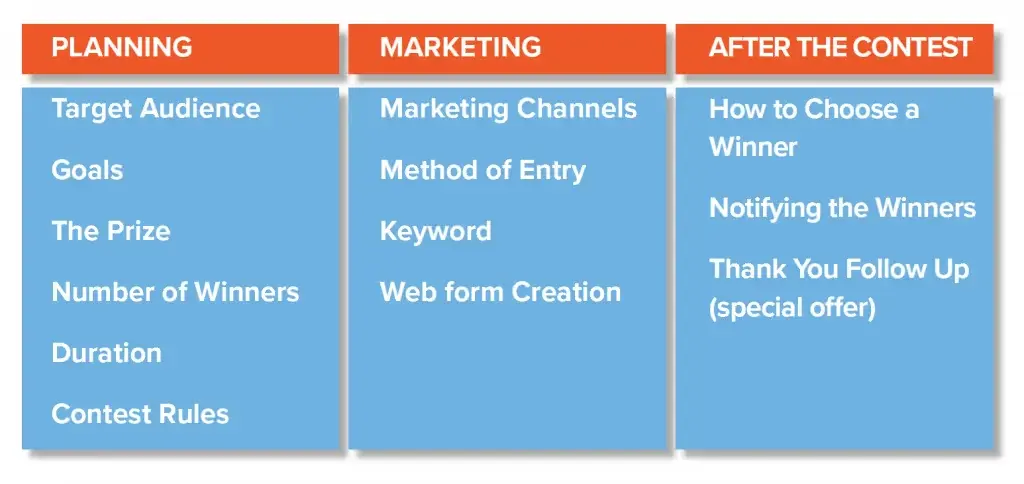
What Is a Text-to-Win Contest?
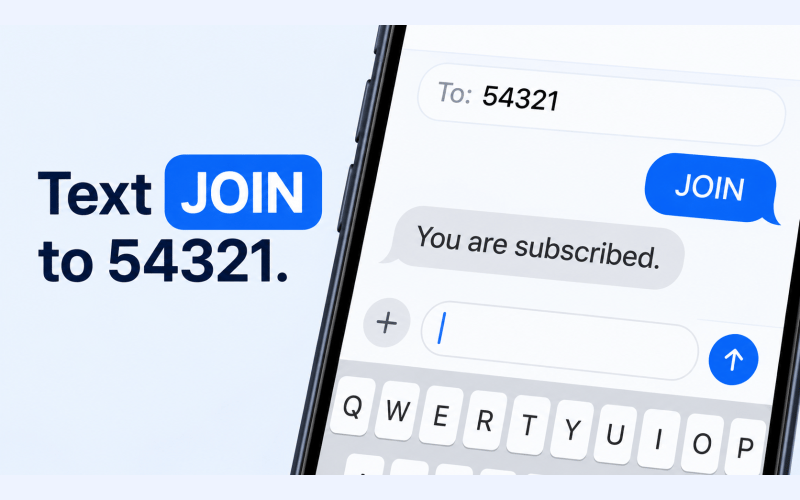
A Text-to-Win contest is an effective and easy way for businesses to engage their customers. In this type of contest, customers enter by sending a specific keyword via a text message to an sms short code or a toll-free number. A short code is a five- or six-digit number that businesses use for SMS campaigns (that is how CTIA defines it). Once they send the keyword, they are automatically entered for a chance to win a prize. These contests are a great marketing strategy because they can help increase sales, grow your contact list, and boost brand awareness.
Most text-to-win promotions are legally sweepstakes: winners are picked at random. A smaller group are skill contests, where entries are judged (best photo, trivia, best answer). The difference changes the rules you must follow, so it gets its own section below. If you want to learn how keywords work in general, see our guide to keyword text messaging.
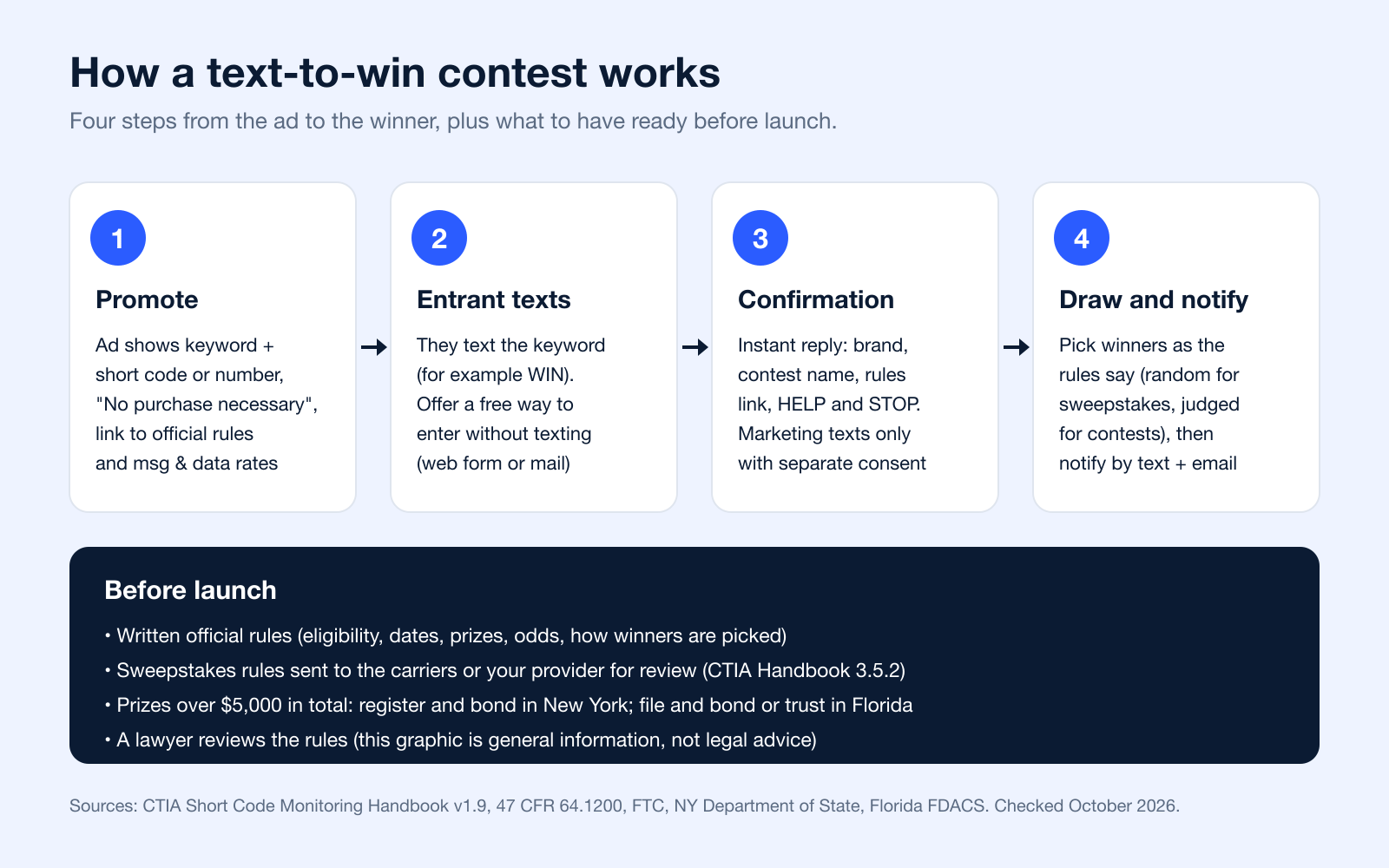
How a Text-to-Win Contest Works, Step by Step
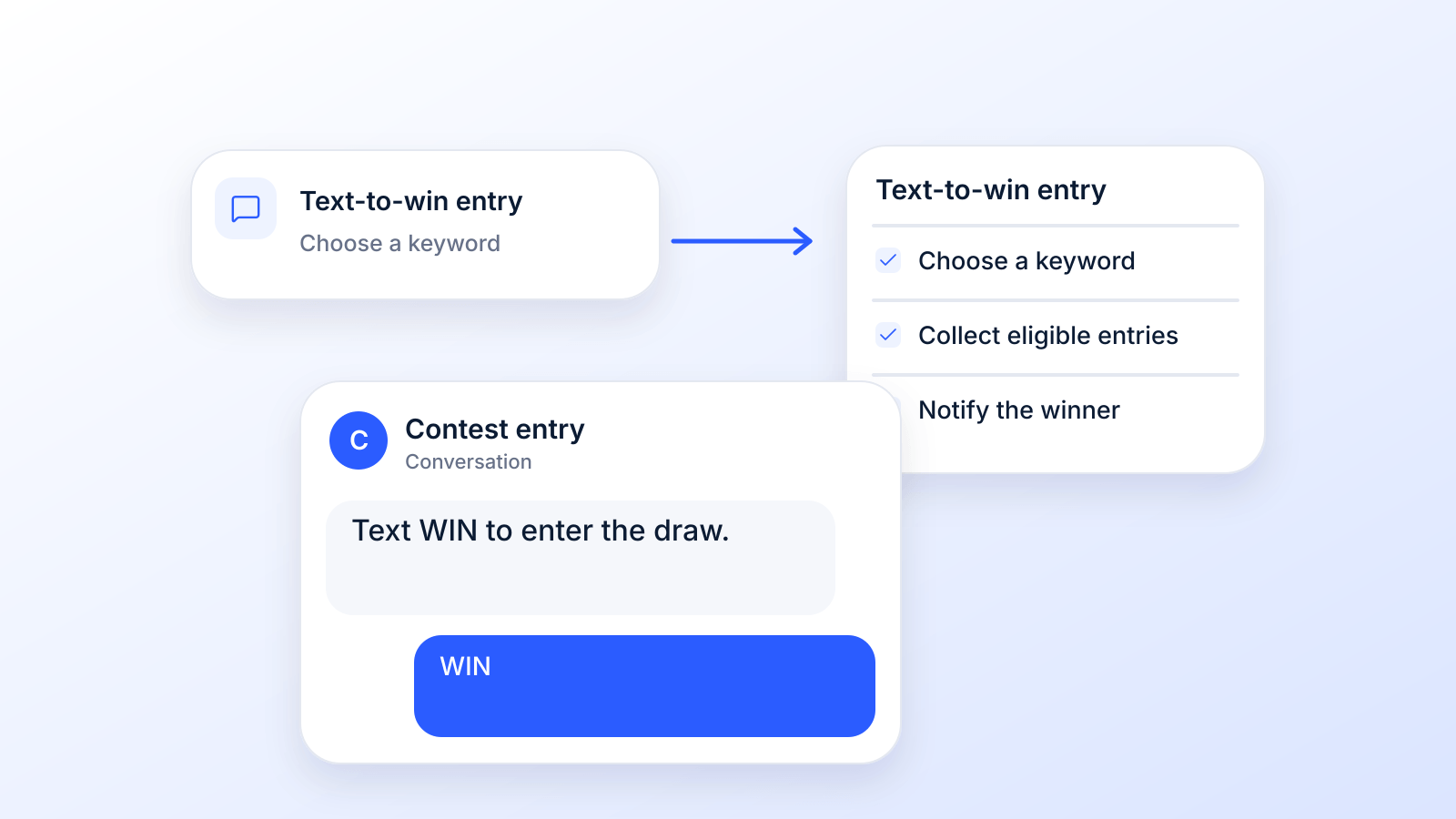
Every text-to-win contest follows the same flow, whatever platform you use:
- Promote the keyword
Your ad, poster, on-air read or social post says what to text and where (for example "Text WIN to your short code"), that no purchase is necessary, where the official rules are, and that message and data rates may apply.
- The entrant texts in
Their text is the entry. Also offer a free way to enter that does not require texting, such as a web form or mail-in entry, because the CTIA Short Code Monitoring Handbook asks sweepstakes to "include a free method of entry".
- Instant confirmation
Your platform replies right away with your brand, the contest name, a link to the rules, and HELP and STOP instructions. If you also want to send marketing texts later, ask for that consent separately.
- Draw and notify
When the entry period closes, pick winners exactly as your rules describe (random drawing for a sweepstakes, judging criteria for a skill contest) and notify them by the method the rules state.
Example Text-to-Win Messages
These are illustrative examples only. Replace the brackets with your details and have your final wording and rules reviewed before launch.
Keep each message short. A single SMS holds 160 standard characters, or 70 if it includes an emoji or other special character; longer texts are split into segments (Twilio).
Choosing a Text to Win Software Platform
First you need to choose a platform capable of running an SMS contest. In all honesty there are plenty of them out there. But needless to say, when it comes to SMS platforms, we are a bit biased here at Broadcast and recommend using ours.
Regardless of whom you choose, the service should be affordable, intuitive, and feature packed. It should be simple to set up your campaign with little technical know-how and be easy to measure your results. To see how easy setting up an SMS contest is within Broadcast, just go here. Now, enough about us.
Whichever platform you pick, check that it can: run a keyword on a short code or registered number, send an instant confirmation, handle HELP and STOP automatically, export entrants for the drawing, and keep a record of each opt-in. On 10DLC (standard 10-digit) numbers, sweepstakes is a special campaign use case that needs carrier approval after registration (Bandwidth 10DLC use cases), so ask your provider how they handle contest campaigns.
Let’s get to it.
Why Should I Run an SMS Contest?
Text to win SMS contests are a fun and entertaining way to engage prospects. They work well for a variety of situations, especially for generating leads using free giveaways, like a product, vacation trip, or event tickets. Often people cannot pass up an opportunity to win something, especially if you make it easy for them to enter using text to win.
Before starting your campaign, ask yourself these three questions…
1. Does this make sense for my company?
Businesses that offer a consumer product will often have better results, because their products tend to solve personal problems or meet internal desires. Often times their current marketing is better suited to engaging your target audience.
If your business is B2B, making your SMS contest a success can be more of a challenge due to the nature of your product or service. Don’t worry, if you think outside the box, anything can be accomplished.
Think of Coca Cola vs. commercial tax software. Which one is better suited to pulling off a contest?
Coca Cola will have a much easier time promoting a contest because of the mass appeal of their product and the strength of their brand. The commercial tax software company is a niche and has limited appeal.
2. Can we provide a great incentive or prize?
A strong incentive is one of the most crucial elements of the planning process.
One thing to think about is that picking an extremely low-value prize will stymie your results and can cause a campaign to fail. The incentive you choose should resonate with your target audience. It should get people excited about joining your contest.
The incentive does not have to be some expensive grand prize; it could be a discount. Furthermore, if a customer opts in to your SMS contest, you could reward that action with a voucher, special promo, or even exclusive content.
3. Are we going to put 100% into this campaign?
An SMS contest that is not properly marketed will fall on its face. You can’t set it up and expect it to achieve great results by itself. If you want a stellar campaign, it will require you to put in your full effort. Plan properly and, more importantly, execute all aspects of the campaign.
Nothing is worse than putting in time and effort to build a campaign that fails because you didn’t go the extra mile. Next we will talk about how to find your targets.
Find Your Target Audience
1. Who are you trying to reach?
Who is your target? Maybe its location based or gender based. If you have been marketing your business for any time at all, then this step is probably a no-brainer. You likely already have your target audience dialed in.
For instance, if you sell golf products, then it’s clear your target is going to be people interested in golf.
Here is a list to think about when you are finding your audience:
- Age
- Location
- Gender
- Relationship Status
- Product Owner
- Family
Set Your Goals
First you must sort out the primary goals of the campaign. What do you want to get out of it? Doing so will help you build a strategy, craft your messages, and determine your follow-up sequence. Outlining your objectives and setting achievable goals is your first step.
Here are some goals to think about during your planning:
- Lead Generation
- Raise Brand Awareness
- Drip Content
- Increase Sales
- Heighten Event Attendance
- Build Social Media Presence
To begin planning your SMS contest, it’s best for you to create a set of predetermined goals. Setting goals gives you a way to determine whether your campaign is successful once it’s over. Often businesses running a SMS contest set no objectives and then watch as it fails. Then they say “that doesn’t work.” This is because they had no way to measure its success.
Regardless of your goal, keep in mind that building your SMS marketing list is important for staying connected to your prospects. Text messages land on the phone people carry all day, which makes SMS one of the most direct channels for getting your message out to a large group of people quickly. For more ways to turn a list into leads, see how to use text messaging to generate leads.
Set specific, measurable goals and you will quickly be able to see whether your SMS contest was successful. This can be done by answering yes or no questions, like these:
- Did we collect “X” leads?
- Did we get “X” coupon redemptions?
- Did we increase attendance by “X”?
- Did we increase sales by “X”?
Sweepstakes vs Contest: Which One Are You Running?
People say "contest" for both, but the law treats them differently. In most states, a promotion that combines a prize, chance, and a required payment or purchase (consideration) is an illegal lottery. Sweepstakes stay legal by removing consideration; skill contests remove chance.
| Sweepstakes (text-to-win drawing) | Skill contest (judged entries) | Source | |
|---|---|---|---|
| How winners are picked | By chance: random drawing | By skill: entries judged on stated criteria | 39 U.S.C. 3001(k) definitions; CTIA 3.5.2 |
| Purchase or payment to enter | Not allowed. "No purchase necessary", and buying cannot improve the odds | Some states allow an entry fee for true skill contests; check each state | FTC; Fla. Stat. 849.094 |
| Free method of entry | Required for SMS sweepstakes (for example a web form or mail-in) | Recommended when texting could cost entrants money | CTIA 3.5.2 |
| Official rules | Required. Eligibility, dates, prizes and value, odds, drawing method, how winners are notified | Required. Also the judging criteria and who judges | CTIA 3.5.2 (rules go to carriers for review) |
| State registration | New York and Florida: prizes over $5,000 in total (see below) | Usually tied to games of chance, not skill | NY DOS; FDACS |
| Typical SMS example | "Text WIN to enter the drawing for 2 tickets" | "Text your best caption; our team picks the winner" | Illustrative |
Text-to-win is almost always run as a sweepstakes because it is simpler: a text is the entry and the winner is drawn at random.
Text-to-Win Contest Planning Checklist
Use this list before you announce the contest. It pulls together the steps in this guide and the rules in the legal section below.
- Goal and number to measure (leads, coupon redemptions, attendance, sales)
- Prize that your audience wants, with its approximate retail value
- Sweepstakes or skill contest decided
- Keyword chosen and reserved on your short code or number
- Official rules written: sponsor, eligibility, start and end dates, how to enter (including the free method), prize and value, odds, drawing or judging method, winner notification
- Free method of entry set up (web form or mail-in)
- Confirmation message with brand, contest name, rules link, HELP and STOP
- Separate opt-in for ongoing marketing texts, with clear disclosure
- Sweepstakes rules sent to your messaging provider for carrier review
- State filing checked if total prizes exceed $5,000 (New York, Florida)
- Promotion plan for every channel, with the same keyword and disclosures
- Drawing date, winner notification method and backup winner process
- Follow-up offer for everyone who entered
For the messaging side of compliance, our SMS compliance checklist goes deeper.
Method of Entry – Text to Join
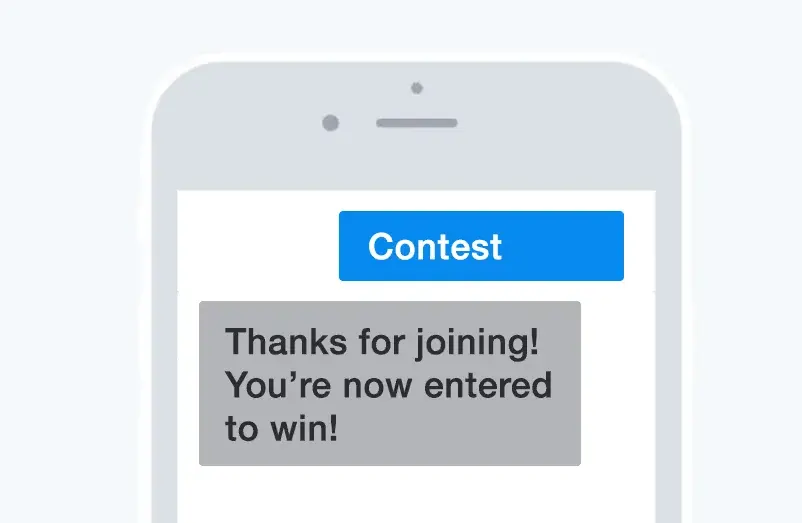
Will the contest be text to join or webform? Well, it depends. If you are promoting your contest online, then a webform probably makes the most sense. If you are promoting your contest where you are in front of a crowd or engaging mobile foot traffic like at a trade show, then text to join may be your best option. Or it may be both. Just remember that you want to use the easiest method given the channels you are using.
If you run a sweepstakes, a web form also works as the free method of entry that the CTIA Short Code Monitoring Handbook asks for, so offering both is often the safest choice.
Choosing Your Text to Join Keyword
Don’t overthink this step. The KISS method is the best rule here. Use something short and sweet, like a brand or product name. Avoid a generic term like “save” or personal names like “James”
If the keyword you want is already taken on your number, pick a close variation that is still easy to spell, and use exactly the same spelling in every ad. Learn more in our guide to short codes.
We have instructions on setting this up in Broadcast. Learn how to choose a keyword.
From Broadcast, just search for the keyword you want and secure it with a click.

This keyword will be the word people will text into.
Create Your Text Message Follow-Up & Auto-Reply Response
Keep wording of the text as brief as possible. Many text platforms have character restrictions, which limits the amount you can say. Detailed explanations will either get cut off or sent in multiple obnoxious messages, causing them to be ignored altogether.
That is why it is important to craft your message to be short and simple, outlining what the participant has to do and what the incentive is.
Carrier guidelines also say what a confirmation must contain: the program or brand name, customer care contact information, opt-out instructions, how many messages to expect, and "message and data rates may apply" (CTIA Handbook, section 3.3.3). See the illustrative confirmation message in the step-by-step section above.
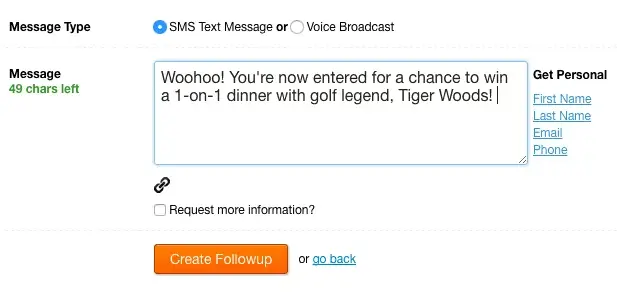
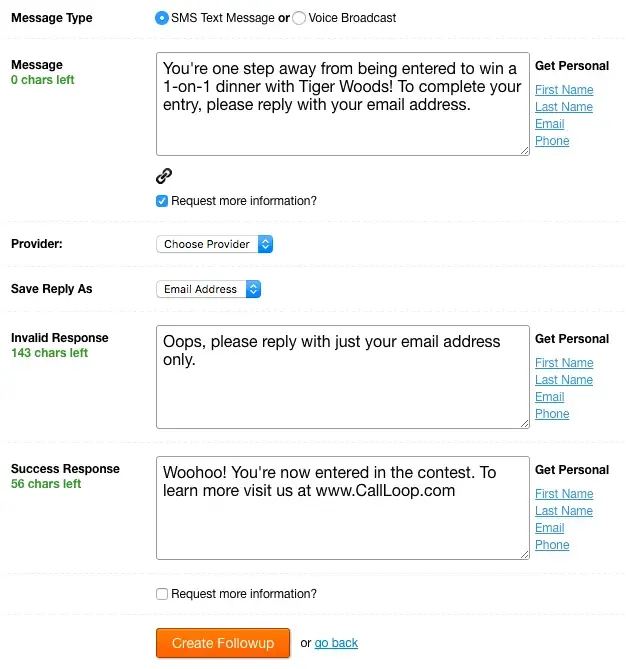
Want to capture an email address or name for your contest?
This option will allow you to capture the person’s email address for later marketing follow-up. You can also connect one of your email autoresponders to Broadcast and we’ll send these new leads to your 3rd party email marketing provider.
Ask only for what you need to run the contest and contact the winner, and link your privacy policy from the call to action, as carrier guidelines expect (CTIA Handbook, section 3.6).
Promoting Your Text to Join Contest
Create Awesome Images
It’s no mistake that most contest promotion ads are eye-catching. If you are planning to promote your contest on social media posts, then you need awesome images. Using an awesome-looking prize image means that more people will want to share it. If it sucks, then it’s not going to prompt shares, tweets, and likes. So be sure to use graphics that grab the attention of your target audience and make them say, “I want to win that.” Don’t ignore this. It’s too simple to not do it.
You can use a free service like Canva to create beautiful text to join images in just a few minutes.
From here, you can promote your text to join sms contest across all of your channels like Facebook, X (Twitter), Pinterest, Linkedin, and more.
Wherever you promote it, repeat the same essentials: the keyword and number, "No purchase necessary", the end date, where to find the official rules, and that message and data rates may apply. Social platforms have their own promotion policies, so check them before you post.
After the Contest
Picking the winners
Picking random winners is super simple. You can just use a free tool like Miniwebtool. With it, you can copy and paste a list of names exported from your group of subscribers and generate random winners. It’s not the only method out there, but whatever you use, be sure to state what method you are using to pick the winners in your official rules.
Keep a record of the entry list, the date and method of the drawing, and who was selected. In Florida, for example, the operator of a game promotion over $5,000 must provide a list of winners on request (FDACS).
Notifying The Winner
Now that winners have been chosen, it’s best that you notify the winners in a timely manner after the campaign ends. You also want to be sure that you use the notification method stated in your official rules. In our experience, following up with both a text message and an email is optimal. If you still don’t get a response, then you can call and leave a message.
While a phone call to notify the winners may be more personal, it’s not recommended. People tend to screen their phone calls, and calls are not as trackable. Texts and emails can be easily tracked if ever a dispute should arise. You can also notify the winner using ringless voicemail to deliver your message without actually calling.
Thank the Participants
Ok, so you notified the winners. What’s next?
Thank all the people who participated by giving them a special offer, driving some sales in the process. It’s best if you use some scarcity such as a time limit to respond to the offer.
Only send that offer to people who agreed to receive marketing texts. Entering a contest by text is not, on its own, consent to ongoing promotions; that is why the separate opt-in matters.
Create an SMS coupon and send out a broadcast message to them all with a link to your site or an expiring coupon to drive you more sales.
Common Mistakes to Avoid in SMS to Win Contests
When running an SMS to win contest, avoiding common mistakes is key to ensuring its success. One of the biggest mistakes is choosing a prize that doesn't excite your customers. If the prize isn't appealing, fewer people will enter the contest. Another mistake is not making your text message clear enough. If the contest instructions are confusing, participants might not know how to enter. Additionally, failing to promote your contest widely can result in fewer entries, so be sure to spread the word through multiple channels. Finally, don’t forget to track your results. Analyzing the data through analytics and reporting will help you understand what worked well and what could be improved for future contests.
Legal Considerations for SMS to Win Contests
When running an SMS to win contest, it's crucial to follow legal guidelines to protect your business. First, you must obtain opt-in consent from participants before sending them any SMS messages. This ensures that your text messages are not unsolicited. It's also important to clearly explain the contest rules, including how the winner will be randomly selected. Providing these details helps build trust with your customers and ensures the contest is fair. Be transparent about how the prize will be awarded and what participants need to do to claim it.
Consent for Contest Texts (TCPA)
The FCC treats text messages as calls under the Telephone Consumer Protection Act (FCC Enforcement Advisory 2016-06). Under the FCC rule, a marketing text sent with an autodialer needs the recipient’s prior express written consent, and that consent cannot be required as a condition of buying anything (47 CFR 64.1200(a)(2) and (f)(9)). People can revoke consent by any reasonable method, and you must honor it within 10 business days (47 CFR 64.1200(a)(10)). Read more in our guide to express written consent.
CTIA’s consent guidelines separate messages that answer a consumer’s request from promotional messages, which need express written consent (CTIA Handbook, section 3.3.3). So the entry confirmation answers the entrant’s text, while promotions afterward are a different purpose: ask for that consent separately and keep a record of it.
Carrier Rules for SMS Sweepstakes (CTIA)
The CTIA Short Code Monitoring Handbook (version 1.9) says sweepstakes are "characterized by the element of chance and the awarding of a prize" and that, at a minimum, sweepstakes programs should:
- Follow each wireless provider’s process and guidelines
- Provide the wireless provider with the sweepstakes rules for review
- Include a free method of entry
- Consult with legal counsel
Sweepstakes reviews can take longer than other programs, so build that time into your launch date. On 10DLC numbers, sweepstakes is a special use case that needs carrier approval after registration (Bandwidth).
No Purchase Necessary (FTC)
The FTC is clear that real sweepstakes are free: it is illegal to ask people to pay or buy something to enter or to improve their odds (FTC). In 2023 the FTC required Publishers Clearing House to pay $18.5 million and to disclose on every shopping page that a purchase is not required to enter and will not help a consumer win (FTC press release, June 27, 2023).
State Rules for Large Prizes
Some states add registration and bonding when the prizes are large. Two verified examples:
| State | When it applies | What you file | Source |
|---|---|---|---|
| New York | Game of chance promoting consumer products or services, no consideration to enter, total prizes over $5,000 | Registration with the rules, $100 fee, and a surety bond or certificate of deposit for the total prize amount; winners certified within 90 days after the game ends | NY Department of State |
| Florida | Game promotion with total announced prizes over $5,000 | Rules filed at least 7 days before the start, plus a trust account or surety bond for the total prize value; list of winners provided on request | FDACS; Fla. Stat. 849.094 |
Other states have their own rules on eligibility, disclosures and prize limits. If your contest is open nationwide or the prizes are valuable, this is where a lawyer earns their fee.
What Official Rules Usually Include
- Sponsor name and address
- "No purchase necessary" and the free method of entry
- Who can enter (age, residency) and who cannot (employees, family)
- Start and end dates and time zone
- How to enter and entry limits
- Prizes, approximate retail value and number of winners
- Odds of winning (depends on number of entries)
- How and when winners are selected and notified
- What happens if a winner does not respond
- Privacy policy link and how entrant data is used
- Void where prohibited
For a broader view of the federal law, see what TCPA compliance means for business texting.
Measuring the Success of Your SMS to Win Contest
Analyzing Participation and Engagement Rates
After your contest ends, it's essential to measure its success by analyzing participation and engagement rates. Look at how many people entered by texting the keyword to your short code and how many of them engaged with your SMS messages. This will give you insight into how well your contest performed and where there might be room for improvement.
Understanding ROI from SMS to Win Contests
Calculating the return on investment (ROI) is a crucial step in determining the effectiveness of your SMS contest. To measure ROI, compare the costs of running the contest with the revenue generated, including increased brand awareness and new sales. A successful SMS to win contest should result in more customers and increased sales, making it a valuable marketing strategy for your business.
Best Practices for Ongoing SMS Marketing After the Contest
Once your SMS to win contest ends, it’s important to keep engaging with your new subscribers to maintain their interest in your brand. Continue sending valuable text messages, such as special offers, event invitations, and product updates. This ongoing communication will help keep your customers interested in your business and encourage them to stay engaged with your marketing efforts.
Conclusion
I hope this special report gave you a full understanding on how to create, run, and successfully manage your SMS contest. Now it’s up to you to get started by following the steps outlined in this report to start seeing the results you want.
To get your free Broadcast account to setup your SMS contest, just click the link below and we’ll give you 25 free messages and a demo keyword to give us a try.
Get Your Free Broadcast Account
Frequently Asked Questions
How to Set Up a Text to Win Contest?
To set up a text-to-win contest, start by choosing an exciting prize that will attract participants, such as a free pair of shoes. Next, create a memorable keyword that customers will text to your designated short code. Once entries are in, you can randomly select one lucky winner. Be sure to provide details about the contest, including how and when the prize will be awarded. Finally, promote your contest through various channels to maximize participation.
What Is an SMS Competition?
An SMS competition is a marketing strategy where participants enter a contest by sending a keyword via text message to a short code. The contest often offers a prize, such as a free pair of tickets or a special discount, to encourage entries. After the contest period ends, the business will randomly select one lucky winner from the entries. These competitions are popular because they are simple to set up and effectively engage customers.
Is SMS Marketing legal in the USA?
SMS marketing is legal in the USA, but it is regulated by strict laws. The Telephone Consumer Protection Act (TCPA) governs these practices to protect consumers from unsolicited texts: under the FCC rule, marketing texts sent with an autodialer require the recipient’s prior express written consent, which cannot be a condition of purchase (47 CFR 64.1200). Companies must clearly provide details about the campaign, including how to stop receiving messages, and honor opt-out requests, ensuring that SMS marketing remains a trusted and legal method of communication.
How Do Text-to-Win Contests Work?
You advertise a keyword and a short code or number. People text the keyword to enter, get an instant confirmation with a link to the official rules, and the sponsor picks winners the way the rules describe, usually by random drawing. A free way to enter without texting should also be offered.
Is a Text-to-Win Contest a Sweepstakes or a Contest?
If winners are drawn at random, it is a sweepstakes, and entry must be free. If entries are judged on skill (a caption, a photo, trivia), it is a skill contest. See the comparison table above.
Can I Require a Purchase to Enter a Text-to-Win Sweepstakes?
No. The FTC says it is illegal to ask people to pay or buy something to enter a sweepstakes or to improve their odds (FTC), and carrier guidelines ask SMS sweepstakes to include a free method of entry.
Do I Need a Short Code for a Text-to-Win Contest?
Short codes are the classic choice because they are easy to remember. You can also run keyword campaigns on toll-free or 10DLC numbers; on 10DLC, sweepstakes is a special use case that needs carrier approval. Ask your provider which number type fits your contest.
How Do You Pick a Winner for a Text Contest?
Export the list of valid entries and use a random selection method for a sweepstakes, or apply the published judging criteria for a skill contest. Use the exact method written in your official rules and keep a record of the drawing.
Do I Have to Register My Sweepstakes?
Only in some states and usually only for large prizes. New York and Florida, for example, require filing and a bond (or trust account in Florida) when total prizes exceed $5,000 (NY DOS; FDACS). Check with a lawyer for your situation.